
Oak Powdery Mildew
Erysiphe alphitoides (Griffon & Maubl.) U. Braun & S. Takam.Oak Powdery Mildew overview
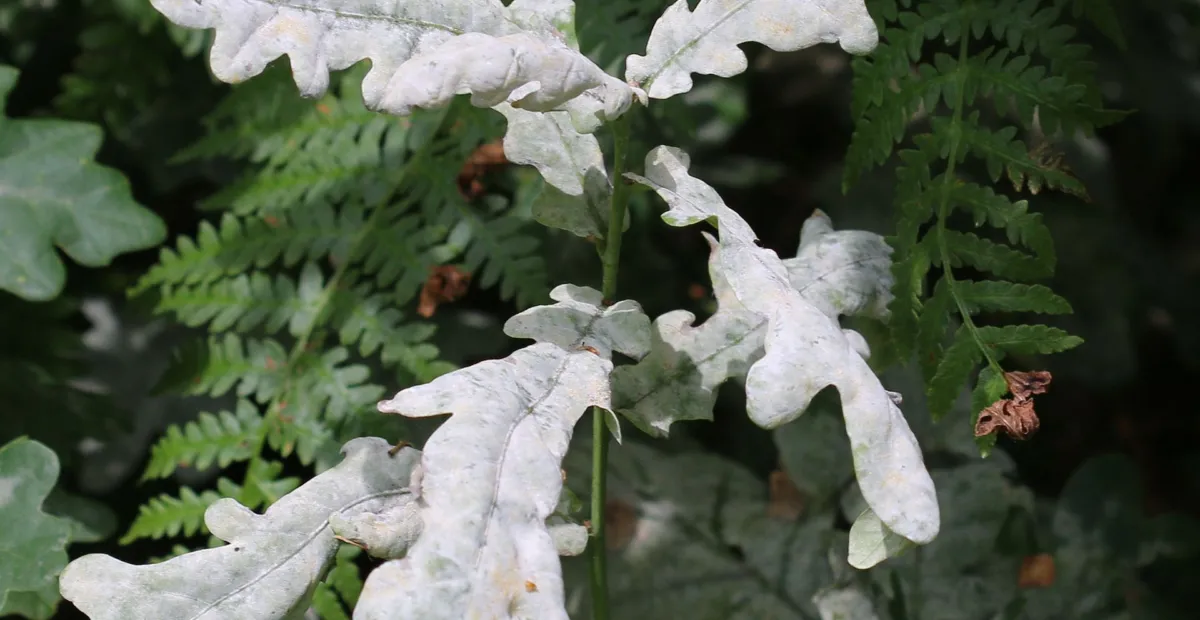
Oak powdery mildew is a superficial fungal disease caused by Erysiphe alphitoides, a host-specialized powdery mildew associated primarily with oaks. It produces conspicuous white, dusty growth on young leaves and shoots, especially during warm days, cool nights, high humidity, and low air movement. Most infections are cosmetic, but severe early-season disease can distort foliage, reduce photosynthesis, and cause premature leaf loss.
Typical conditions
Overview
Erysiphe alphitoides is one of the principal fungi associated with oak powdery mildew, particularly on European oak. It forms a white to gray, flour-like or felted fungal colony on the surface of young leaves, shoots, buds, and occasionally other tender tissues. The fungus obtains nutrients through specialized feeding structures inserted into living epidermal cells rather than decaying the leaf.
In the United States, oak powdery mildew is commonly reported at the broader disease level because several powdery mildew fungi can infect Quercus. A laboratory-confirmed diagnosis is advisable when the exact species matters, especially on unusual hosts or in plant-health surveys.
Symptoms and identification
Early symptoms are small white patches on the upper leaf surface. These expand into a dusty, mealy, or felt-like coating that may cover much of the leaf or extend along young shoots.
- Young leaves may curl, pucker, twist, yellow, or remain undersized.
- Heavily infected shoots and buds may be stunted or distorted.
- Older leaves can develop brown or necrotic areas beneath dense colonies.
- Severe early infections may cause premature partial defoliation, particularly in seedlings and saplings.
- Late-season black spherical chasmothecia may appear within the fungal growth.
Unlike many foliar fungal diseases, powdery mildew does not require prolonged leaf wetness for infection. White superficial growth is the most useful field clue, but it should be distinguished from dust, aphid honeydew with sooty mold, and other oak powdery mildew species.
Causes and spread
The disease is caused by the obligate biotrophic ascomycete Erysiphe alphitoides. Spores are carried primarily by air currents from infected oak tissue to susceptible young foliage. Disease is favored by warm days, cool nights, high relative humidity, shade, dense canopies, and poor air movement. Tender water-shoots, stump sprouts, and late-season regrowth remain especially susceptible.
Severity depends on oak species and genotype, tissue age, tree vigor, canopy density, and weather. Mature leaves generally become less susceptible as they expand and develop thicker protective tissues. Surface water is not required for germination and prolonged wetness may inhibit or kill many powdery mildew spores.
Life cycle and persistence
Erysiphe alphitoides survives between growing seasons on living oak tissue, especially infected buds, shoots, and sometimes as dark sexual fruiting bodies called chasmothecia. In spring, overwintered mycelium or ascospores can initiate primary colonies on newly expanding leaves. These colonies produce chains of airborne asexual conidia, which spread the disease repeatedly during the season.
As leaves age and conditions change, susceptible tissue declines and disease often slows. In late summer or fall, chasmothecia may form in the mildew colony. Their ascospores can contribute to the following season’s primary infections. Exact overwintering importance varies with climate, host, and local population.
Treatment and control
For established landscape oaks, treatment is often unnecessary because the disease is mainly cosmetic and infections commonly decline as leaves mature. Monitor young trees, nursery stock, valuable specimen oaks, and trees that have repeated early-season defoliation.
Remove badly infected shoots only when practical and when pruning will not stimulate excessive regrowth. Improve light and ventilation without making severe canopy cuts. If fungicide treatment is justified, begin at bud break or when the first colonies appear and use a product specifically labeled for powdery mildew on the particular oak or ornamental crop. Thorough coverage of susceptible new growth is more useful than attempting to cure heavily colonized tissue.
Low-impact and biological control
Begin with sanitation, canopy ventilation, moderate irrigation, and avoidance of excess nitrogen. On small, accessible plants, remove heavily infected leaves or shoots and dispose of them rather than composting visibly diseased material in a home pile. Products based on horticultural oil, potassium bicarbonate, sulfur, or other lower-impact active ingredients may suppress powdery mildew when legally labeled for the crop and used preventively or at the earliest symptoms.
Do not apply oils and sulfur close together, and do not spray oils during heat or drought stress. Test any treatment on a small portion of foliage first, because tender oak leaves can be sensitive to some formulations.
Prevention
- Plant oaks where the mature canopy will receive adequate sunlight and air movement.
- Thin crowded nursery or landscape growth when appropriate, while avoiding excessive pruning that stimulates vigorous watershoots.
- Remove or reduce infected stump sprouts and highly susceptible tender regrowth where practical.
- Water deeply at the soil surface rather than routinely wetting foliage.
- Avoid excessive nitrogen fertilization, which can promote lush, highly susceptible shoots.
- Prune dead or severely diseased tender shoots during dry weather when this will not disfigure or stress the tree.
- Maintain overall tree vigor through suitable planting depth, mulch that does not touch the trunk, and protection from root-zone damage.
Interesting facts
- Erysiphe alphitoides is a living-tissue parasite and generally does not behave like a decay fungus.
- Powdery mildew fungi can infect without free water on the leaf surface, which helps explain why the disease may be severe during humid but relatively dry weather.
- Oak powdery mildew is a disease complex: similar symptoms on Quercus may be caused by more than one powdery mildew species.
- Young oak leaves and late-season watershoots are usually more vulnerable than fully mature foliage.
- Severe disease is more consequential in seedlings and saplings, where repeated loss of photosynthetic leaf area can reduce growth and cause misshapen plants.
Use only pesticide products legally authorized and currently labeled in the United States for powdery mildew on the specific oak or ornamental crop and in the intended use site. Follow the current label for rate, timing, personal protective equipment, reentry interval, environmental precautions, and application limits. Do not infer legality from a product’s use on another crop, and do not apply treatments to stressed trees without checking the label and local extension guidance.