
Chrysanthemum white rust
Puccinia horiana HenningsChrysanthemum white rust overview
Chrysanthemum white rust is a serious fungal disease of florist’s chrysanthemums, garden mums and a limited group of related daisy plants. Puccinia horiana causes pale, slightly sunken spots on upper leaf surfaces and white, pink or yellowish pustules underneath. It spreads especially efficiently in cool, humid, crowded greenhouses and nurseries, where rapid sanitation and confirmation are important.
Typical conditions
Overview
Chrysanthemum white rust affects florist’s chrysanthemum, pot mums, spray mums and garden mums, with occasional infection of a narrow group of related Asteraceae. The disease is most damaging in protected production because cool temperatures, high relative humidity, prolonged leaf wetness and dense plant spacing favor infection and spore movement.
Do not confuse it with common chrysanthemum rust, caused by Puccinia chrysanthemi. White rust typically produces pale spots above and light-colored waxy pustules below the leaf, whereas common rust generally produces darker brown pustules and urediniospores. Laboratory or regulatory confirmation may be needed, especially when symptoms are atypical.
Symptoms and identification
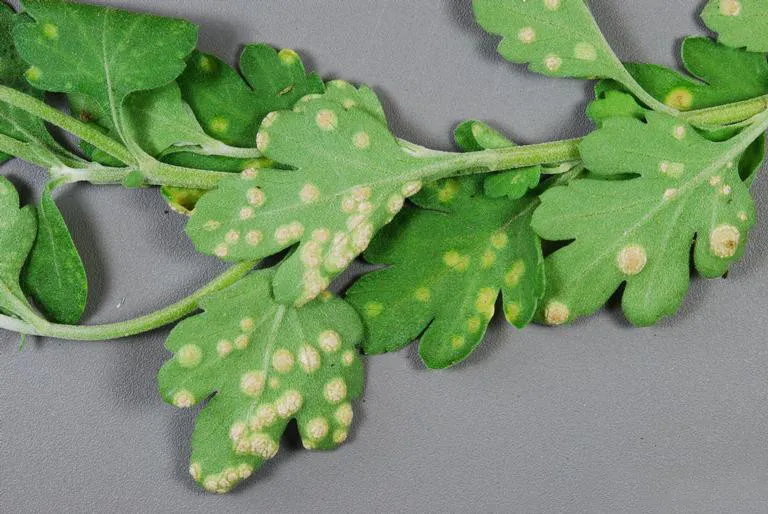
Initial symptoms are small, pale green, yellow or cream spots on the upper leaf surface, usually slightly sunken and up to about 4 mm across. Spots may enlarge, become brown and develop surrounding chlorosis or necrosis.
Corresponding pustules form mainly on the lower leaf surface beneath the spots. They are commonly white, cream, pale yellow, pink or light brown and may look waxy rather than powdery. Pustules are especially common on young leaves and flower bracts but can occur on other green tissues. Severe infection can reduce photosynthesis, cause premature leaf drop, weaken plants and reduce flower quality.
Causes and spread
The pathogen is introduced most often on infected or latently infected chrysanthemums, cuttings, finished plants or plant debris. Once present, basidiospores move through greenhouse air currents and may also spread by splashing water, handling and contaminated equipment.
Dense canopies, prolonged leaf wetness, high humidity, cool temperatures and short-day production conditions promote infection. Moving plants or workers through a crop while foliage is wet can accelerate local spread. The limited host range does not make an outbreak harmless: commercial chrysanthemum cultivars can be highly susceptible and crop losses may result from disease and required destruction.
Life cycle and persistence
Puccinia horiana is an autoecious, microcyclic rust: its known life cycle occurs on a single host group and involves teliospores and basidiospores, not the repeating urediniospore stage typical of many rusts. Teliospores form in pustules, usually on the lower leaf surface, and germinate in place when moisture and temperature are favorable.
Germinating teliospores produce basidiospores, which are carried by air currents and can infect susceptible chrysanthemum tissue when a film of moisture is present. Infection can remain inconspicuous for days or weeks before pustules become visible. The disease cycle may be completed in roughly two to four weeks under favorable protected-crop conditions. Infected plants, cuttings and plant debris are important sources of introduction and spread.
Treatment and control
There is no treatment that removes established lesions or reliably makes an infected plant safe for propagation. In a greenhouse or nursery, the preferred response is immediate isolation, professional confirmation and removal of infected plants and associated material according to current state and federal guidance.
Place removed plants and debris in sealed bags to prevent spores from dispersing. Do not carry them uncovered through a clean crop or place them in a compost pile. Clean and disinfect the affected production area, correct excessive humidity and leaf wetness, and review plant movement records to identify potentially exposed lots.
Where retention of high-value plants is permitted and a currently labeled product is available, fungicides may protect uninfected tissue and reduce secondary spread. They are most useful as part of an integrated program begun early, not as a cure for visibly diseased tissue.
Low-impact and biological control
No consistently reliable home-garden organic cure is established for chrysanthemum white rust. The most useful nonchemical measures are exclusion, rapid sanitation and moisture management.
- Buy chrysanthemums and cuttings from reputable suppliers and inspect lower and inner foliage before purchase.
- Isolate suspect plants immediately. Avoid brushing against foliage or moving plants, tools, clothing or carts from the suspect area to clean stock.
- Remove infected plants, including roots when practical, and place them directly into sealed plastic bags. Do not compost diseased material.
- Disinfect hands, tools, benches, pots and work surfaces using a product and contact time appropriate for plant-production sanitation.
- Increase spacing and ventilation, reduce nighttime humidity, and water at the base rather than wetting foliage.
- For valuable collections, obtain professional diagnosis before attempting to preserve apparently healthy stock by cuttings.
Prevention
- Start with clean, traceable plants or cuttings and keep incoming material separated from established stock during an observation period.
- Scout weekly, concentrating on lower leaves, inner canopy, young foliage and flower bracts. Use a hand lens and inspect both leaf surfaces.
- Maintain plant spacing and horizontal or vertical airflow that dries foliage quickly. Avoid overhead irrigation, especially late in the day.
- Remove fallen leaves and crop debris promptly. Clean and disinfect benches, floors, containers and tools between crop cycles.
- Train staff to recognize the difference between white rust and common chrysanthemum rust and to report suspicious symptoms before moving material.
- In the United States, contact the state department of agriculture or USDA APHIS for current confirmation and regulatory instructions when the disease is suspected in commercial or nursery production.
Interesting facts
- The disease is called white rust because mature pustules commonly appear white or pale rather than the orange-brown color associated with many other rust diseases.
- Puccinia horiana has a narrow documented host range, concentrated in several chrysanthemum and related daisy genera.
- Basidiospores are highly sensitive to drying, which helps explain why persistent humidity and leaf wetness are particularly important in greenhouse outbreaks.
- Symptoms may be inconspicuous during hot, dry weather and become more apparent after cooler, wet conditions.
- Systemic infection has been reported in chrysanthemum research, so apparently clean propagation material cannot always be assumed pathogen-free solely from a brief visual inspection.
Use fungicides only when a product is currently legally authorized and labeled for chrysanthemum white rust or the applicable crop and disease in your state. Follow the current federal and state label exactly, including application rate, interval, worker-protection requirements and disposal instructions. Fungicides protect healthy tissue and may reduce spread; they do not restore damaged leaves or replace removal and sanitation.
Affected plants
The plants below are linked to this problem by structured host-plant data. The list updates automatically as new plant profiles are added.
 Edible amaranth (Amaranthus tricolor) care guideAmaranthus tricolor
 Amaranth (Amaranthus cruentus) care guideAmaranthus cruentus
 Brown Mustard (Brassica juncea) care guideBrassica juncea
 Black Mustard (Brassica nigra) care guideBrassica nigra
 White Mustard (Sinapis alba) care guideSinapis alba
 Shallot (Allium cepa Aggregatum Group)Allium cepa Aggregatum Group
 Victory onio (Allium victorialis) care guideAllium victorialis
 Allium ‘Millenium’Allium 'Millenium'