
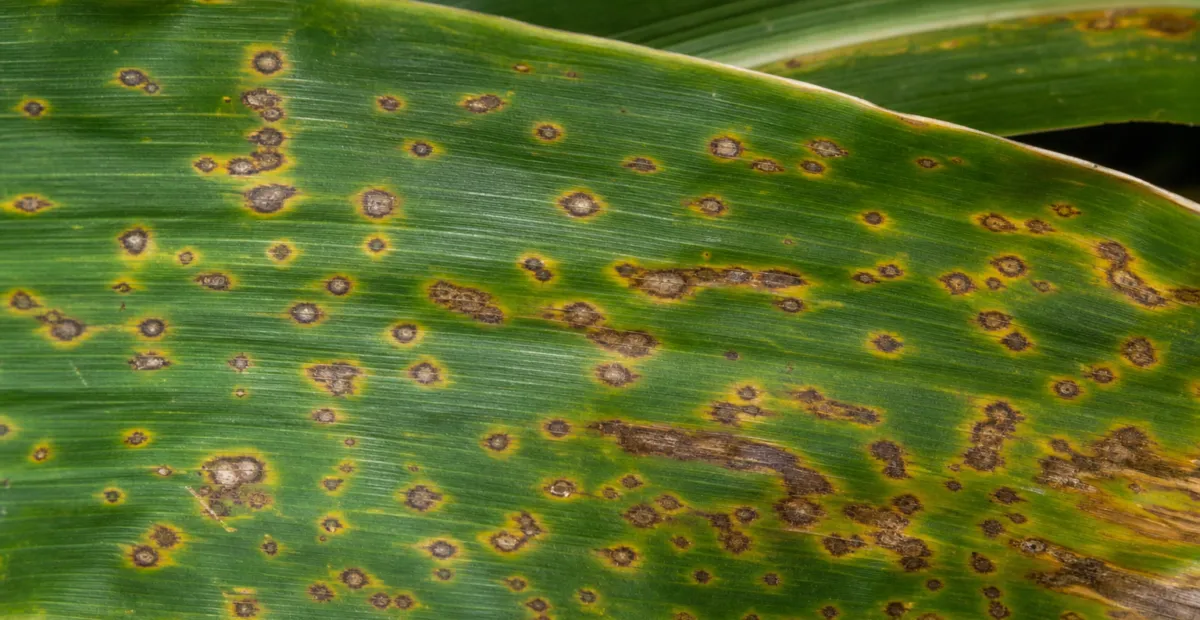
Corn eyespot
Kabatiella zeae (synonym: Aureobasidium zeae)Corn eyespot overview
Corn eyespot is a residue-borne fungal leaf disease caused by Kabatiella zeae, also known by its current name Aureobasidium zeae. It produces small, translucent tan lesions with dark purple-brown margins and narrow yellow halos on corn leaves. The disease is favored by cool, wet weather, continuous corn and heavy surface residue, but serious yield loss is uncommon outside high-risk fields and susceptible hybrids.
Typical conditions
Overview
Corn eyespot affects Zea mays and is most often seen in the northern Corn Belt and other regions where cool, humid weather persists during early crop development. The disease begins as small, translucent leaf spots that develop the characteristic eye-like appearance of a tan center, dark margin and yellow halo.
Lesions commonly start on lower leaves and may occur in patches. When numerous spots merge, large portions of the leaf can die. Leaf sheaths and husks may occasionally be affected, and severe foliar damage can contribute to premature senescence and reduced crop performance.
Symptoms and identification
- Small circular to oval lesions, usually about 1/16–1/8 inch across, initially water-soaked or translucent.
- Mature spots have tan to cream centers, brown or purple-brown margins and a narrow yellow halo.
- The halo is especially conspicuous when the leaf is held toward sunlight.
- Lesions may be scattered, concentrated in patches or fused into larger necrotic areas.
- Lower leaves are often affected first; leaf sheaths and outer husks may also show lesions.
- Severe early infection can cause extensive leaf blighting, premature loss of green tissue and occasional yield reduction.
Causes and spread
The causal fungus survives primarily in infected corn residue left on or near the soil surface. Spores produced from residue are moved locally by rain splash and may also disperse by wind. Disease pressure increases when corn follows corn, susceptible hybrids are planted, and abundant residue remains under no-till or reduced-tillage management. The pathogen is considered highly host-specific to maize.
Life cycle and persistence
Kabatiella zeae overwinters in infected maize leaves and other corn debris. During cool, wet periods, the fungus produces inoculum on residue. Spores are splashed or blown onto young corn foliage, where infection produces small translucent spots. Lesions enlarge and develop their characteristic halos and dark margins; repeated wetting allows additional infections and lesion coalescence. Disease development is favored early in the season and during prolonged periods of leaf wetness.
Treatment and control
There is no practical way to cure existing lesions. Management should focus on protecting new foliage and reducing disease pressure in future crops. In commercial corn, fungicide treatment is rarely justified for eyespot alone; decisions should be based on hybrid susceptibility, disease severity, crop value, expected weather, timing and local extension guidance. In gardens, remove heavily diseased annual corn residue after harvest and avoid replanting corn in the same bed when disease has been persistent.
Low-impact and biological control
Use resistant or tolerant corn varieties, rotate to unrelated crops, and remove or incorporate infected corn residue where appropriate. Improve airflow by avoiding unnecessarily dense plantings and irrigate at the soil surface rather than wetting foliage. No consistently reliable organic treatment should be assumed to eradicate established eyespot; biological products should be considered only when they are legally labeled for the crop and disease and supported by locally relevant evidence.
Prevention
- Plant hybrids with documented eyespot resistance or improved tolerance when the disease has occurred repeatedly.
- Rotate corn with non-host crops where practical, particularly in fields with a history of severe eyespot.
- Reduce infected surface residue through appropriate tillage or residue management, balancing disease control with soil-conservation goals.
- Avoid planting a highly susceptible hybrid into a field with heavy corn residue and a recent history of severe disease.
- Scout lower leaves during cool, wet periods and distinguish eyespot from gray leaf spot, northern corn leaf blight, physiological leaf spots and insect injury.
Interesting facts
- The eye-like appearance comes from the contrast between the tan lesion center, dark margin and narrow yellow halo.
- The former name Kabatiella zeae remains widely used in U.S. extension literature, while Aureobasidium zeae is used as a current synonym in some references.
- Corn is the only reliably documented host of practical importance.
- Eyespot is more likely to become economically important in seed-production fields, continuous-corn systems and fields planted with susceptible inbreds or hybrids.
Use chemical products only if they are currently legally authorized in the United States for corn and this disease, and follow the current product label exactly, including crop, rate, timing, personal protective equipment, reentry interval and preharvest interval. Do not apply an off-label product or assume that a fungicide registered for another corn leaf disease is labeled or economically effective for eyespot.