Few backyard fruit trees feel as generous as a fig. Once established, a healthy fig tree can provide fresh, jammy fruit with surprisingly little fuss—and its broad leaves give a garden a relaxed, Mediterranean look. The secret is choosing the right planting time, giving the tree enough sun and protecting it from the coldest conditions your garden can deliver.
Whether you are planting a young tree from a garden center or moving a container-grown fig into the landscape, start with the basics: a warm location, excellent drainage, regular moisture during the growing season and a variety suited to your local climate. Get those decisions right, and your fig will have a much easier start.
When is the best time to plant a fig tree?
For most parts of the United States, early spring is the safest planting time. Wait until the tree is still dormant or just beginning to wake up, and plant after the danger of severe freezes has passed. This gives the roots a full growing season to settle before winter.
In warm regions where the ground rarely freezes hard, you can also plant a dormant fig in late fall or winter. Fall planting may work especially well for a container-grown tree, but avoid planting just before a forecast of freezing weather, prolonged rain or unusually strong winds.
- Cold-winter areas: Plant in spring after the soil can be worked and hard freezes have passed.
- Mild-winter areas: Plant from fall through early spring while the tree is dormant.
- Container-grown trees: They are more flexible than bare-root trees, but spring remains the easiest season for establishment.
- Bare-root trees: Plant promptly while dormant, keeping the roots moist until planting.
In USDA-style climate terms, figs are easiest to grow in warmer regions, but gardeners in colder zones can succeed with cold-tolerant cultivars, a protected microclimate, heavy winter protection or a large container that can be sheltered. Your local winter low temperature matters more than the zone number printed on a plant tag.
Choose a fig variety before you dig
Most home gardeners should look for a common fig. These varieties set edible fruit without requiring a pollinating partner. That is important because some other fig types depend on a specialized pollination relationship that is not available in many parts of the country.
Popular choices for home gardens
- ‘Brown Turkey’: A widely available, adaptable choice with medium-sized brown or bronze fruit. It can produce fruit on new growth after winter damage, which is helpful in colder regions.
- ‘Celeste’: Often valued for sweet fruit and relatively good cold tolerance. It tends to ripen early, though fruit quality and performance can vary with heat and local conditions.
- ‘Chicago Hardy’: A useful option for gardeners who regularly experience cold winters. It may die back in a severe winter but can regrow from the base and produce on new shoots.
- ‘Black Mission’: An excellent fresh-eating and preserving fig for warm climates. It generally needs a longer, hotter season than the hardiest selections.
- ‘Violette de Bordeaux’: A compact, dark-fruited variety that can suit smaller gardens and large containers.
- ‘Kadota’ or ‘White Adriatic’: Green-skinned figs with different flavor profiles from the familiar dark varieties; best where summers are long and warm.
Ask a local nursery, cooperative extension office or experienced fig grower which varieties consistently ripen in your area. A variety that thrives in coastal California may struggle to finish fruit in a cool northern summer, while a cold-tolerant selection may still need a warm, protected position to produce a worthwhile crop.
Pick the warmest, sunniest spot in your yard
Give your fig at least eight hours of direct sun during the growing season. More sun usually means stronger growth, better fruit ripening and fewer problems with persistently damp foliage and fruit.
Look for a south- or west-facing location near a light-colored wall, fence or building. Reflected heat can extend the growing season, especially in cooler parts of the country. Avoid low spots where cold air settles and avoid places that stay wet after rain.
- Choose soil that drains freely after watering.
- Keep the tree away from downspouts and areas with standing water.
- Allow room for a mature bush, which may reach 10 to 20 feet wide if left unpruned.
- Check overhead wires, paths, patios and nearby structures before planting.
- In areas with gophers or other root-feeding pests, consider protective underground wire while planting.
Figs tolerate a range of soil types, but drainage matters more than creating a perfect soil recipe. A soil test can help you understand pH and nutrient levels before you amend a large planting area. Avoid adding concentrated fertilizer directly into the planting hole; it can injure newly exposed roots.
How to plant a fig tree in the ground
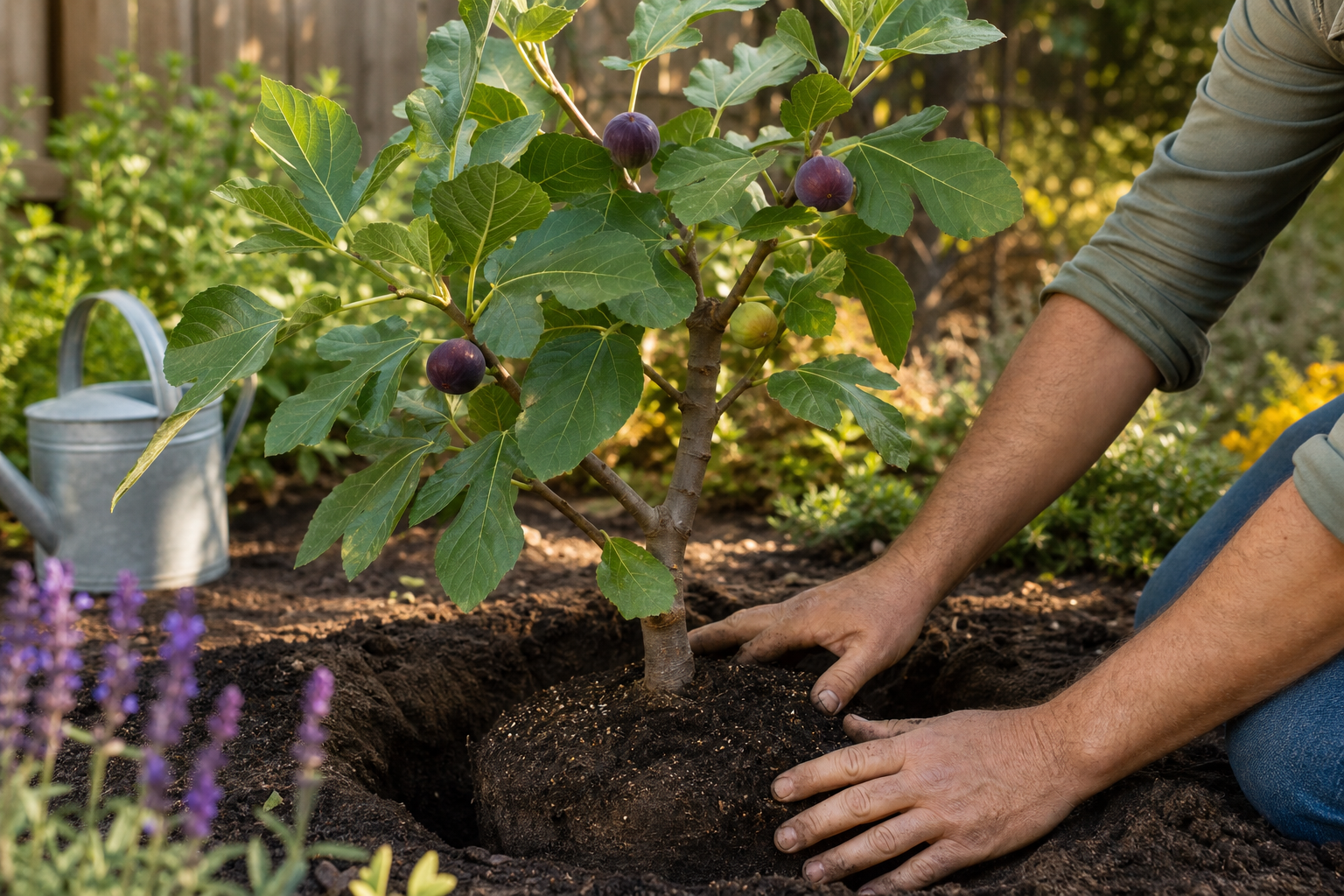
Prepare the site before bringing the tree out of its pot. Remove weeds and grass in a broad circle so the young fig does not compete for moisture. If the soil is compacted, loosen a wide area rather than digging a narrow, deep hole.
Step-by-step planting
- Water the tree first. Give a container-grown fig a thorough drink a few hours before planting. If it is bare-root, keep the roots damp and out of direct sun.
- Dig a wide hole. Make the hole about twice as wide as the root ball and no deeper than the soil level in the container.
- Inspect the roots. Gently loosen circling roots around the outside of the root ball. Cut away only roots that are dead, broken or tightly circling.
- Set the tree at the correct depth. Position the top of the root ball level with, or just slightly above, the surrounding soil. Do not bury the trunk flare.
- Backfill with the excavated soil. Break up large clods, but do not create a pocket of rich compost that encourages roots to remain in the planting hole.
- Water slowly and deeply. Apply enough water to settle the soil around the roots and remove large air pockets.
- Mulch the root zone. Add 2 to 3 inches of composted organic mulch, keeping it several inches away from the trunk.
Container-grown figs generally need little or no pruning at planting. If you plant a bare-root tree, follow the nursery’s instructions; a light reduction in top growth may help balance the loss of roots, especially if the tree was not already headed back.
Growing a fig tree in a container
A container is a practical solution if your winters are too cold, your garden soil drains poorly or you want to keep the tree compact. Choose a pot with large drainage holes and enough weight to prevent the tree from tipping. A 15-gallon container is a useful long-term size for many home growers, although a smaller tree can begin in a smaller pot and move up gradually.
Use a high-quality potting mix rather than garden soil, which can become heavy and waterlogged in a container. Place the pot where the tree receives full sun, and remember that container plants dry out faster than trees in the ground.
- Water when the top inch of mix feels dry, rather than relying only on a calendar.
- Let excess water drain freely; never leave the pot sitting in a saucer of water.
- Refresh or replace some of the potting mix when roots fill the container.
- Prune lightly to maintain a manageable bush shape.
- Move the container to a protected, cool location before severe winter weather.
In cold climates, a dormant container fig can often overwinter in an unheated garage, shed or similar protected space. The goal is to keep it dormant without allowing the root ball to freeze solid for long periods. Water sparingly during dormancy, checking occasionally so the mix does not become completely dry.
Watering: use a measurement, not a guess
Newly planted figs need consistent moisture while their roots establish. Mature trees become more drought tolerant, but drought during active growth can cause yellowing leaves, premature fruit drop, small fruit or fruit that fails to ripen properly.
A useful starting target during hot, dry weather is about 1 to 1 1/2 inches of water per week from rain and irrigation. That is a guideline, not a rigid prescription: sandy soil may need more frequent watering, while clay soil may need slower applications at wider intervals.
A simple irrigation experiment
Try measuring your irrigation for one month. Place a straight-sided rain gauge or shallow cans beneath the canopy while a sprinkler runs. If your system delivers 1/2 inch in 30 minutes, two 30-minute sessions per week would provide about 1 inch, provided rain does not add more. In very hot weather or fast-draining soil, you might divide that amount into three shorter sessions.
For a drip system, measure the output of one emitter. A 1-gallon-per-hour emitter running for 30 minutes supplies 1/2 gallon. Two emitters running for one hour supply 2 gallons. The total amount your tree needs depends on its size, soil and weather, so use the measurement to compare with soil moisture—not as a universal rule.
Push a finger several inches into the soil beneath the mulch. If it feels dry below the surface, water slowly around the root zone. Aim the water at the soil, not the leaves and fruit, and reduce watering as the tree enters dormancy.
Pruning and shaping after planting
Figs can grow as a single-trunk tree, but a multi-stemmed bush is often more practical for home gardens. Bushes are easier to protect from winter cold and easier to harvest. In regions where branches frequently freeze back, a low, multi-stemmed form also allows the plant to recover from the base.
During the first years, focus on structure rather than aggressive size control. Select several strong, well-spaced stems and remove weak, damaged or badly crossing growth during dormancy. Once the tree is established, prune out dead wood and branches that rub together.
Do not remove all last year’s wood if you hope to harvest an early breba crop, because that crop forms on older branches. The larger main crop generally develops on current-season growth. Heavy pruning can therefore reduce one part of the harvest, even if the tree regrows vigorously.
Protect figs from winter damage
Cold is the biggest limitation for figs in much of the United States. Young trees are especially vulnerable, and a sudden freeze after warm weather can damage tender growth. A protected site, appropriate variety and sensible pruning usually help more than excessive fertilizing.
- Mulch the root zone after the ground cools, using a 3- to 4-inch layer of loose organic material.
- Wrap or shelter young stems when severe cold is forecast.
- In colder regions, grow the fig as a low bush so stems can be tied and protected more easily.
- For container trees, move the pot into a sheltered dormant location before the root ball freezes hard.
- Wait until spring to assess damage; brown twigs may conceal living wood farther down the branch.
Do not rush to fertilize a damaged tree. Allow new growth to show where the living wood remains, then remove clearly dead sections with clean, sharp pruners.
What to expect from your first harvest
Patience pays with figs. A young tree may spend its first seasons building roots and branches before producing a substantial crop. The exact timing depends on variety, climate, winter damage and whether the plant was propagated from a mature cutting.
Figs are ready when they soften, droop and begin to hang from the stem. The skin color changes according to variety, so softness and a rich aroma are more reliable clues than color alone. Pick ripe fruit gently and eat or refrigerate it promptly because fresh figs are delicate and highly perishable.
A rewarding tree for patient gardeners
Plant your fig while it is dormant, place it in the sunniest warm spot you have, and give it steady moisture during its first growing season. Choose a common variety that matches your winter climate, and use a container if the ground is simply too cold or wet.
Your first tree may need time, but each season teaches you more about your garden’s heat, drainage and winter patterns. Start with one well-chosen plant, measure your watering, protect it during its first cold season and enjoy the satisfying moment when your own fig finally softens on the branch.