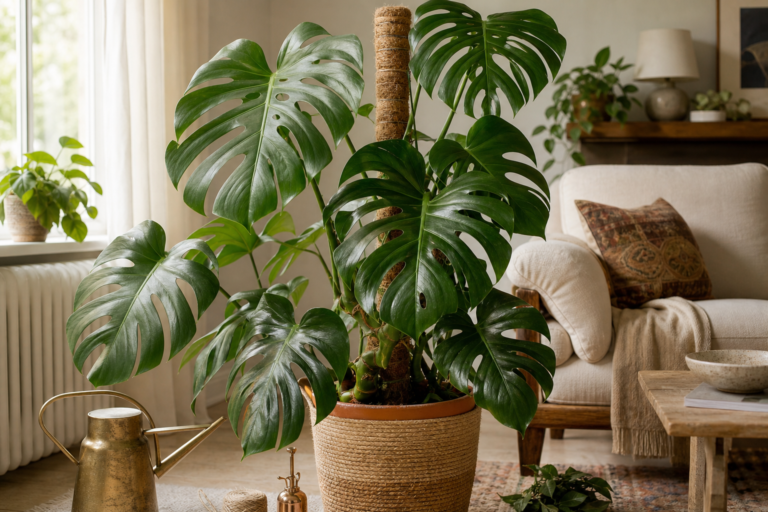
Few houseplants make an entrance quite like a Monstera deliciosa. Its broad, glossy leaves seem to have been cut with a craft knife, leaving a pattern of splits and holes that has inspired common names such as Swiss cheese plant and hurricane plant.
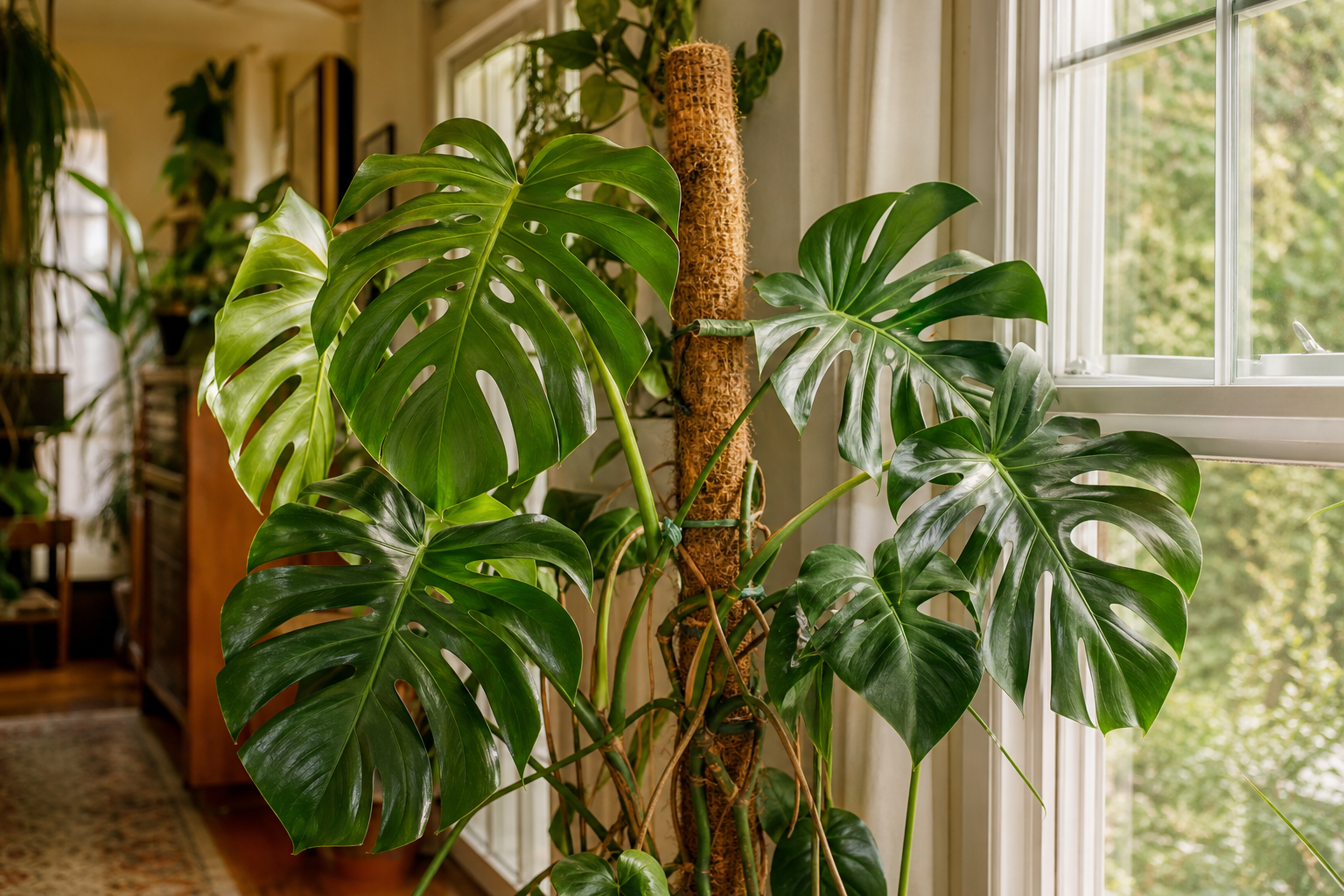
But those openings are not damage, disease or a sign that something has been nibbling your plant. They are a natural part of the leaf’s design, and botanists call them fenestrations—a word related to “window.” Once you understand how they form, you can read your Monstera’s leaves as a record of its age, growing conditions and climbing lifestyle.
First, what exactly counts as a Monstera “hole”?
Monstera leaves can develop two related features. Some openings remain inside the leaf blade, surrounded by green tissue. Others begin near the edge and mature into deep cuts or splits. In everyday plant care, people often call both features holes or fenestrations, although the distinction is useful when comparing different species and cultivars.
- Internal fenestrations: enclosed holes that sit between the main veins.
- Marginal fenestrations: splits that open toward the leaf edge.
- Juvenile leaves: usually smaller, simpler and often completely solid.
- Mature leaves: larger and more likely to show a regular pattern of holes and splits.
The pattern is built into the plant’s developmental program. A Monstera does not wait for a pest, wind gust or careless hand to punch the openings after the leaf has finished growing. Instead, selected cells in a young, developing leaf die in a controlled process known as programmed cell death. The surrounding tissues continue expanding, and the tiny gaps become visible fenestrations as the leaf unfurls and enlarges.
Why would a rainforest vine evolve windows?
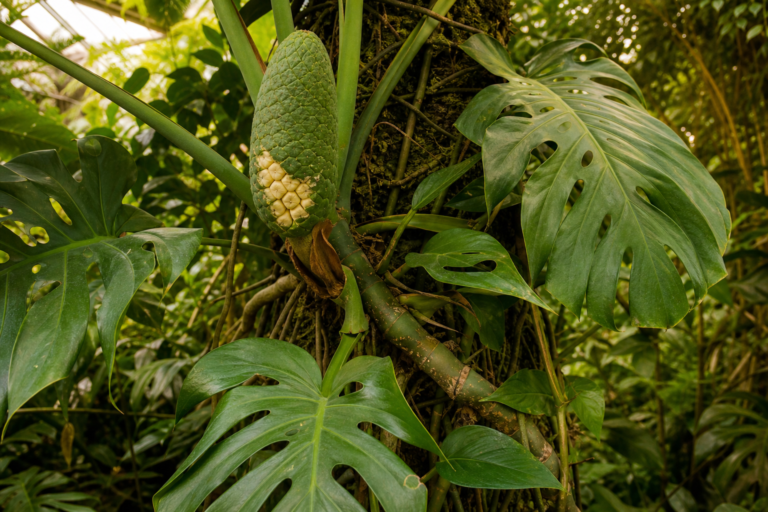
The honest answer is that scientists still do not have one universally accepted explanation. Fenestration probably reflects several advantages working together rather than a single purpose. Monstera deliciosa is a climbing vine from tropical forests, so its leaf shape makes the most sense when you picture it growing upward through a crowded canopy rather than sitting in a pot beside a window.
1. Holes may help rain reach the plant below
A climbing Monstera can hold large leaves high above the soil. When rain lands on those leaves, much of the water may otherwise run off the edges or collect on the surface. Openings allow some rainfall to pass through and continue downward toward the stem, aerial roots or growing medium around the plant.
One field study found that leaves with fenestrations captured more water for the plant’s roots than leaves whose openings had been covered. That result supports the water-routing idea, although it does not prove that water capture is the only reason Monstera leaves have holes.
2. The openings may reduce the cost of making a huge leaf
A very large leaf can intercept plenty of light, but it also requires a lot of living tissue. In the dim, unpredictable light of a tropical understory, a perforated leaf may provide a useful balance: it can spread across a broad area while using less tissue than a completely solid leaf of the same outer dimensions.
Research on leaf shape suggests that fenestrated leaves may make light capture more consistent when sunlight arrives in brief patches, called sunflecks. The holes do not magically create more light, but they may help the plant manage the fluctuating light available beneath a forest canopy.
3. Wind may pass through more easily
It is easy to imagine a perforated leaf behaving like a net. Air can move through the openings instead of pushing against one unbroken surface, which might reduce tearing in exposed plants. This is a plausible benefit, particularly for a large vine growing among branches.
However, experimental evidence has not strongly confirmed wind protection as the main explanation. In one test, holes did not produce a major reduction in wind damage. So it is best to describe wind diffusion as a reasonable hypothesis, not a settled fact.
4. The holes are not mainly there to discourage insects
Another popular theory suggests that a perforated leaf might look less attractive to herbivores or give insects fewer useful places to lay eggs. Yet experimental work has not supported this as a clear benefit; in some conditions, fenestrated leaves actually experienced more herbivory.
That finding is a good reminder that a beautiful botanical explanation is not automatically a proven one. The strongest current picture is a combination of development, water movement and life in a complex forest environment, with the exact evolutionary advantages still being studied.
Why are young Monstera leaves usually solid?
If your new Monstera leaf has no holes, do not assume you have the wrong plant. Young Monstera deliciosa plants naturally produce simpler leaves. In the wild, seedlings may spend an early stage close to the forest floor or climbing along a tree trunk, where small, intact leaves are practical.
As the plant grows taller and begins producing larger leaves, fenestrations become more common. Age matters, but age alone does not guarantee holes. A plant also needs enough energy to produce mature growth, and that depends on light, root health, water management, nutrition and physical support.
There is no reliable schedule such as “the sixth leaf will have holes.” One plant may begin earlier than another, while a cutting may temporarily produce smaller or simpler leaves as it rebuilds its root system. Look for a gradual trend: larger leaves, thicker stems and increasingly complex patterns over time.
Light is the practical trigger you can influence
In a home, insufficient light is one of the most common reasons a Monstera continues producing small, solid leaves. The plant may survive in a dim room, but it has less energy available for large, mature foliage. Bright, indirect light usually gives it a better chance to develop characteristic fenestrations.
Place your plant near an unobstructed east- or west-facing window, or a few feet from a bright south-facing window with sheer protection if the afternoon sun is intense. A north-facing window may work in summer or in a naturally bright room, but it can be too weak for strong growth in many homes.
- Increase light gradually rather than moving a shaded plant into harsh midday sun.
- Rotate the pot every week or two for more even growth.
- Watch the leaves: pale, bleached patches can indicate excessive direct sun, while long gaps between leaves and small new foliage often point to inadequate light.
- If you use a grow light, follow the fixture’s distance and timing instructions rather than guessing from brightness alone.
Remember that a leaf already unfurling cannot be redesigned. Better light affects future leaves, so give your plant several growth cycles before judging the result.
Why climbing support can change the leaf shape
Monstera deliciosa is not naturally a freestanding shrub. It is a climbing hemiepiphyte: it can begin life near the ground, then climb a tree using aerial roots and a flexible stem. In a home, a moss pole, coir pole, trellis or sturdy stake gives the plant a version of that climbing structure.
Training the main stem upward can encourage larger, more mature leaves. Attach the stem loosely with soft ties, keeping aerial roots in contact with the support when practical. Do not tie the leaf stalks tightly; the petioles need room to move and orient the leaves toward light.
Support does not force holes into a weak plant overnight. It works best alongside bright light, a healthy root system and active growth. Think of it as helping the Monstera express its natural climbing form rather than as a special trick for manufacturing fenestrations.
A closer look at popular Monstera types
Monstera deliciosa
This is the large, familiar houseplant with heart-shaped leaves, deep marginal splits and, on mature plants, internal holes. Juvenile plants may look surprisingly plain. With time and good conditions, the leaves can become dramatically larger and more heavily fenestrated.
Monstera adansonii
Often sold as another Swiss cheese plant, M. adansonii usually has thinner, more elongated leaves with numerous oval openings. Its growth is generally more delicate and trailing or climbing than that of M. deliciosa. A young adansonii can still have fewer holes than expected, especially after transport or a change in light.
Variegated cultivars
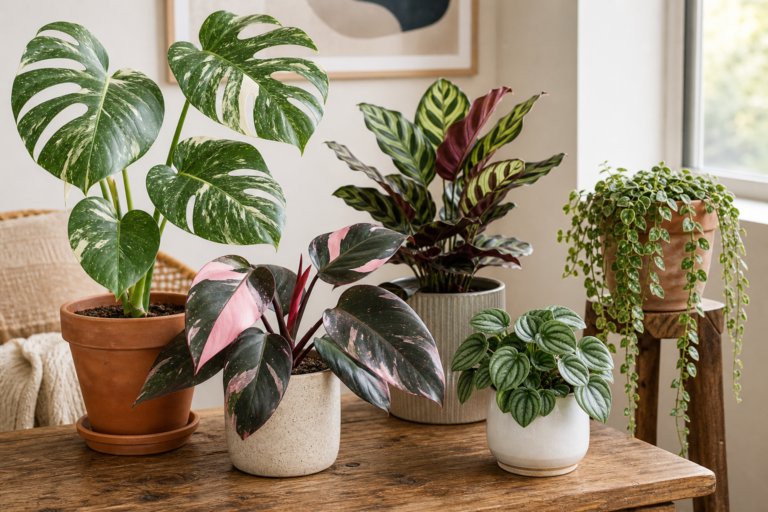
Forms such as ‘Albo Variegata’ and ‘Thai Constellation’ combine fenestrations with white or cream patterning. Because pale tissue contains less chlorophyll than green tissue, variegated plants may grow more slowly and need especially thoughtful light placement. Bright, indirect light can support growth, but intense sun may scorch the lighter areas.
Do not compare the hole count of a variegated plant directly with a vigorous green plant of a different age and species. Genetics, maturity and the amount of green tissue all influence the result.
A simple home experiment: measure before you guess
If you want to understand your own plant, try a small observation project rather than changing five care factors at once. Choose one actively growing Monstera and record its conditions for eight to twelve weeks.
- Measure the distance from the plant to its brightest window.
- Photograph each new leaf after it fully unfurls.
- Record leaf length, leaf width, number of internal holes and number of edge splits.
- Note the date of each watering and the approximate amount used.
- Check the potting mix before watering by inserting a finger about 2 inches into the surface.
- Record whether the plant is climbing, leaning or growing without support.
For a consistent starting point, you might measure out 24 fluid ounces of water for a medium-sized plant, then pour slowly until a little water drains from the bottom. Empty the saucer after about 10 minutes. The correct amount varies with pot size, root density, potting mix and indoor temperature, so the useful data point is not “24 ounces is always right.” It is whether the mix is drying at a reasonable pace and whether the roots remain healthy.
In a typical indoor setup, you might find that a plant needs water every 7 to 14 days in bright summer conditions, but every 14 to 21 days in a cooler, darker winter room. Treat those ranges as examples for your log, not as a calendar. Always check the mix first.
Care mistakes that can delay mature leaves
Fenestration is a growth feature, so anything that repeatedly slows growth can postpone it. The goal is steady progress, not maximum moisture or constant feeding.
- Overwatering: Let the upper portion of the mix dry before watering again. A pot that stays wet for too long can stress roots and reduce new growth.
- Very low light: A Monstera may produce elongated stems and small leaves without developing its mature form.
- Pot-bound or damaged roots: Check for roots circling densely or a mix that repels water. Repot only when needed, using a container with drainage holes.
- Sudden environmental changes: Moving from a warm greenhouse to a dry, dim room can temporarily affect leaf size and development.
- Removing new leaves too early: A leaf may need time to harden and expand fully. Judge its pattern only after it has finished unfurling.
Also avoid cutting holes into a solid leaf. That creates an imitation, not a true fenestration, and it damages the plant’s functioning tissue.
The bottom line: holes are a sign of maturity, not a care requirement
Monstera’s holes begin as a carefully controlled feature of leaf development. Their exact evolutionary purpose remains an active scientific question, but the plant’s rainforest lifestyle offers several compelling clues: better water passage, efficient use of leaf tissue and possible advantages in the shifting light of a crowded canopy.
At home, focus on what you can control. Give your Monstera bright, indirect light, water when the mix begins to dry, provide a stable climbing support and allow new leaves time to mature. If the next leaf is still solid, take it as information—not failure. With patience and consistent care, many Monsteras gradually reveal the dramatic fenestrated foliage that makes them so captivating.