You don’t need a frost-free climate—or a garage full of enormous pots—to give your garden a tropical mood. The secret is choosing plants that look exotic but rely on hardy roots, rhizomes, trunks or evergreen foliage to handle winter.
“Cold-hardy” does not always mean the plant will look tropical in January. Some selections lose their leaves or die back to the ground after frost, then return in spring. Others keep their foliage but need shelter from drying wind, winter sun or wet soil. Use the USDA hardiness zone ranges below as a starting point, then consider your garden’s microclimate: a sunny wall, sheltered courtyard or well-drained raised bed can make a meaningful difference.
How to choose a tropical-looking plant for your winter climate
Before buying, check the hardiness of the exact species or cultivar—not just the common name. “Elephant ear,” “hibiscus” and “ginger” can refer to plants with very different winter limits.
- In Zones 4–6: focus on hardy hibiscus, Japanese banana, yucca, needle palm in protected sites, and passionflower.
- In Zones 7–8: add hardy ginger, fatsia, dwarf palmetto, selected elephant ears and rice-paper plant.
- In Zones 9–10: many of these plants can remain evergreen or nearly so, although occasional freezes may still damage foliage.
For new plantings, water deeply after planting and keep the soil evenly moist during the first growing season. A simple moisture check is more useful than a fixed calendar: push a finger about 2 inches into the soil. If it feels dry at that depth, give the plant a thorough soak. During hot weather, large-leaved plants may need about 1 to 1½ inches of water per week from rainfall and irrigation, while newly planted specimens may need more frequent checks.
1. Japanese banana (Musa basjoo)
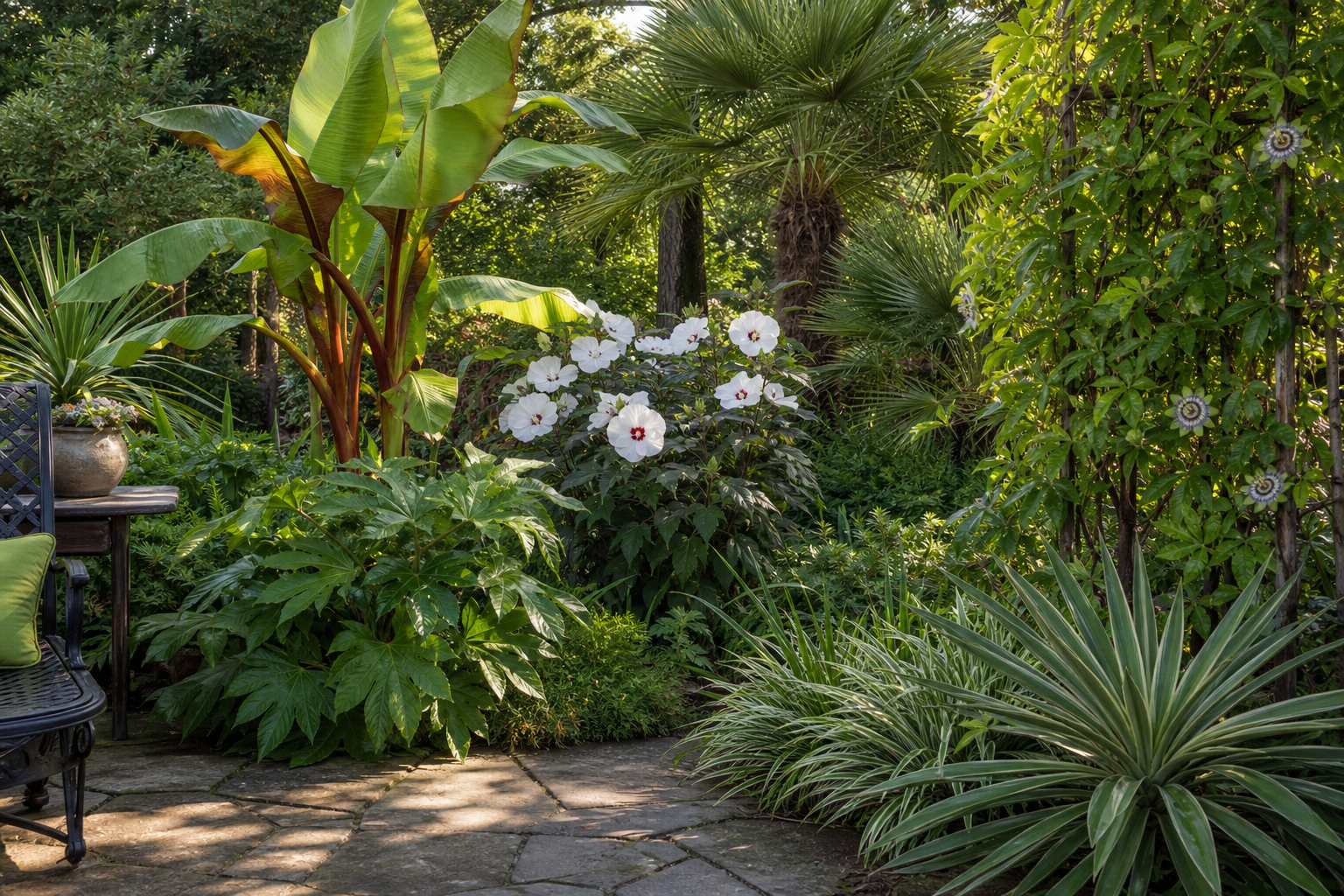
If you want the fastest route to a tropical-looking garden, start with Japanese banana. Its huge paddle-shaped leaves form a trunk-like clump that can reach 6 to 14 feet in a single growing season under good conditions.
The roots are remarkably cold hardy, often surviving in USDA Zones 5 through 8 when protected with a thick layer of mulch. In colder areas, the leaves and stems usually collapse after frost, but new shoots emerge from the underground rhizome in spring. It is grown mainly for foliage; the small green fruit is not useful as a dessert banana.
- Best site: full sun or light afternoon shade, protected from strong wind.
- Water: keep soil consistently moist, but not waterlogged.
- Winter care: after frost, cut damaged stems back and mulch deeply around the base.
2. Hardy hibiscus or rose mallow (Hibiscus moscheutos hybrids)
Hardy hibiscus delivers dinner-plate flowers without the winter drama of tropical hibiscus. Depending on the cultivar, blooms can reach 6 to 10 inches across in shades of red, pink, white and burgundy.
These herbaceous perennials are generally hardy in Zones 4 or 5 through 9. They disappear almost completely in late fall, so don’t worry if the plant looks finished after the first hard freeze. Cut stems to a few inches above the ground in late autumn, then wait patiently: new shoots can emerge surprisingly late in spring.
Give hardy hibiscus rich, moisture-retentive soil and full sun. It is especially effective beside a pond, rain garden or patio, where its bold leaves and enormous flowers create an instant resort-like feel.
3. Needle palm (Rhapidophyllum hystrix)
Few plants create a stronger tropical impression in a cold climate than a real palm. Needle palm is a dense, clumping, nearly trunkless palm native to the southeastern United States. Its fan-shaped evergreen leaves can remain attractive through winter, especially in a sheltered garden.
It is among the most cold-hardy palms, with reliable performance commonly reported through Zone 6b in protected conditions. Mature plants may tolerate brief subzero temperatures, but winter wind can cause more damage than cold alone.
- Plant in part shade for the best foliage, although it tolerates full sun.
- Choose a site protected from prevailing winter winds.
- Mulch the root zone, keeping mulch away from the central growing point.
- Handle carefully: the leaf bases carry sharp, needle-like spines.
4. Adam’s needle yucca (Yucca filamentosa)
Yucca may be associated with desert gardens, but its bold evergreen rosette also works beautifully in a tropical-inspired border. Adam’s needle yucca produces stiff, sword-shaped leaves and tall spikes of creamy, bell-shaped flowers in late spring or early summer.
Hardy through much of the eastern and central United States, it is a dependable choice for gardeners who want year-round structure with minimal fuss. Choose a well-drained site in full sun or light shade. Once established, yucca tolerates drought, heat, poor soil and salt spray better than many large-leaved ornamentals.
Use it as an architectural accent among ornamental grasses, hardy hibiscus or dark-leaved perennials. Variegated cultivars can brighten a shady corner, but green-leaved forms are often the toughest choice for exposed sites.
5. Japanese aralia or fatsia (Fatsia japonica)
For a shady garden, fatsia is one of the best tropical-looking choices. Its glossy, hand-shaped leaves can grow up to 16 inches wide, giving a woodland border the atmosphere of a lush courtyard.
Japanese aralia is generally suited to Zones 8 through 10, while some cultivars, including ‘Spider’s Web,’ may survive colder conditions in a protected Zone 7b microclimate with heavy mulch. It prefers part to full shade, humus-rich soil and protection from drying wind. Avoid hot afternoon sun, which can scorch the broad leaves.
Fatsia is evergreen in suitable climates. After a severe winter, damaged leaves may brown, but the plant can recover if the stems and roots remain healthy. Place it near a foundation, under tall trees or beside a shaded porch.
6. Hardy passionflower (Passiflora incarnata)
Hardy passionflower combines tropical-looking flowers with a surprisingly tough root system. Its intricate lavender-and-white blooms appear in summer, followed by oval fruits commonly called maypops.
This native vine is hardy from approximately Zone 5 through Zone 9. The top growth may die back in cold weather, but the plant returns from underground roots. Provide a trellis, fence or arbor, and expect vigorous growth once established.
- Light: full sun gives the best flowering.
- Soil: moist, well-drained soil is ideal.
- Pruning: cut back dead vines in late winter or early spring.
- Garden value: the flowers attract pollinators, while the foliage supports several butterfly species.
7. Hardy ginger lily (Hedychium hybrids)
Hardy ginger lilies bring tropical foliage and fragrant summer flowers to gardens in Zones 7b and warmer, particularly where roots receive winter protection. The tall, strappy leaves form clumps 3 to 6 feet high, and some cultivars produce sweetly scented white, yellow, orange or red flowers.
Plant ginger lilies in rich, moist but well-drained soil. They appreciate full sun in cooler climates and afternoon shade in hot regions. A thick mulch layer helps protect rhizomes from cold, especially during winters with little snow cover.
In the coldest part of their range, the foliage may die back. That is normal. Remove collapsed stems after frost and wait for warm spring soil before deciding the plant has failed.
8. Canna lily (Canna hybrids)
Cannas are classic tropical-style garden plants, with broad leaves and vivid flowers in red, orange, yellow or pink. Cultivars range from compact plants about 18 inches tall to dramatic selections over 6 feet.
They can remain in the ground year-round in warmer parts of the country, especially where the soil drains well and winter temperatures remain above about 25°F. In colder Zones 6 and below, rhizomes usually need to be lifted and stored, so choose cannas only if your local climate allows them to stay outside.
Grow cannas in full sun to partial shade. They tolerate moist soil and work well near ponds or rain gardens, but standing water around the rhizomes can cause rot. If winter is borderline, plant the rhizomes slightly deeper and apply a generous mulch after the foliage is cut down.
9. Elephant ear (Colocasia selections)
Elephant ears offer some of the boldest foliage available: enormous heart-shaped leaves that instantly suggest a tropical landscape. The catch is that most selections are tender, so this is a “leave outdoors” plant primarily for gardeners in Zones 7b through 10.
Choose a protected, moist site in part shade or filtered sun. In warm regions, the corms can remain in the ground under a deep mulch layer. In colder zones, they are usually grown as annuals or dug and stored, so check the hardiness of the specific cultivar before planting.
Do not let the soil dry out during the growing season, and shelter the leaves from strong wind. Large leaves tear easily, even when temperatures are ideal.
10. Rice-paper plant (Tetrapanax papyrifer)
Rice-paper plant is a bold, fast-growing shrub or small tree with deeply lobed, gray-green leaves that can reach 10 to 15 inches across. It gives a border the look of a tropical canopy and can become a striking background plant.
It is best suited to Zones 8b through 11. Frost may damage the foliage and stems, but the plant can re-emerge from its roots in spring. Choose a site with sun or partial shade, fertile soil and protection from strong wind.
Rice-paper plant spreads by underground rhizomes, so give it room or install a root barrier. If you prefer a more restrained plant, look for the smaller ‘Rex’ form and remove unwanted shoots promptly.
Simple winter protection that makes a difference
Even a hardy plant benefits from thoughtful placement. Before winter arrives, make sure the soil drains freely, water plants deeply during a dry fall, and apply mulch after the ground begins to cool.
- Use 3 to 6 inches of shredded leaves, pine straw or bark mulch around herbaceous perennials.
- Keep mulch a few inches away from woody stems and palm crowns to reduce moisture-related problems.
- Avoid late-season heavy fertilizing, which can encourage tender growth before a freeze.
- Leave attractive seedheads and stems standing when they help protect the crown or provide winter habitat.
- Wait until spring growth clearly begins before cutting back plants that may have winter damage.
Bring the tropics home—without the winter haul
The best cold-hardy tropical-looking garden combines plants with different winter strategies. Pair an evergreen needle palm or yucca with a deciduous hardy hibiscus, then add a banana, canna or ginger lily for summer drama. In warmer zones, fatsia, elephant ear and rice-paper plant can supply the broad foliage that makes the whole planting feel lush.
Start with one well-sited specimen, observe how it handles your winter, and expand from there. With the right plant and a little seasonal protection, you can enjoy a vacation-inspired garden that comes back on its own every spring.