
Rhabdocline Needle Cast of Douglas-Fir
Rhabdocline pseudotsugaeRhabdocline Needle Cast of Douglas-Fir overview
Rhabdocline needle cast is a fungal disease of Douglas-fir that causes yellow spots, reddish-brown blotches, orange-brown fruiting bodies, and premature loss of current-season needles. It is most damaging to young, densely planted or poorly sited trees during cool, wet springs. Correct identification matters because Swiss needle cast can look similar, while management depends on protecting new foliage and improving airflow.
Typical conditions
Overview
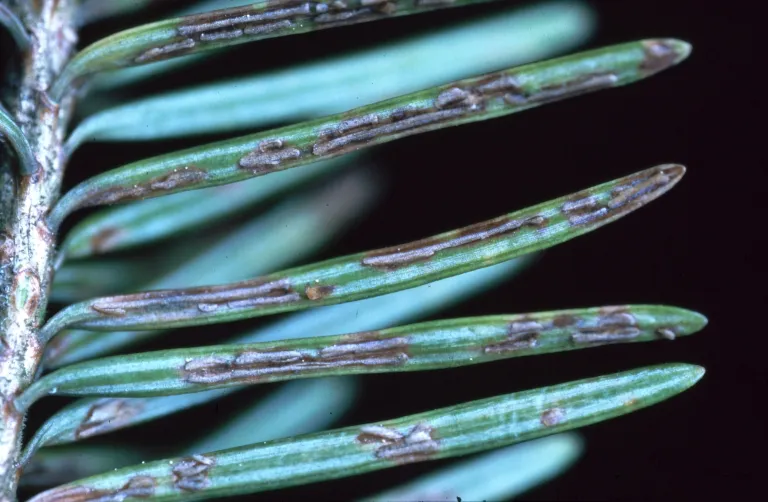
Rhabdocline pseudotsugae causes Rhabdocline needle cast, a disease restricted to Douglas-fir in the documented host references. Initial symptoms commonly appear on current-season needles as small yellow spots in late summer or fall. By late winter or spring, spots enlarge into conspicuous yellow, reddish, or dark reddish-brown blotches. In late spring, infected areas on the underside of needles may swell and split, exposing orange-brown fruiting structures.
Diseased needles may remain attached through winter and then be shed by late spring or early summer. Severe, repeated defoliation can leave a tree with mainly current-year needles, reduce vigor and marketability, and increase susceptibility to secondary stresses. Because Swiss needle cast and other needle disorders can resemble it, confirmation by a university or diagnostic plant clinic is advisable when treatment decisions are significant.
Symptoms and identification
Look for:
- Numerous small yellow spots on current-season needles, often appearing in late summer or fall.
- Spots enlarging into yellow, reddish, or dark reddish-brown blotches by late winter and spring.
- Orange-brown fruiting structures that swell and rupture the needle surface during wet spring weather.
- Premature browning and needle drop, commonly most noticeable in the lower, shaded canopy.
- In severe cases, sparse branches retaining mostly current-year needles.
Needle loss alone is not diagnostic. Swiss needle cast typically produces much smaller black fruiting bodies in rows along the underside of Douglas-fir needles, so inspect symptomatic foliage with a hand lens or submit a sample.
Causes and spread
Spread occurs when spores from infected overwintered Douglas-fir needles are released during wet spring weather and carried by wind or splashing rain to newly expanding needles. Dense plantings, shade, tall weeds, poor airflow, and prolonged needle wetness increase infection risk. Movement of infected nursery stock can introduce the pathogen to new plantings.
Life cycle and persistence
The fungus survives on infected needles that remain attached through winter. In spring, moisture causes mature fruiting structures to swell and split the needle epidermis. Wind- and rain-dispersed ascospores infect newly expanding Douglas-fir needles around bud break and during early shoot growth, when foliage is most vulnerable.
New infections may remain inconspicuous for months. Lesions develop through the growing season, fruiting structures mature in or on the affected needle tissue, and infected needles are often cast by late spring or early summer. The cycle repeats when wet conditions coincide with susceptible new foliage.
Treatment and control
Confirm the diagnosis before committing to repeated sprays, particularly where Swiss needle cast is also possible. Remove severely affected branches when practical and improve site conditions, but recognize that damaged needles will not recover. Protecting the next flush of Douglas-fir needles is the main treatment objective.
In high-value young trees, nurseries, or Christmas-tree plantations, a locally appropriate, legally labeled fungicide program may be considered beginning around bud break or as new needles emerge, with follow-up applications determined by the product label, weather, disease pressure, and local Extension guidance. Thorough coverage of susceptible new foliage is essential. Older landscape trees often do not justify routine spraying unless symptoms are severe, recurring, and confirmed.
Low-impact and biological control
No reliably curative organic treatment is available once needles are infected. Emphasize prevention and sanitation:
- Prune and destroy heavily infected twigs or branches during dry weather, avoiding unnecessary removal of healthy canopy.
- Remove severely affected fallen or retained foliage where practical, particularly in nursery and Christmas-tree production settings.
- Improve spacing, weed control, and airflow around lower branches; avoid dense underplanting that keeps foliage wet.
- Choose well-adapted, healthy Douglas-fir stock and avoid planting it in persistently humid, shaded, or poorly ventilated sites.
- Use biological or low-impact products only if they are currently registered and labeled for this crop and disease; efficacy and legal availability vary by state and product.
Prevention
Start with site and canopy management:
- Plant Douglas-fir in full sun where feasible, in well-drained soil and with enough spacing for air circulation.
- Avoid low, shaded, humid locations and reduce tall weeds or dense companion vegetation around the lower canopy.
- Inspect nursery stock before planting and favor healthy, disease-free plants.
- Prune dead or severely diseased branches during dry weather and sanitize tools between questionable cuts.
- Monitor current-year needles from late spring through fall, especially after cool, wet periods.
- For valuable young trees or commercial plantings with a confirmed history, coordinate preventive fungicide timing with local Extension or a qualified applicator; protection must cover new foliage before infection.
Interesting facts
- The disease is documented primarily on Douglas-fir, Pseudotsuga menziesii.
- It can be especially damaging in young Christmas-tree plantations and nurseries, where repeated needle loss reduces both vigor and saleability.
- Individual Douglas-fir trees can differ greatly in apparent susceptibility even under similar conditions.
- Rhabdocline needle cast and Swiss needle cast may occur on the same tree, making close examination important.
- Fungicides cannot reverse symptoms on already infected needles; successful protection targets the next flush of expanding foliage.
Use fungicides only when the product is legally authorized and specifically labeled for Douglas-fir, Rhabdocline needle cast, and the intended use site in the United States. Follow the current EPA-approved label for rate, timing, protective equipment, reentry, environmental precautions, and harvest or disposal restrictions. Do not assume that an active ingredient labeled for another needle-cast disease is legal or effective for this disease. Sprays protect expanding new needles; they will not restore needles already damaged or dropped.
Affected plants
The plants below are linked to this problem by structured host-plant data. The list updates automatically as new plant profiles are added.
 Darjeeling banana (Musa sikkimensis) care guideMusa sikkimensis
 Oncidium alexandrae care guideOncidium alexandrae
 Ensete glaucum care guideEnsete glaucum
 Clowes’ Tulip Orchid (Anguloa clowesii) care guideAnguloa clowesii
 Warty Brassia (Brassia verrucosa) care guideBrassia verrucosa
 Cymbidium sinense care guideCymbidium sinense
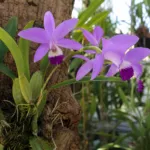 Laelia anceps care guideLaelia anceps
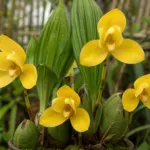 Lycaste aromatica care guideLycaste aromatica
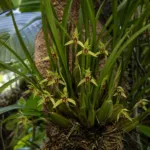 Coconut Orchid (Maxillaria tenuifolia) care guideMaxillaria tenuifolia
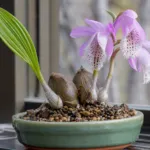 Windowsill Orchid (Pleione formosana) care guidePleione formosana
 Maurelii (Ensete ventricosum ‘Maurelii’)Ensete ventricosum 'Maurelii'
 Sweet wild banana (Musa balbisiana) care guideMusa balbisiana