
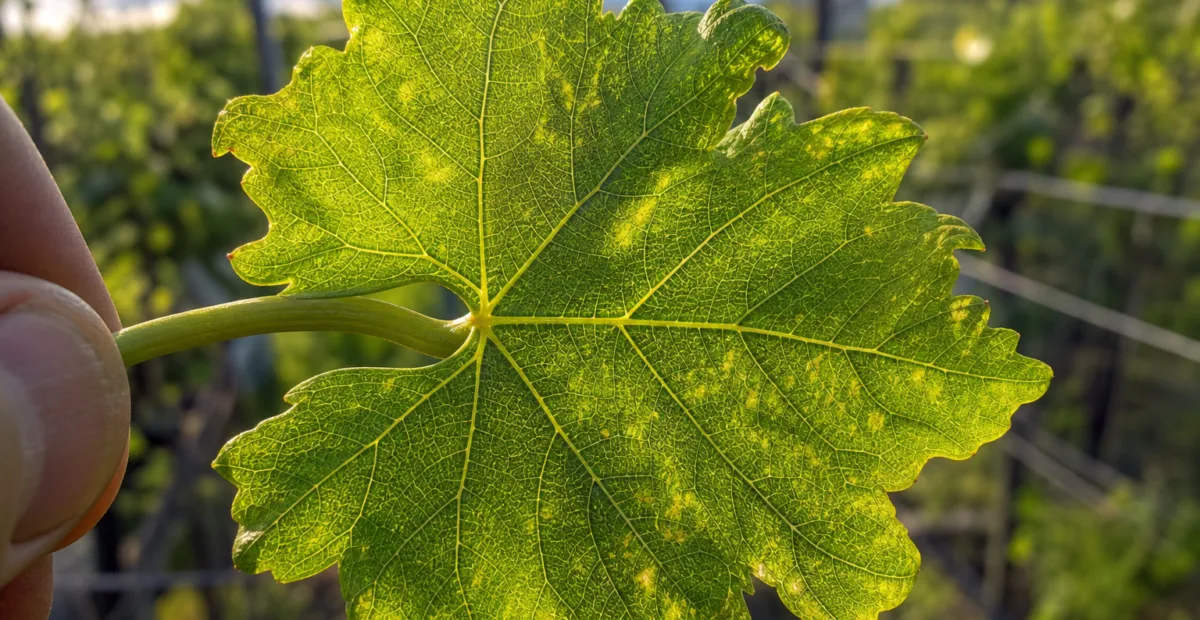
Grapevine fleck disease
Maculavirus vitisGrapevine fleck disease overview
Grapevine fleck disease is caused by Grapevine fleck virus, a phloem-limited virus that is commonly symptomless in Vitis vinifera cultivars and many grape rootstocks. Its diagnostic symptom is translucent clearing of small leaf veins on the sensitive indicator Vitis rupestris, sometimes followed by fleck mosaic, wrinkling, upward curling and stunting. Spread is primarily through infected grafting and propagation material.
Typical conditions
Overview
Grapevine fleck virus is a positive-sense, single-stranded RNA virus that remains largely confined to the phloem. The disease is often invisible in commercial wine and table grape cultivars, so visual inspection alone cannot reliably determine infection status.
The classic diagnostic response occurs in the sensitive indicator host Vitis rupestris. Young leaves develop clearing of the small, third- and fourth-order veins, producing translucent flecks that are easiest to see when the leaf is held against the light. Older leaves may show a mosaic-like pattern, wrinkling, upward curling or, with severe strains, reduced growth.
Symptoms can be confused with other members of the grapevine fleck complex or with mixed virus infections. Confirmation requires laboratory testing, commonly reverse-transcription PCR, and in some diagnostic programs serological testing or biological indexing.
Symptoms and identification
- On Vitis rupestris, young leaves develop pale, translucent clearing along small veins and veinlets.
- Flecks may expand into a light mosaic pattern as leaves mature.
- Strongly affected leaves can become wrinkled, twisted or curled upward.
- Severe strains may cause some stunting, although major yield effects are not established for GFkV alone.
- Vitis vinifera cultivars and many American rootstocks usually show no distinctive field symptoms.
- Symptoms may be less conspicuous or disappear during hot weather, and mixed infections can alter the appearance.
Do not diagnose GFkV from flecking alone. Similar symptoms may occur with other fleck-associated viruses, nutrient or environmental stress, and combined grapevine virus infections.
Causes and spread
Long-distance spread occurs mainly through infected vegetative propagation material, including grafts, buds, scionwood, cuttings and rootstocks. Grafting efficiently transfers the virus because GFkV occupies the vascular system.
No confirmed natural vector is known, and routine sap contact, pruning contact or seed transmission is not considered an established primary pathway. Field spread has been reported, but its mechanism remains unresolved. Avoid treating unexplained spread as proof of an insect vector.
Life cycle and persistence
GFkV persists systemically in infected grapevines, particularly in phloem tissues, and can be carried into new plants through infected scions, buds, cuttings or rootstocks. Grafting and budding establish the virus in the vascular system of the propagated plant.
There is no confirmed insect or mite vector, and the virus is not mechanically transmitted by ordinary sap inoculation. Seed transmission has not been demonstrated. Experimental transmission through dodder has been reported, but this is not considered an important routine pathway in vineyards.
Because many cultivated grapevines remain symptomless, infected material can enter nurseries or vineyards unnoticed. Biological indexing on Vitis rupestris and laboratory assays are therefore important for detecting latent infections.
Treatment and control
There is no curative field treatment for an established GFkV-infected grapevine. Pruning, fertilizing or pesticide applications will not eliminate the virus.
For valuable vines, confirm the result with an appropriate diagnostic laboratory because mixed infections and latent infections are common. In nurseries or mother blocks, remove confirmed infected plants and replace them with certified clean stock. Specialized virus-elimination methods such as meristem culture or thermotherapy may be used by professional certification and propagation programs, but they are not practical home remedies and require subsequent testing.
Manage the vineyard for overall plant health and investigate other viruses if growth, yield, graft compatibility or fruit quality are affected; GFkV alone is frequently symptomless.
Low-impact and biological control
There is no organic spray or biological treatment that removes GFkV from an infected grapevine. The practical organic and low-input strategy is exclusion and sanitation:
- Purchase certified or professionally virus-tested grapevines, scionwood, buds and rootstocks from reputable U.S. suppliers.
- Do not propagate from vines of unknown virus status, even when they appear vigorous and symptom-free.
- Use clean, disinfected grafting and budding tools and keep suspect lots separate from clean nursery material.
- Remove and destroy confirmed infected propagation stock; do not compost it for future propagation use.
- When symptoms are observed, submit representative tissue to a plant diagnostic laboratory rather than attempting repeated sprays.
Prevention
- Start vineyards and nursery blocks with certified, virus-tested grapevine material suited to the intended rootstock and cultivar.
- Maintain traceability of scion and rootstock lots and avoid exchanging untested cuttings with other growers.
- Use clean tools and sound grafting practices; sanitize equipment between lots according to nursery protocols.
- Isolate and test unusual vines or indicator plants before collecting propagation wood.
- Have suspect plants tested by a qualified plant diagnostic laboratory, preferably using an assay validated for the cultivar and tissue sampled.
- Rogue confirmed infected nursery plants and replace them with tested clean material when maintaining a high-health block.
- Remember that symptomless Vitis vinifera plants can still carry the virus; visual scouting is not a substitute for testing.
Interesting facts
- The disease name refers to the fleck-like translucent markings seen most clearly on the indicator host Vitis rupestris.
- GFkV is the type species of the genus Maculavirus.
- The virus is phloem-limited and is not readily transmitted by sap inoculation.
- Its presence in a symptomless Vitis vinifera vine can be detected by laboratory testing or indicator indexing.
- Fleck symptoms are often discussed as part of a broader grapevine fleck complex, but detection of GFkV does not prove that it caused every fleck symptom in a mixed-infected vine.
No pesticide, fungicide or miticide can cure an infected grapevine or eradicate this virus from established tissue. Use only products legally authorized for grapevines and this specific problem in the United States, and follow the current product label. Management should focus on clean propagation material, testing, sanitation and removal of infected stock.