
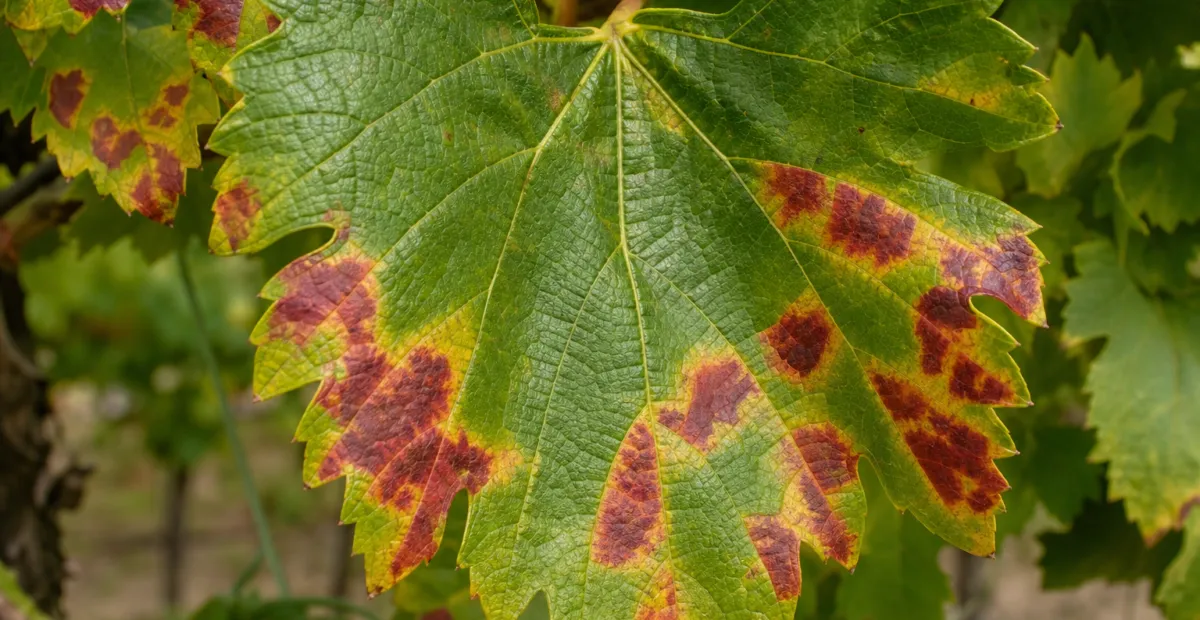
Red Fire Disease of Grapevine
Pseudopezicula tracheiphila (synonym: Pseudopeziza tracheiphila)Red Fire Disease of Grapevine overview
Red fire disease, also called Rotbrenner, is a fungal disease of grapevines caused by Pseudopezicula tracheiphila. It produces vein-limited yellow, red, or reddish-brown leaf lesions, premature defoliation, and occasionally drying of flower clusters or rachis tissue. Symptoms can resemble Pierce’s disease, grapevine red blotch, sunburn, or nutritional stress, so laboratory confirmation may be needed.
Typical conditions
Overview
Red fire disease, or Rotbrenner, is caused by the ascomycete fungus Pseudopezicula tracheiphila. It is primarily a disease of Vitis and is more frequently emphasized in European viticulture, although the pathogen is a U.S. regulatory and diagnostic concern. The disease should not be diagnosed from leaf color alone because similar symptoms occur with Pierce’s disease, grapevine red blotch, downy mildew injury, sunburn, drought, and nutrient disorders.
In the United States, suspected finds—especially in commercial vineyards, nurseries, or imported plant material—should be documented and submitted to a state plant diagnostic laboratory or extension diagnostician. Some North American angular-leaf-scorch records may involve the related species Pseudopezicula tetraspora, so species-level identification may require microscopy or molecular testing.
Symptoms and identification
- On white-fruited cultivars, lesions begin as yellow or pale areas; on red- and black-fruited cultivars, they commonly appear bright red, ruby red, or reddish brown.
- Lesions enlarge into angular or wedge-shaped areas with reddish-brown necrosis and a narrow yellow, red, or green transition zone.
- Major veins commonly restrict lesion expansion, producing a characteristic vein-limited pattern.
- Late-season infections may cause scattered spotting, extensive leaf death, and premature defoliation.
- Flowers or inflorescences may rot and dry before or around bloom. The fruit is not usually infected directly, but berries beyond an infected pedicel or rachis section may wither and dry.
- Symptoms may be confused with Pierce’s disease, grapevine red blotch, potassium or magnesium stress, drought injury, and other grapevine leaf disorders.
Causes and spread
The pathogen survives in infected fallen grape leaves and can produce small apothecia, or cup-like sexual fruiting bodies, in leaf tissue, often near veins. During wet weather, especially rainfall or prolonged leaf wetness, apothecia release airborne ascospores. Wind, rain splash, dew, and overhead irrigation can move spores to susceptible foliage.
There are no known insect vectors. Long-distance introduction is associated primarily with movement of infected plant material, particularly older leaves or nursery stock. Secondary spread within a vineyard is generally limited but can occur when wet conditions persist and new fruiting bodies develop on current-season infected leaves.
Life cycle and persistence
- Mycelium survives in infected fallen leaves and possibly in infected leaf tissue retained in the canopy.
- In spring, moisture stimulates development and maturation of apothecia on overwintered leaves.
- Rain or extended wetness triggers ascospore release; spores are dispersed by air and water to young grape leaves.
- After infection, symptoms generally remain latent for approximately 2–4 weeks, although symptomless infections can occur.
- The fungus colonizes vascular elements, producing lesions that are frequently bounded by major veins.
- Apothecia may form later in summer or fall on infected current-season leaves, allowing additional sporulation when wet weather continues.
Young leaves become susceptible after expanding to roughly 2 inches across, with susceptibility increasing as shoots develop several fully expanded leaves. Disease severity depends strongly on rainfall, duration of wetness, cultivar response, infection timing, and the amount of infected leaf debris present.
Treatment and control
Remove and destroy severely diseased leaves and affected flower or rachis material when feasible, while avoiding unnecessary handling that spreads wet debris between vines. Improve canopy ventilation and correct irrigation practices immediately.
Fungicide decisions should be based on confirmed diagnosis, cultivar susceptibility, disease history, weather, growth stage, and local extension recommendations. Protection is most useful before infection or during periods when susceptible foliage is expanding and wet weather is forecast. Once extensive vascular colonization and defoliation have occurred, sprays cannot restore damaged tissue.
In commercial vineyards, coordinate management with a state extension plant pathologist or crop adviser. Repeated or unnecessary fungicide applications can increase cost, environmental impact, and resistance risk, especially when the diagnosis is actually Pierce’s disease, grapevine red blotch, or a noninfectious disorder.
Low-impact and biological control
- Prioritize sanitation by removing infected fallen leaves and reducing the amount of overwintering inoculum.
- Use drip irrigation and canopy practices that reduce humidity and leaf wetness.
- Maintain balanced vine nutrition and consistent irrigation without using fertilizers as a substitute for diagnosis.
- Use clean propagation material and segregate suspect nursery stock.
- Monitor weather and symptoms so any permitted organic fungicide is used only when justified by disease risk and the product label.
No reliable biological-control program specific to Pseudopezicula tracheiphila is established for home vineyards. Beneficial microbes may be part of a broader organic program, but product performance should be supported by local trials and the current U.S. label.
Prevention
- Purchase grapevines and propagation material from reputable, inspected sources and avoid moving symptomatic plants or contaminated leaf debris.
- During dormant-season and early-season sanitation, remove, bury, or otherwise properly dispose of infected fallen leaves where practical. Do not move vineyard debris to clean blocks.
- Use trellising, pruning, shoot positioning, and canopy management to improve airflow and shorten leaf-wetness periods.
- Prefer drip or under-vine irrigation rather than overhead irrigation, particularly during spring shoot growth.
- Scout lower and older leaves regularly after rainy periods, recording cultivar, shoot position, rainfall, and symptom development.
- Submit representative symptomatic leaves and, when available, associated dead-leaf tissue for laboratory diagnosis before making a costly disease-control decision.
- Manage other causes of grapevine decline, including poor drainage, drought stress, and vector-borne diseases, because mixed problems can make diagnosis more difficult.
Interesting facts
- The disease name Rotbrenner means “red burner” and refers to the conspicuous red leaf symptoms on red grape cultivars.
- Color expression depends partly on grape cultivar: white-fruited cultivars often show yellow lesions, while red- and black-fruited cultivars commonly show red lesions.
- The pathogen’s hyphae can occur in a distinctive sine-wave pattern inside xylem vessel elements, a feature used in specialized diagnosis.
- Flowers may be severely damaged even though the berries themselves are not usually infected directly.
- Reported host information is conservative: Vitis is the principal host genus, while Virginia creeper and Boston ivy have also been reported as hosts in some plant-health assessments.
Use only fungicides legally authorized for red fire disease or the applicable grape disease on the specific crop and site in your U.S. state. Follow the current label exactly, including rate, timing, reentry interval, preharvest interval, personal protective equipment, resistance-management instructions, and restrictions for wine or table grapes. Product registrations and labels can change; confirm them through the current EPA label and state requirements or consult your state extension service. Do not use a product merely because it is labeled for another grape disease.