
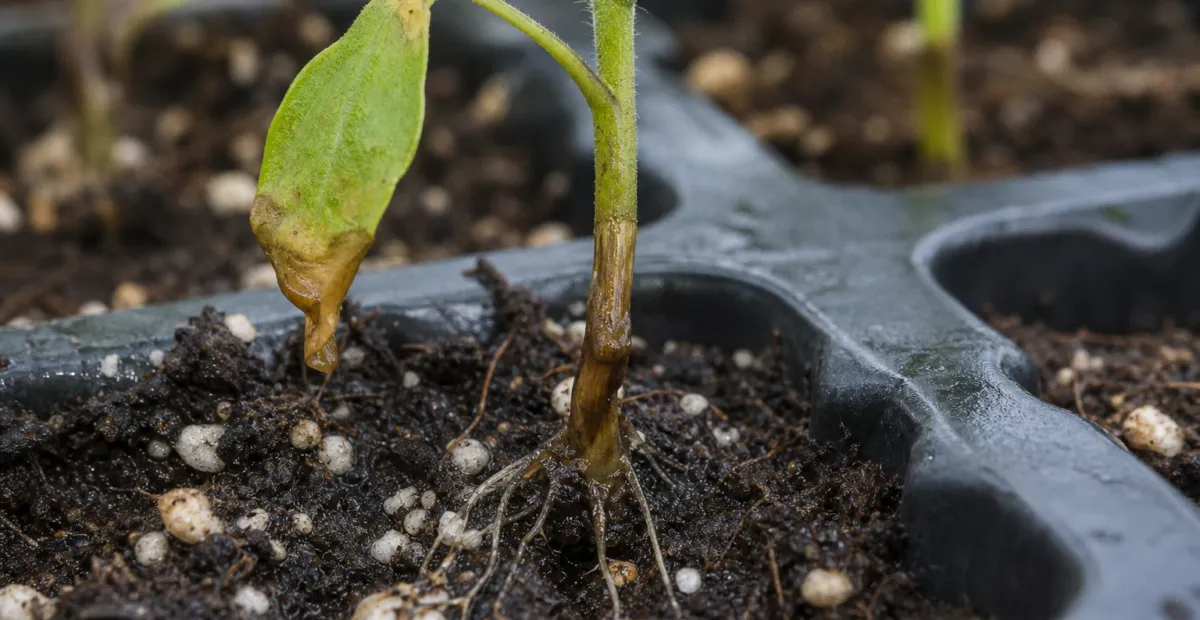
Pythium damping-off and root rot
Pythium debaryanum R. Hesse; often treated taxonomically as Globisporangium debaryanumPythium damping-off and root rot overview
Pythium debaryanum is a soilborne oomycete, or water mold, historically associated with damping-off and root diseases in many crops and ornamentals. In the United States, the same symptoms may be caused by several Pythium species, Phytophthora, Rhizoctonia or Fusarium, so species-level identification should not rely on appearance alone. Excess moisture, poor drainage and contaminated propagation equipment are major risk factors.
Typical conditions
Overview
Pythium debaryanum is a fungus-like oomycete that can colonize germinating seeds, tender roots and stem bases. Typical disease expressions include pre-emergence seed decay, post-emergence damping-off, root rot and occasional stem or growing-tip blight. Because Pythium diseases are caused by a complex of related species and can resemble Phytophthora, Rhizoctonia and Fusarium diseases, visual symptoms are not sufficient for species-level diagnosis. In home gardens and greenhouses, the practical diagnosis is usually Pythium-associated damping-off or root rot pending laboratory testing.
Symptoms and identification
Before emergence, infected seeds may become soft, brown and water soaked, then disintegrate, leaving irregular or circular gaps in a tray or seedbed.
After emergence, the lower stem or hypocotyl may become translucent, constricted, gray-brown and mushy. The green top wilts and collapses at the soil line. Roots may be sparse, brown, water soaked or easily stripped of their outer cortex. Older plants may remain stunted, wilt during warm periods, yellow from the lower leaves and develop a brown, decayed root system.
Symptoms alone cannot distinguish Pythium debaryanum from other Pythium species, Phytophthora, Rhizoctonia or Fusarium. A laboratory can culture or molecularly identify the pathogen from fresh advancing lesions; dead, dried tissue is much less useful.
Causes and spread
Outbreaks commonly begin when contaminated soil, potting media, seed, trays or benches are kept continuously wet. Excess irrigation and poor drainage create water films in which zoospores can move from one cell or plant to another.
Dense sowing, deep planting, cool or stressful germination conditions, low light, root injury and weak seedlings increase susceptibility. Reusing contaminated water, subirrigation reservoirs or tools can spread the pathogen throughout a greenhouse or nursery. The disease is often a complex involving more than one Pythium species or another soilborne pathogen.
Life cycle and persistence
The organism survives in infested soil, potting residues and plant debris as mycelium and resistant oospores. When the medium becomes wet, it can produce sporangia and, under suitable conditions, motile zoospores. Zoospores swim through films of water toward roots or germinating seeds, encyst, germinate and penetrate susceptible tissue.
Infected tissue is rapidly colonized, producing soft rot and additional inoculum. Water movement, splashing, irrigation, reused containers, tools, workers and infested transplants spread the pathogen locally. Oospores and surviving mycelium allow persistence between crops. Pythium is not primarily spread as an airborne foliar pathogen; moisture and contaminated growing media are the main concerns.
Treatment and control
Seedlings that have collapsed or whose roots are extensively rotted rarely recover. Remove them with the surrounding medium, discard them, and clean the container or bench before replanting. For plants with limited root damage, improve drainage immediately, reduce irrigation frequency and transplant only into clean, well-drained medium.
Do not expect a fungicide or oomycete-targeted product to restore dead root tissue. If a treatment is justified, obtain a diagnosis first and use only a product currently labeled for the exact crop and use site in the United States. Rotate labeled modes of action where appropriate and avoid repeated applications of one chemistry, because resistance has been documented in some Pythium populations.
In commercial greenhouse, nursery or hydroponic systems, investigate irrigation-water sanitation, reservoir hygiene, drainage, substrate handling and crop movement. A diagnostic laboratory should distinguish Pythium from Phytophthora and other damping-off pathogens before a costly treatment program is selected.
Low-impact and biological control
Organic production and home-garden management should focus on exclusion and moisture control. Use fresh, clean, well-drained seed-starting mix rather than garden soil, and sow seed at the recommended depth and spacing.
- Disinfect reusable trays, pots, tools and work surfaces before sowing.
- Water thoroughly but allow the surface and upper root zone to drain; avoid standing water and routine overhead misting.
- Provide strong light, adequate air movement and temperatures that promote rapid germination and root growth.
- Remove collapsed seedlings and surrounding mix promptly; do not compost diseased material if the compost pile will not reach pathogen-killing temperatures.
- Use certified, high-quality seed and avoid moving contaminated flats or irrigation water between benches.
- Where permitted by the production standard and label, consider registered biological products containing beneficial microbes such as Trichoderma or Bacillus as preventive tools, not as cures for established rot.
Prevention
Prevention is more dependable than rescue treatment. Start with clean containers, a pathogen-free commercial growing medium and disease-free seed or transplants. Keep benches, tools and floors free of spilled soil and plant debris, and sanitize trays before reuse.
- Use containers with unobstructed drainage holes.
- Water according to crop need rather than on a fixed schedule.
- Do not leave trays standing in runoff or reservoir water.
- Improve light and air circulation, and avoid overcrowding.
- Separate suspect flats from healthy plants.
- Remove diseased seedlings and the adjacent growing medium rather than merely pulling out the dead tops.
- Have representative fresh tissue tested when losses continue or when a crop has high value.
Interesting facts
Pythium debaryanum is traditionally called a water mold, but it is not a true fungus; it belongs to the oomycetes.
The species name is used in older literature for a broad and sometimes inconsistent group of isolates. Modern taxonomic resources place it under Globisporangium in some classifications, while Pythium debaryanum remains widely used in plant pathology references.
Not every Pythium infection kills a mature plant. Plants with vigorous root regeneration may survive with stunting, while young seedlings with limited roots often collapse quickly.
Use only products legally authorized and currently labeled in the United States for the specific crop, production site and Pythium-related problem. Follow the current label exactly, including crop restrictions, personal protective equipment, reentry intervals and preharvest intervals. Chemical treatments are preventive or suppressive rather than reliable cures for advanced root rot, and product performance can vary among Pythium species and populations.