
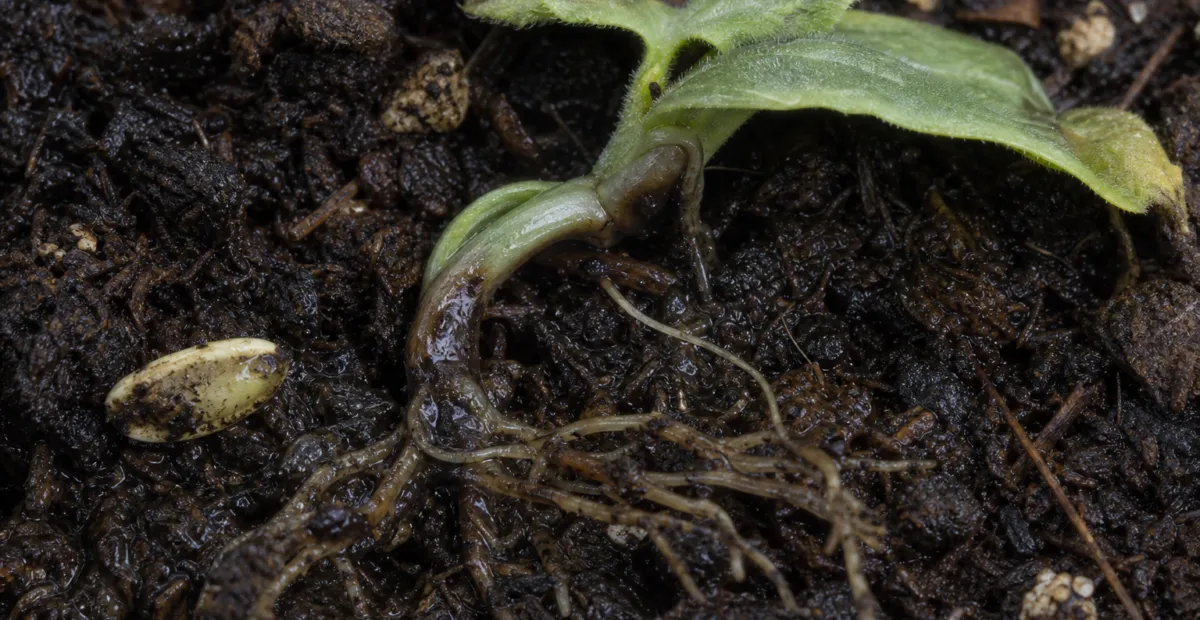
Pythium damping-off, root rot and blight
Pythium aphanidermatumPythium damping-off, root rot and blight overview
Pythium aphanidermatum is a warm-weather water mold that causes seed rot, seedling damping-off, root and crown rot, sudden wilt, and—in some crops—foliar blight. It is especially destructive when growing media or soil remains saturated, irrigation water moves between plants, and temperatures are high. Diagnosis should distinguish it from other Pythium species and Phytophthora.
Typical conditions
Overview
Pythium aphanidermatum is not a true fungus; it is an oomycete that produces rapidly growing, mostly non-septate hyphae and water-dispersed zoospores. Disease expression depends strongly on the host, production system and environment.
Common disease forms include seed rot and damping-off in propagation media, root and crown rot in vegetables and greenhouse crops, sudden wilt in warm irrigated fields, and Pythium blight of turfgrass. Species-level identification is often difficult because several Pythium species produce similar symptoms.
Symptoms and identification
- Seedlings: poor emergence, seed decay, water-soaked or translucent stems, a thin brown constriction at the soil line, rapid collapse and missing or severely stunted roots.
- Established plants: chlorosis, temporary or persistent wilt, brown water-soaked roots, crown or lower-stem lesions, reduced vigor and sudden death after irrigation or heat stress.
- Spinach and other susceptible foliage: water-soaked leaves, rapid collapse of young plants and white aerial cottony growth under humid conditions.
- Turfgrass: greasy or water-soaked patches, cottony mycelium, leaf blighting, crown and root injury, and rapidly expanding irregular areas of dead turf during hot, humid weather.
Symptoms overlap with Phytophthora, other Pythium species, Rhizoctonia, Fusarium, bacterial soft rots and irrigation or heat injury. Laboratory diagnosis is recommended for valuable plants or crop-scale outbreaks.
Causes and spread
The pathogen survives in infested soil, crop debris, thatch, roots and growing media, commonly as durable oospores. It is moved in contaminated potting mix, reused containers, tools, hands, footwear, transplants, soil, runoff and irrigation water. Zoospores swim through free water, while mycelium can grow directly from infected tissue into nearby roots or leaves.
Flooding, standing water, poor drainage, long irrigation periods, saturated media and splash or recirculating irrigation greatly increase spread. Mower clippings and wet equipment can move Pythium inoculum in turf. High nitrogen producing lush turf, salinity, drought stress and heat stress may further increase susceptibility in some host systems.
Life cycle and persistence
Oospores remain dormant in soil, roots, thatch or debris and germinate when moisture and temperature are favorable. Germinating inoculum produces hyphae and, in free water, sporangia that release motile zoospores. Zoospores are attracted to and encyst near susceptible roots or wet plant surfaces, then germinate and penetrate tissue.
P. aphanidermatum is strongly favored by warmth. Turfgrass blight is most severe when temperatures are roughly 86–95°F, nighttime temperatures remain above about 70°F, relative humidity is very high and leaves stay wet for prolonged periods. In soil and greenhouse systems, disease can develop rapidly after excessive irrigation or flooding.
Treatment and control
There is no reliable rescue for seedlings whose stems are girdled or whose roots have largely decayed. Remove and dispose of collapsed plants, surrounding contaminated media and badly infected roots. Correct the underlying water-management problem immediately: improve drainage, lengthen intervals between irrigations, reduce irrigation volume, and prevent water from moving from diseased to healthy plants.
For established plants, isolate affected containers or beds when possible and avoid handling healthy plants after diseased material. In turf, improve drainage and reduce leaf wetness; severely damaged areas may require renovation. Confirm the diagnosis before treating because different Pythium species and look-alike diseases differ in sensitivity and management response.
Low-impact and biological control
Prioritize sanitation, clean propagation media, drainage, careful irrigation, airflow and prompt removal of infected plants. Commercial biological products containing antagonistic microorganisms such as selected Trichoderma or beneficial bacterial strains may reduce disease risk in some crops and systems, but performance is product-, crop- and environment-dependent; they are not a substitute for sanitation and water management.
Use only biological products registered or otherwise legally permitted for the intended crop and use site in the United States, and follow the current label. Avoid homemade microbial drenches or unsterilized compost teas, which may introduce additional pathogens.
Prevention
- Use clean, commercial soilless propagation media and disinfected trays, tools, benches and irrigation equipment.
- Provide drainage holes, porous media, raised beds and properly graded growing areas; never allow containers or beds to remain waterlogged.
- Water according to crop need rather than on a fixed schedule. Avoid flooding, excessive irrigation and long periods of wet foliage or crown tissue.
- Use pathogen-free seed and transplants, remove diseased seedlings promptly, and discard heavily infected media rather than spreading it.
- Improve greenhouse airflow and reduce humidity and leaf-wetness duration. For turf, improve drainage, avoid mowing when foliage is wet, and avoid excessive nitrogen that creates a dense lush canopy.
- Rotate susceptible field crops where practical and control volunteer plants and debris that can maintain inoculum. In recirculating hydroponics, monitor sanitation and water movement closely.
Interesting facts
- Pythium aphanidermatum is commonly called a water mold because its swimming zoospores require free water for movement, even though the disease may occur in soil, soilless media, hydroponic systems and turf.
- It is a major warm-weather Pythium species in U.S. turfgrass, but disease reports labeled “Pythium” often involve several species and do not always establish species identity.
- In the U.S. Southwest, the pathogen has been documented causing a distinctive foliar web blight of spinach with water-soaked foliage, rapid collapse and white aerial mycelium.
- Some outbreaks appear suddenly after irrigation or heat stress because crown and root damage can progress rapidly while the canopy still looks comparatively healthy.
Use chemical products only when they are currently legally authorized for Pythium or the specific crop and use site in your U.S. state. Follow the current product label, including crop, rate, application interval, personal protective equipment, reentry and preharvest requirements. Do not assume that a fungicide labeled for one Pythium disease, crop or production system is legal or effective for another; resistance and species differences are important.
Affected plants
The plants below are linked to this problem by structured host-plant data. The list updates automatically as new plant profiles are added.
 Maroon cucumbe (Cucumis anguria) care guideCucumis anguria
 Horned Melon (Cucumis metuliferus) care guideCucumis metuliferus
 Cucumber (Cucumis sativus) care guideCucumis sativus
 Melon or true melo (Cucumis melo) care guideCucumis melo
 Cantalupensis Group (Cucumis melo Cantalupensis Group)Cucumis melo Cantalupensis Group
 Mango melon (Cucumis melo Chito Group)Cucumis melo Chito Group
 Oriental pickling melon (Cucumis melo Conomon Group)Cucumis melo Conomon Group
 Dudaim melon (Cucumis melo Dudaim Group)Cucumis melo Dudaim Group
 Flexuosus Group (Cucumis melo Flexuosus Group)Cucumis melo Flexuosus Group
 Inodorus Group (Cucumis melo Inodorus Group)Cucumis melo Inodorus Group
 Makuwa Group (Cucumis melo Makuwa Group)Cucumis melo Makuwa Group
 Momordica Group (Cucumis melo Momordica Group)Cucumis melo Momordica Group