
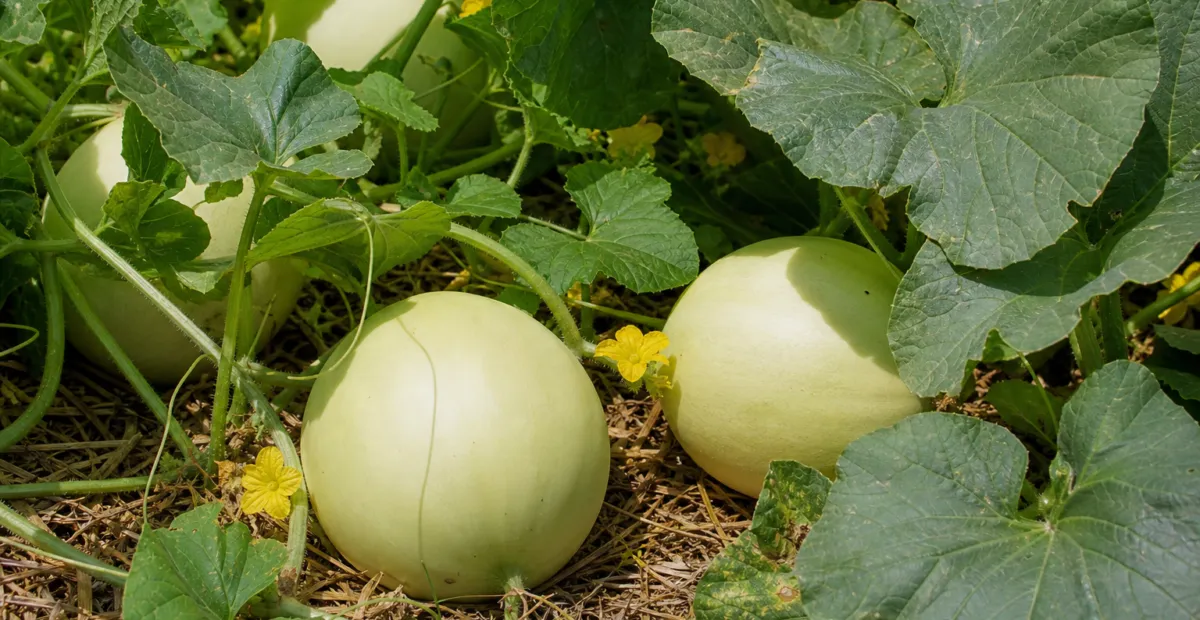
 AI-generated illustration
Inodorus Group (Cucumis melo Inodorus Group) short overview
Cucumis melo Inodorus Group is a horticultural group of warm-season melons that includes honeydew, casaba and other long-keeping winter melons. The plants form sprawling annual vines with tendrils, yellow flowers and edible fruits that may mature in green, cream or yellow tones. Grow them in full sun, warm soil and fertile, well-drained ground, allowing ample room for vines and a long frost-free season.
Taxonomic classification
Inodorus Group (Cucumis melo Inodorus Group) care guide
Light and placement
Give plants an unobstructed full-sun position, ideally with southern or southwestern exposure and at least 8 hours of direct light. Shade, reflected coolness or crowded foliage can slow growth, delay maturity and reduce sugar. Excessive heat is usually less problematic than insufficient light, provided roots receive regular moisture and the vines have airflow.
Watering and humidity
Water deeply and consistently at the root zone, keeping soil evenly moist but never saturated. Drip irrigation or a soaker hose is preferable to wetting leaves. Increase frequency during flowering, fruit enlargement and hot weather, then moderate irrigation as mature fruit approaches harvest if the cultivar’s guidance recommends it. Mulch helps reduce evaporation and soil splash.
Soil and growing medium
Use fertile, well-drained sandy loam or loam amended with mature compost. Avoid compacted or waterlogged ground, which encourages root and fruit rots. A soil pH of about 6.0–6.5 is suitable; strongly acidic soil can reduce vigor and fruit set. Raised beds are useful where drainage is poor.
Feeding
Before planting, incorporate mature compost or a modest complete vegetable fertilizer according to soil-test results. Once vines begin active growth, feed lightly if foliage is pale or growth is weak; excessive nitrogen produces leaves at the expense of fruit. Avoid fresh manure and stop routine feeding as fruit approaches maturity unless a soil test indicates a deficiency.
Growth and habit
This group forms vigorous, ground-sprawling vines with tendrils and a long seasonal growth cycle. Give vines room to run, or guide them over sturdy supports only when the fruit can be supported safely. Consistent warmth, water and nutrition are especially important during flowering and fruit enlargement.
Planting and repotting
Plant outdoors only after frost danger has passed and soil is at least 65°F. Sow seeds 1–1½ inches deep, or transplant carefully because melon roots dislike disturbance. Space plants about 2 feet apart in rows 4–6 feet apart, or grow one plant per large mound with substantial vine room.
Propagation and pruning
Propagation
Propagate from seed. Sow directly after the soil warms, or start indoors in biodegradable pots roughly 3–4 weeks before outdoor planting. Use fresh, viable seed and avoid disturbing roots during transplanting. Commercial cultivars may be hybrid and should not be expected to reproduce true from saved seed.
Pruning
Pruning is optional. Remove damaged or diseased leaves promptly and, if space is limited, guide or selectively shorten vigorous runners after fruit has set. Avoid heavy pruning because reducing healthy foliage can lower photosynthesis and fruit quality. Keep developing fruit off bare, wet soil with straw or another clean mulch.
Overwintering
These are frost-tender annual vines and are not normally overwintered outdoors. Harvest before the first freeze and remove spent vines after disease inspection. In short-season regions, start transplants indoors or use row covers early in the season; do not expose plants to freezing temperatures.
Uses
Primarily grown for fresh eating, fruit salads, desserts, beverages and home-garden production. Long-keeping forms can extend the melon season after harvest. Fruits should be harvested at cultivar-appropriate maturity and handled hygienically. Do not make medicinal claims for this horticultural group.
Appearance
Leaves are broad, rough-textured and shallowly to moderately lobed, with angular stems and coiling tendrils. Small yellow flowers arise at the leaf axils. Fruits vary widely within the group but are commonly smooth-skinned, oval to round, and green, cream, yellow or mottled at maturity; many have pale green to white flesh.
Flowering
Plants generally produce separate male and female yellow flowers on the same vine, with male flowers often appearing first. Flowers open during warm daylight hours. Successful fruit set depends on repeated insect visits and adequate moisture; poor weather or low bee activity can result in misshapen or aborted fruit.
Pollination and visitors
Melon flowers are visited by bees and other insects, and honeybees are important for reliable fruit set in cultivated plantings. Avoid insecticide applications during bloom, and maintain open access to flowers. Pollinator activity is reduced by cool, rainy or windy weather.
Cucumis melo Inodorus Group photos
Click any photo for a larger view. Source, author and license are shown separately.
Diseases and pests
Diseases
Important diseases include powdery mildew, downy mildew, Fusarium wilt, gummy stem blight, angular leaf spot and soil-borne rots. Reduce risk with crop rotation, clean transplants, drip irrigation, good airflow and resistant cultivars where available. Remove badly diseased foliage and avoid working among wet plants.
Pests
Common pests include cucumber beetles, squash bugs, aphids, spider mites and melon aphids. Inspect undersides of leaves and young stems regularly, use row covers before flowering, hand-pick larger pests and encourage beneficial insects. Remove covers when flowers open so bees can pollinate. Use only locally labeled controls and protect flowering pollinators.
Related diseases and pests
Only Plant Doctor profiles whose host data indicate this plant may be affected are shown here.
 DiseaseFusarium wiltFusarium oxysporum species complex
 DiseaseCucurbit Downy MildewPseudoperonospora cubensis (Berk. & M.A. Curtis) Rostovzev
 DiseaseCucurbit Powdery MildewPodosphaera xanthii (Castagne) U. Braun & Shishkoff
 PestMelon aphid (cotton aphid)Aphis gossypii Glover
 DiseasePhytophthora blightPhytophthora capsici
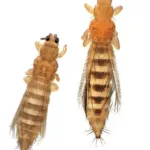 PestOnion thripsThrips tabaci Lindeman
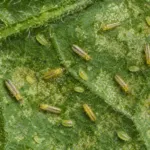 PestMelon thripsThrips palmi Karny
 PestTwo-spotted spider miteTetranychus urticae
Toxicity and pollen
The ripe fruit is commonly grown as food, but melon can cause food-allergy reactions or oral-allergy symptoms in susceptible people, including some individuals sensitized to ragweed or grass pollen. Wash fruit before cutting and avoid eating it if a known melon allergy exists. Evidence does not support treating the living plant as broadly poisonous, but unripe or bitter volunteer fruit should not be eaten casually.
- Typical season
- Summer during flowering
- Pollination / pollen
- Insect-carried pollen
The plant produces pollen for sexual reproduction, but it is insect-transferred rather than commonly dispersed in large airborne quantities. Allergy concerns are more notable from eating melon fruit: honeydew and related melons can participate in pollen-food allergy syndrome, especially among some ragweed- or grass-pollen-sensitive people.
Native habitat
Cultivated melons derive from the broader Cucumis melo species complex, whose native range extends across parts of Africa, Southwest Asia, the Indian subcontinent and northern Australia. Inodorus melons are domesticated crops rather than a narrowly defined wild habitat type and perform best in warm, seasonally dry conditions with fertile, well-drained soil.
Interesting fact
Inodorus melons are traditionally characterized by smooth or wrinkled fruit that lacks the strong musky aroma associated with many netted melons. They are often later-maturing and longer-keeping than cantaloupe-type melons. The group includes several commercially important melon types rather than one uniform fruit shape or skin color.
Frequently asked questions (FAQ)
The most relevant questions about this plant, with short and direct answers.
🌱Quick care
What is Cucumis melo Inodorus Group?⌄
Cucumis melo Inodorus Group is a horticultural group of winter melons that includes honeydew, casaba, Crenshaw, Canary, and Piel de Sapo types. These melons generally have smooth or lightly marked rinds, later maturity, and better storage potential than many netted melon types.
Is Cucumis melo Inodorus Group a honeydew melon?⌄
Honeydew is one well-known type within Cucumis melo Inodorus Group, but the group is broader than honeydew. Casaba, Canary, Crenshaw, and Piel de Sapo melons are also commonly associated with this group.
Is Cucumis melo Inodorus Group perennial or annual?⌄
Cucumis melo Inodorus Group is grown as a frost-tender annual in the United States. It completes its life cycle in one growing season and must be replanted from seed or transplants each year.
How much sun does Cucumis melo Inodorus Group need?⌄
Cucumis melo Inodorus Group needs full sun, ideally with at least 8 hours of direct sunlight daily. Strong sunlight and warm conditions help the fruit develop better sweetness and flavor.
How often should I water Cucumis melo Inodorus Group?⌄
Water Cucumis melo Inodorus Group regularly to keep the soil consistently moist but not waterlogged. Maintain steady moisture during vine growth and fruit development, then avoid excessive watering as fruit approaches ripeness because it can reduce flavor concentration.
🌤️Environment and placement
What temperature is best for growing Cucumis melo Inodorus Group?⌄
Warm conditions are best, with soil at least 65°F before planting and germination generally strongest around 70–90°F. Cold soil, cool nights, and cloudy weather can slow growth and reduce fruit sweetness.
What type of soil does Cucumis melo Inodorus Group prefer?⌄
Cucumis melo Inodorus Group grows best in fertile, well-drained sandy loam or loam. A slightly acidic to neutral soil around pH 6.0–6.5 is commonly recommended, and raised beds can improve drainage in heavy soil.
Can Cucumis melo Inodorus Group grow in containers?⌄
Cucumis melo Inodorus Group can grow in a large container, but the plant needs substantial root space and room for long vines. Use a container of at least 5 gallons for one plant, provide full sun, and choose a compact cultivar when available.
How much space does Cucumis melo Inodorus Group need?⌄
Allow about 2 feet between transplanted plants and 4–6 feet between rows, or provide several square feet per plant when growing in a home garden. Vines can spread extensively, so trellising is useful only when the fruit can be supported securely.
Can Cucumis melo Inodorus Group tolerate frost?⌄
No, Cucumis melo Inodorus Group is frost tender and can be damaged or killed by freezing temperatures. Plant after the danger of frost has passed, and protect early plants with row covers or similar protection when appropriate.
💧Care and problems
Why is my Cucumis melo Inodorus Group plant not producing fruit?⌄
The most common causes are inadequate pollination, insufficient sunlight, cool weather, excess nitrogen, or plant stress from drought, disease, or pests. The plant produces male and perfect flowers, but pollinating insects still need access to the blossoms.
Does Cucumis melo Inodorus Group need pollination?⌄
Yes, Cucumis melo Inodorus Group needs pollination for fruit set. Bees and other pollinators usually transfer pollen between the plant’s male and perfect flowers, so avoid insect barriers once flowering begins unless you hand-pollinate.
Why does Cucumis melo Inodorus Group have flowers but no melons?⌄
Flowers without fruit usually indicate incomplete pollination or stressful growing conditions. Encourage pollinators, keep the soil evenly moist, provide full sun, and avoid excessive nitrogen, which can promote vines and leaves instead of fruit.
What are common pests of Cucumis melo Inodorus Group?⌄
Common pests include cucumber beetles, aphids, spider mites, and some caterpillars. Regularly inspect leaves and flowers, use physical barriers before flowering when practical, and manage infestations with an integrated pest-management approach.
What diseases affect Cucumis melo Inodorus Group?⌄
Cucumis melo Inodorus Group can be affected by powdery mildew, downy mildew, bacterial wilt, Fusarium wilt, viruses, and various leaf spots. Good airflow, crop rotation, clean garden sanitation, careful watering, and disease-resistant cultivars can reduce problems.
Why are the leaves of Cucumis melo Inodorus Group turning yellow?⌄
Yellow leaves may result from overwatering, poor drainage, nutrient problems, cold soil, pests, or disease. Check the roots and soil moisture first, then inspect the undersides of leaves and the vines for insects or wilt symptoms.
Should I fertilize Cucumis melo Inodorus Group?⌄
Fertilize according to a soil test and use compost or a balanced vegetable fertilizer when needed. Avoid excessive nitrogen because it can produce vigorous vines while delaying flowering and fruit production.
🪴Planting and repotting
When should I plant Cucumis melo Inodorus Group in the United States?⌄
Plant after the last spring frost when the soil has warmed to at least 65°F and nights are no longer cold. Exact timing varies by USDA hardiness zone, but winter melons often need a long, warm growing season and may benefit from early transplants.
Can I start Cucumis melo Inodorus Group seeds indoors?⌄
Yes, you can start the seeds indoors about 2–4 weeks before the expected last spring frost. Transplant carefully because melon roots are sensitive to disturbance, and move seedlings outdoors only after the soil and weather are warm.
How deep should I plant Cucumis melo Inodorus Group seeds?⌄
Plant Cucumis melo Inodorus Group seeds about 1/2–1 inch deep in warm soil. Direct-sown seeds can be planted in groups and thinned after emergence, leaving the strongest seedlings at the recommended spacing.
Can Cucumis melo Inodorus Group be grown vertically?⌄
Yes, vines can be trained vertically on a strong trellis, but developing melons may need individual slings or other support. Ground culture is simpler for large or heavy-fruited cultivars and reduces the risk of vine or fruit damage.
✂️Propagation and pruning
How is Cucumis melo Inodorus Group propagated?⌄
Cucumis melo Inodorus Group is normally propagated by seed or nursery transplants. Seed-grown plants are the standard choice, while transplants can provide a head start in regions with shorter growing seasons.
Can I save seeds from Cucumis melo Inodorus Group melons?⌄
You can save seeds from a fully mature melon, but the next generation may not match the parent if other Cucumis melo plants flowered nearby. Cross-pollination does not change the current fruit, but it can produce different offspring from saved seed.
Should I prune Cucumis melo Inodorus Group vines?⌄
Routine pruning is usually unnecessary for Cucumis melo Inodorus Group. You may redirect or lightly trim damaged, diseased, or excessively tangled growth, but heavy pruning can reduce leaf area needed to fill and sweeten the fruit.
⚠️Toxicity and safety
Is Cucumis melo Inodorus Group toxic to people or pets?⌄
The ripe fruit is generally edible and has low toxicity concern, but individual people or pets may experience food-allergy or digestive reactions. Do not eat fruit that is spoiled, moldy, unusually bitter, or contaminated.
Can people with melon allergies eat Cucumis melo Inodorus Group fruit?⌄
People with known melon allergies should avoid Cucumis melo Inodorus Group fruit unless their healthcare professional has confirmed it is safe. Reactions can vary among individuals and may include oral itching, hives, swelling, or more serious symptoms.
How should I wash Cucumis melo Inodorus Group melons before eating?⌄
Wash and scrub the intact melon under running water before cutting it, even if you will discard the rind. A clean knife can transfer bacteria from the surface into the edible flesh during slicing.
🌸Flowering and special interest
When does Cucumis melo Inodorus Group flower?⌄
Cucumis melo Inodorus Group flowers after the vines establish in warm summer weather, with individual yellow flowers generally lasting about one day. Fruit set follows successful insect pollination of the female or perfect flowers.
How long does Cucumis melo Inodorus Group take to produce melons?⌄
Winter melon types commonly mature later than cantaloupes and may require roughly 2–4 additional weeks of growing time, depending on the cultivar and climate. Check the seed packet for the specific days-to-maturity estimate.
How do I know when Cucumis melo Inodorus Group fruit is ripe?⌄
Ripeness depends on the cultivar, but common signs include a mature rind color, a slightly softened blossom end, a waxy surface, and a sweet aroma. Unlike many cantaloupes, Inodorus melons usually do not slip cleanly from the vine, so do not use easy detachment as the main test.
Does Cucumis melo Inodorus Group fruit continue ripening after harvest?⌄
Most Inodorus melons do not become substantially sweeter after harvest, although some cultivars may soften or continue limited ripening. When possible, leave the fruit on the vine until its cultivar-specific rind color, aroma, and firmness indicate maturity.
Similar plants
 Azure Monkshood (Aconitum carmichaelii) care guideAconitum carmichaelii
 Monkshood (Aconitum ‘Stainless Steel’)Aconitum 'Stainless Steel'
 Monkshood (Aconitum ‘Bressingham Spire’)Aconitum 'Bressingham Spire'
 Golden full moon maple (Acer shirasawanum ‘Aureum’)Acer shirasawanum 'Aureum'
 Globosum (Acer platanoides ‘Globosum’)Acer platanoides 'Globosum'
 Striped maple (Acer pensylvanicum) care guideAcer pensylvanicum