 Source:
 Two-spotted spider mite
Tetranychus urticaeTwo-spotted spider mite overview
The two-spotted spider mite, Tetranychus urticae, is a minute arachnid pest of vegetables, fruits, ornamentals and greenhouse crops. It punctures leaf cells and removes their contents, producing fine yellow stippling that can progress to bronzing, webbing, leaf drop and plant decline. Outbreaks are favored by hot, dry weather and stressed plants, so early scouting and conservation of predatory mites are central to control.
Typical conditions
Overview
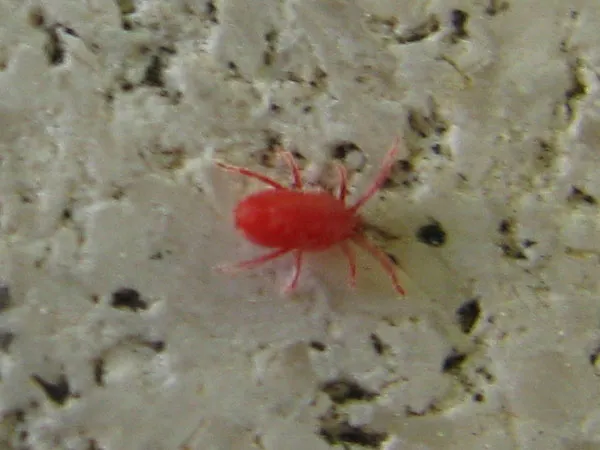
The two-spotted spider mite is an arachnid, not an insect. Adults are usually pale green, yellowish or gray with two dark lateral spots, although color varies and overwintering females may become orange-red. Individuals are about 1/50 inch long or smaller and usually require a hand lens for reliable detection.
Feeding occurs chiefly on leaf undersides. The mite removes cell contents with piercing-sucking mouthparts, leaving a characteristic stippled appearance. Many plant species can host it, and exact field identification may require magnification because other webspinning spider mites can look similar.
Symptoms and identification
Early damage consists of numerous tiny white, yellow or pale-green feeding spots, giving leaves a finely stippled, flecked or mottled appearance. As injury increases, foliage may become gray, bronzed, bleached or dry.
Fine silk webbing is often visible on leaf undersides and between leaves during larger outbreaks. Leaves may curl, distort, yellow, drop prematurely or fail to expand. Severe infestations stunt plants and can kill already stressed annuals or young plants. Similar stippling can result from drought, thrips or other mites, so inspect the undersides with a hand lens.
Causes and spread
Populations commonly build when high temperatures and low humidity combine with drought stress. Mites may move from dry weeds, crop residues or infested neighboring plants into vegetables, fruit crops and ornamentals. They can spread by walking, wind-assisted silk threads, plant handling, tools, clothing and movement of infested plant material.
Broad-spectrum insecticides may trigger outbreaks by destroying predatory mites and insects, while repeated use of the same miticide mode of action can select resistant populations. Distinguish this pest from other spider mites before making crop-management decisions.
Life cycle and persistence
Females lay tiny spherical eggs, commonly on leaf undersides and within colonies or webbing. Eggs hatch into six-legged larvae, followed by eight-legged protonymph and deutonymph stages, then adults. All active stages feed on plant tissue.
Development accelerates sharply in warm conditions: under favorable temperatures, a generation may be completed in roughly one to two weeks, allowing many overlapping generations during summer. In colder regions, females may overwinter in protected plant sites, bark crevices, litter, weeds or other sheltered locations; some populations enter diapause and become orange-red.
Treatment and control
Confirm active mites before treating. Inspect several leaves from different parts of the plant, because stippling may remain after mites have died and because predator mites can be mistaken for pests.
For light infestations, isolate affected plants, remove badly damaged foliage where practical and wash colonies from leaves with a directed water spray. Correct drought stress and reassess after several days.
If treatment is justified, choose a product legally labeled for the specific crop and site. Contact materials such as insecticidal soaps or horticultural oils require complete coverage of leaf undersides and do not provide lasting residual control. Test products on a small section first when crop sensitivity is uncertain, avoid applications to heat- or drought-stressed plants, and follow all label precautions. In commercial or greenhouse production, integrate compatible biological control and rotate modes of action according to the current label and local extension guidance.
Low-impact and biological control
Begin with frequent scouting every 3–5 days during hot, dry weather. Check lower leaves with a hand lens and shake foliage over white paper to detect moving mites. Remove badly infested annuals or isolated leaves when practical and discard them rather than composting heavily infested material.
- Use a firm water spray to wash mites and webbing from both leaf surfaces, especially undersides; repeat as needed without causing erosion or prolonged leaf wetness.
- Reduce plant stress with consistent irrigation, suitable mulch and good root-zone care. Do not overwater, and do not force drought-stressed plants with excess fertilizer.
- Conserve natural enemies by avoiding unnecessary broad-spectrum insecticides and providing diverse flowering habitat where appropriate.
- In greenhouses, use commercially available predatory mites such as Phytoseiulus persimilis when conditions and crop compatibility are suitable; releases work best before mite populations become extreme.
- Insecticidal soaps and horticultural oils can be useful low-residual options when the product label permits the crop and site. They require thorough contact coverage, particularly on leaf undersides, and may need repeat applications.
Prevention
Inspect new plants before bringing them indoors, into a greenhouse or into a production area. Quarantine suspicious material and examine leaf undersides, especially on plants with pale stippling or fine webbing.
- Maintain even irrigation and mulch around outdoor crops to reduce drought stress.
- Keep greenhouse plants adequately watered without creating root or foliar disease conditions.
- Control dry weeds and volunteer plants that can carry mites, while preserving non-crop vegetation that supports beneficial organisms where appropriate.
- Clean benches, tools and greenhouse areas, and remove severely infested plant debris.
- Scout systematically and record mite and predator abundance rather than treating solely by calendar date.
- Rotate legally labeled miticide modes of action in commercial production and follow the label’s resistance-management directions.
Interesting facts
Tetranychus urticae has an exceptionally broad host range and can infest hundreds of plant species, including food crops, landscape plants and greenhouse ornamentals.
Its apparent two spots are often dark internal contents visible through the body wall, not necessarily permanent surface markings. Heavy webbing is a late or high-density sign; damaging populations can be present before webbing is obvious.
Predatory mites, spider-mite destroyer lady beetles, six-spotted thrips, lacewings, minute pirate bugs and other natural enemies can suppress populations when they are conserved.
Use only products legally authorized and currently labeled for two-spotted spider mite control on the specific crop and use site in the United States. Follow the current label exactly, including crop, rate, reentry, preharvest, worker-protection and resistance-management requirements. Avoid routine broad-spectrum insecticides when possible because they can kill predatory mites and other natural enemies and may worsen outbreaks.
Affected plants
The plants below are linked to this problem by structured host-plant data. The list updates automatically as new plant profiles are added.