
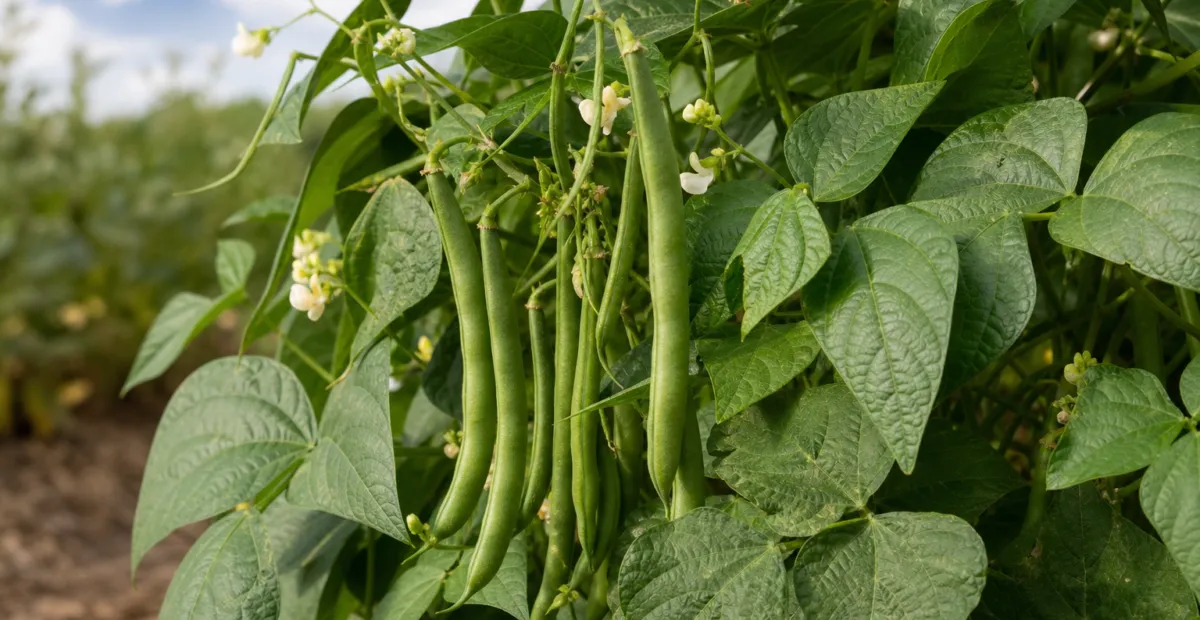
 AI-generated illustration
String Bean (Phaseolus vulgaris) short overview
String Bean, Phaseolus vulgaris, is a warm-season annual legume grown in the United States for tender snap pods, shell beans, and mature dry seeds. Cultivars may form compact bushes or twining vines that need trellising. Plants grow fastest in full sun, fertile well-drained soil, and consistently warm conditions. The species is native to tropical America and includes an exceptionally broad range of edible bean types, pod colors, seed patterns, and growth habits.
Taxonomic classification
String Bean (Phaseolus vulgaris) care guide
Light and placement
Give plants at least 6–8 hours of direct sun, preferably in a south- or west-facing bed or container. Pole types need a sunny trellis with good air movement. Pale, stretched growth and sparse flowering indicate insufficient light; scorched leaves or severe midday wilt suggest heat or root-zone moisture stress rather than a need for shade.
Watering and humidity
Water deeply when the top inch of soil begins to dry, aiming for about 1 inch of water per week from rain or irrigation. Increase frequency in sandy soil, containers, and hot weather; reduce only when rainfall keeps the root zone evenly moist. Water at the soil surface and avoid wetting foliage late in the day to reduce disease spread.
Soil and growing medium
Use loose, fertile soil that drains promptly but holds steady moisture. Incorporate mature compost before planting, especially in sandy or depleted ground. Avoid waterlogged clay and heavy applications of fresh manure. A slightly acidic to neutral reaction supports nutrient availability; raised beds or containers help where drainage is poor.
Feeding
Mix compost into the planting area before sowing. If growth is weak, use a balanced vegetable fertilizer at the label rate after establishment, but avoid high-nitrogen feeding that produces leaves and vines at the expense of pods. Do not fertilize drought-stressed, waterlogged, or visibly diseased plants until the underlying problem is corrected.
Growth and habit
Cultivars range from compact bush plants to twining pole vines. Bush beans tend to produce a concentrated crop, while pole types climb supports and can flower and set pods over a longer period. Install trellises before or at sowing, harvest pods frequently, and use mulch to limit weeds without disturbing the shallow lateral roots.
Planting and repotting
Direct-sow after the soil has warmed; cold, wet soil can delay germination or rot seed. Place pole supports before sowing so roots are not disturbed later. Keep the seedbed evenly moist until emergence, then mulch lightly after seedlings establish. For continuous harvest, make successive bush-bean sowings about two weeks apart.
Container-grown plants are best sown directly into their final container. If transplanting is necessary, move seedlings very young with the root ball intact and avoid disturbing the taproot. Use a container at least 12 inches deep with drainage holes and provide support for pole types.
Propagation and pruning
Propagation
Propagate by seed. Direct-sow once soil has warmed, because bean roots dislike disturbance. Save seed only from mature, fully dried pods and keep cultivars separated if maintaining varietal purity, since occasional cross-pollination can occur.
Pruning
No routine pruning is needed. Guide pole vines onto their support and remove damaged or diseased growth with clean tools. Bush plants can be left intact; frequent pod picking is more useful than cutting back healthy foliage.
Overwintering
This annual is not winter-hardy. Remove spent plants after frost or crop completion and compost only disease-free material. In cold climates, save mature dry seed for the following season rather than attempting to overwinter living plants.
Uses
Grown in home gardens, containers, community plots, and commercial fields for fresh snap pods, shell beans, and dry beans. Pods are harvested immature; seeds are harvested fresh or fully dried for storage. Cook mature dry beans thoroughly because raw or undercooked seeds can cause illness.
Appearance
Leaves are alternate and trifoliolate, with broad, pointed leaflets. Stems may be erect, mounding, trailing, or twining, and pole forms climb by winding around supports rather than producing adhesive tendrils. Small pea-like flowers are followed by elongated pods whose color may be green, yellow, purple, or mottled depending on cultivar.
Flowering
Flowers are typical legume blossoms with a banner, wings, and keel enclosing the reproductive structures. Most cultivars are substantially self-pollinating, and flowering commonly occurs during the warm growing season. Excessive heat during bloom can reduce pod set, especially in pole beans, even when plants appear vigorous.
Pollination and visitors
Flowers commonly self-pollinate before or around opening, so animal visitors are not required for ordinary seed and pod production. Occasional insect visitation and outcrossing can occur, but the species should not be presented as a strongly pollinator-dependent crop.
Phaseolus vulgaris photos
Click any photo for a larger view. Source, author and license are shown separately.
Diseases and pests
Diseases
Common problems include bean common mosaic virus, bacterial blights, anthracnose, rust, and root rots. Use certified or disease-free seed, rotate away from beans, provide air circulation, avoid handling wet plants, and remove severely infected plants. Do not save seed from symptomatic plants.
Pests
Mexican bean beetles, aphids, leafhoppers, spider mites, cutworms, and slugs may damage foliage or seedlings. Inspect leaves regularly, use row cover over young plants where practical, handpick larger pests, and favor targeted controls only when monitoring shows damaging populations.
Related diseases and pests
Only Plant Doctor profiles whose host data indicate this plant may be affected are shown here.
 DiseaseBean common mosaicBean common mosaic virus (BCMV; Potyvirus phaseovulgaris)
 DiseaseBean AnthracnoseColletotrichum lindemuthianum
 DiseaseBean yellow mosaicBean yellow mosaic virus
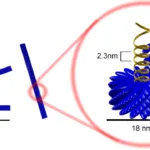 DiseaseTobacco mosaic virusTobamovirus tabaci
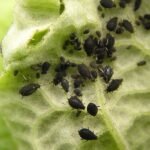 PestBlack Bean AphidAphis fabae
 PestBlack cutwormAgrotis ipsilon (Hufnagel, 1766)
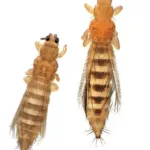 PestOnion thripsThrips tabaci Lindeman
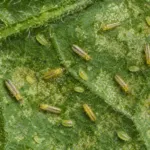 PestMelon thripsThrips palmi Karny
Toxicity and pollen
Mature seeds of some common-bean cultivars contain phytohaemagglutinin, a lectin that can cause nausea, vomiting, abdominal pain, and diarrhea when beans are raw or insufficiently cooked. Fresh snap pods are commonly eaten as food, but dry or shelled beans should be soaked as appropriate and boiled thoroughly; never eat raw dry beans.
- Typical season
- Late spring through summer in outdoor cultivation
- Pollination / pollen
- Heavy, relatively non-airborne pollen retained within the flower
The flowers are primarily self-pollinating and release relatively heavy pollen that is largely retained within the blossom rather than widely dispersed by wind. Allergy risk is therefore generally low, but sensitive people may still react to plant contact, flowers, or occupational exposure. This is separate from the food-safety risk of raw seeds.
Native habitat
The species derives from warm tropical and subtropical American environments and is now cultivated worldwide. It performs best in frost-free periods with warm soil, reliable moisture, and fertile but well-drained ground. Cultivated forms occupy diverse agricultural habitats, from compact garden beds to trellised field plantings.
Interesting fact
Phaseolus vulgaris includes fresh snap beans, shell beans, and many dry-bean market classes. Cultivars may be bush, climbing, or intermediate in habit. Like other legumes, common bean forms root associations with nitrogen-fixing bacteria, although nodulation and nitrogen contribution vary with soil and inoculation conditions.
Frequently asked questions (FAQ)
The most relevant questions about this plant, with short and direct answers.
🌱Quick care
What is a String Bean?⌄
A String Bean is the common garden form of Phaseolus vulgaris grown for edible snap pods, shelling beans, or mature dry beans. It is a warm-season annual in the United States.
How much sun does a String Bean need?⌄
String Beans need full sun, ideally at least 6 to 8 hours of direct sunlight daily. Insufficient light can reduce flowering, pod production, and plant vigor.
How often should I water String Beans?⌄
Water String Beans to maintain evenly moist soil, especially during flowering and pod development. About 1 inch of water per week is a useful general target, adjusted for rainfall, heat, and soil type.
Are String Beans annual or perennial plants?⌄
String Beans are warm-season annuals that complete their life cycle in one growing season. They are frost tender and usually die when exposed to freezing temperatures.
🌤️Environment and placement
What temperature is best for growing String Beans?⌄
String Beans grow best in warm soil and weather, with soil temperatures above about 60°F for direct sowing. Cold, wet soil can delay germination or cause seeds to rot.
What type of soil is best for String Beans?⌄
String Beans grow best in fertile, well-drained loam enriched with organic matter. Avoid heavy, poorly drained soil because excess moisture can contribute to root and seedling diseases.
Can String Beans grow in containers?⌄
String Beans can grow successfully in containers if the container has drainage, fertile potting mix, and sufficient root space. Bush types suit containers better, while pole types require a sturdy trellis.
Do String Beans need a trellis?⌄
Only pole or climbing String Beans need a trellis; bush varieties generally support themselves. Install supports before or at planting so developing roots are not disturbed later.
What is the difference between bush and pole String Beans?⌄
Bush String Beans are compact and usually produce a concentrated harvest, while pole String Beans climb supports and typically produce over a longer period. Choose based on available space and preferred harvest pattern.
Can String Beans tolerate frost?⌄
String Beans cannot tolerate frost and should be planted after the danger of freezing weather has passed. Protecting them from a light cold spell may help temporarily, but freezing temperatures usually cause severe damage.
💧Care and problems
Do String Beans need fertilizer?⌄
String Beans usually need only moderate fertilization when grown in fertile soil because legumes can obtain some nitrogen through root-associated bacteria. Excess nitrogen may produce abundant leaves but fewer pods.
How do I keep weeds away from String Beans?⌄
Control weeds with shallow cultivation or a layer of organic mulch around the plants. Avoid deep hoeing because String Beans can have roots close to the soil surface.
Why are my String Bean leaves turning yellow?⌄
Yellow String Bean leaves may result from overwatering, poor drainage, nutrient stress, disease, or insect feeding. Check soil moisture, root condition, leaf markings, and the undersides of leaves before choosing a treatment.
Why are my String Beans flowering but not producing pods?⌄
String Beans may flower without setting pods during extreme heat, drought, or other environmental stress. Keep soil evenly moist and avoid excessive nitrogen; pod set often improves when temperatures moderate.
What pests commonly attack String Beans?⌄
Common String Bean pests include Mexican bean beetles, leafhoppers, cutworms, armyworms, aphids, and bean leaf beetles. Inspect plants regularly and use the least-toxic control appropriate for the pest and its severity.
How can I prevent disease on String Beans?⌄
Use disease-free seed, rotate beans to a different garden area, provide good air circulation, and avoid working among wet plants. Remove diseased debris after harvest and avoid overhead watering when possible.
How often should I harvest String Beans?⌄
Harvest String Beans every day or every few days once production begins. Frequent picking prevents pods from becoming tough and encourages the plant to continue flowering and producing.
How do I know when String Beans are ready to pick?⌄
Pick String Beans when pods are full-sized, firm, crisp, and snap easily, but before the seeds visibly bulge inside. Harvest after the foliage has dried to reduce the spread of bacterial disease.
Can String Beans be harvested for dry beans?⌄
Yes, String Bean varieties can also be harvested for shelling or dry beans if the variety is suitable. Leave pods on the plant until they become yellow, dry, and brittle before removing and shelling them.
🪴Planting and repotting
When should I plant String Beans in the United States?⌄
Plant String Beans after the last expected spring frost, once the soil has warmed to at least about 60°F. Local planting dates vary by USDA hardiness zone and the length of the growing season.
Can I start String Beans indoors?⌄
String Beans are usually best direct-sown because their roots can be disturbed by transplanting. If you start them indoors, use biodegradable containers and transplant carefully while seedlings are still small.
How deep should I plant String Bean seeds?⌄
Plant String Bean seeds about 1 inch deep, or follow the depth on the seed packet for the specific variety. Planting too deeply in cool or wet soil can slow emergence and increase rot.
How far apart should I plant String Beans?⌄
Space String Bean seeds according to their growth habit and the seed packet, commonly about 2 to 4 inches apart within rows. Bush-bean rows often need roughly 18 to 36 inches between rows, while pole beans need room for support.
Can I succession-plant String Beans?⌄
Yes, succession planting bush String Beans every 2 to 3 weeks can extend the harvest. Stop sowing early enough for the final planting to mature before the first expected frost.
Should I rotate String Beans in the garden?⌄
Rotate String Beans away from locations recently used for beans or other legumes when practical. A rotation of at least two years can help reduce the buildup of some soilborne and bacterial diseases.
✂️Propagation and pruning
How are String Beans propagated?⌄
String Beans are propagated from seeds sown directly in warm garden soil. Save seed only from open-pollinated varieties if you want plants that reliably resemble the parent.
Can I save seeds from String Beans?⌄
You can save seeds by leaving healthy pods on the plant until they are fully dry, then shelling and drying the seeds further. Do not save seed from diseased plants, and remember that cross-pollination can affect saved seed from some varieties.
Do String Beans need pruning?⌄
String Beans generally do not need pruning. Remove damaged or diseased foliage, guide pole vines onto their support, and harvest pods regularly instead of cutting back healthy growth.
⚠️Toxicity and safety
Are String Beans safe to eat raw?⌄
String Beans are safest when cooked rather than eaten raw or undercooked. Phaseolus vulgaris can contain lectins, and adequate cooking reduces the risk of gastrointestinal illness, particularly in mature or dried beans.
Can dogs or cats eat String Beans?⌄
Plain, thoroughly cooked String Beans are generally considered a low-risk treat for many dogs and cats, but they should be served without salt, onions, garlic, or sauces. Consult a veterinarian if your pet eats raw beans or develops symptoms.
Are String Bean plants toxic to people?⌄
String Bean plant material and beans may be harmful when raw or undercooked because Phaseolus vulgaris can contain naturally occurring lectins. Cook beans thoroughly and seek medical advice if someone develops vomiting, diarrhea, or severe abdominal pain after eating them.
🌸Flowering and special interest
When do String Beans flower?⌄
String Beans usually flower after establishing several sets of leaves, with timing varying by variety and growing conditions. Pole types often continue flowering and producing pods longer than bush types.
Do String Beans need pollinators?⌄
String Bean flowers are generally self-pollinating, so they do not require a separate pollinator plant to produce pods. Bees and other insects may visit the flowers, but successful pod set can occur without heavy insect activity.
Similar plants
 Azure Monkshood (Aconitum carmichaelii) care guideAconitum carmichaelii
 Monkshood (Aconitum ‘Stainless Steel’)Aconitum 'Stainless Steel'
 Monkshood (Aconitum ‘Bressingham Spire’)Aconitum 'Bressingham Spire'
 Golden full moon maple (Acer shirasawanum ‘Aureum’)Acer shirasawanum 'Aureum'
 Globosum (Acer platanoides ‘Globosum’)Acer platanoides 'Globosum'
 Striped maple (Acer pensylvanicum) care guideAcer pensylvanicum