
Mediterranean corn stalk borer
Sesamia nonagrioides LefèbvreMediterranean corn stalk borer overview
The Mediterranean corn stalk borer, Sesamia nonagrioides, is a noctuid moth whose larvae tunnel inside maize stems and can also develop on selected sorghum and grass hosts. It is principally a Mediterranean-basin and warm-region cereal pest, not a routinely established U.S. garden pest. Early injury may cause deadheart, while later feeding produces galleries, frass, weak stalks, lodging and yield loss. Similar damage from other corn borers is common, so confirmation matters.
Typical conditions
Overview
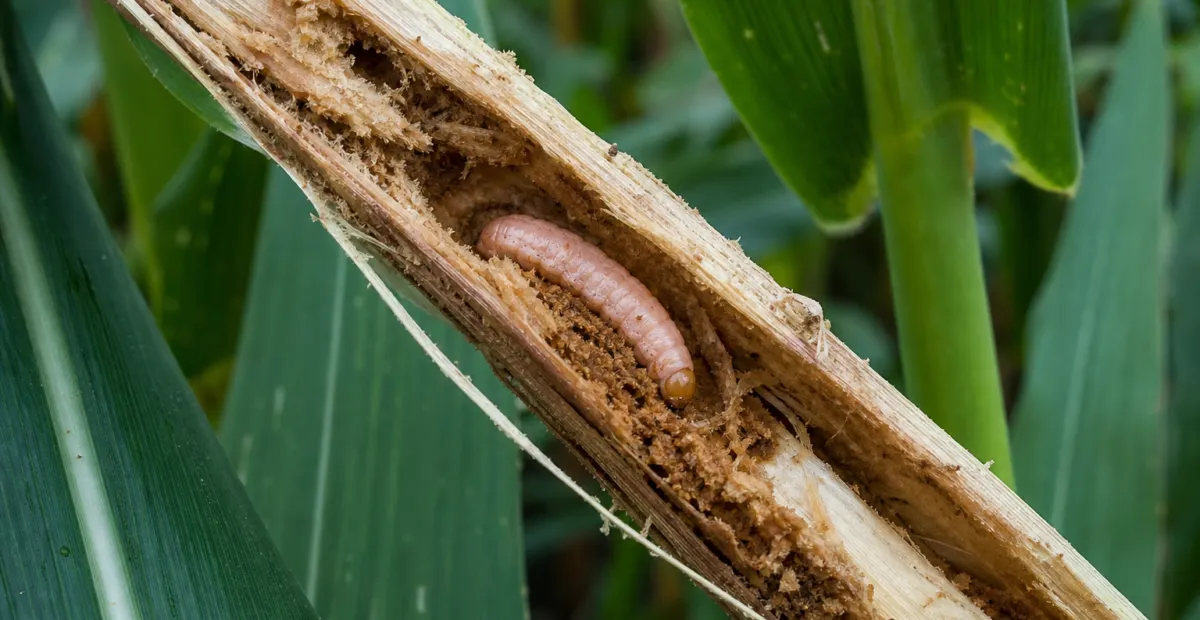
Larvae initially feed around the whorl, leaf axils or inside leaf sheaths, then bore into the stalk and feed in the pith. On young maize, basal injury can kill the growing point and produce deadheart. On older plants, galleries weaken stems, interfere with transport, promote premature senescence and increase the risk of stalk breakage or lodging. Damage can resemble European corn borer and other stalk borers, so larval or adult confirmation is preferable to diagnosis from symptoms alone.
Symptoms and identification
Look for small holes at the lower stalk or beneath leaf sheaths, frass or sawdust-like material around entry points, and internal galleries when the stalk is split. Young plants may show a dead central whorl, wilted emerging leaves, delayed growth or groups of dying plants. Older maize may develop stalk tunneling, weakened nodes, premature leaf senescence, ear or tassel injury, broken stems and lodging.
Egg clusters are usually concealed in tight spaces between the stalk and leaf sheath. Pale pink to pinkish-yellow caterpillars may be found inside the stem. These signs are not unique to S. nonagrioides; European corn borer, southwestern corn borer and other stem borers can cause similar injury.
Causes and spread
Populations spread when adult moths fly into new fields and lay eggs in maize, sorghum or suitable grass hosts. Local buildup is encouraged by continuous cereal production, volunteer plants, unmanaged Johnsongrass, overlapping crop generations and infested stalk residue that shelters overwintering larvae. Movement of infested whole stalks, nursery material or plant debris can also assist short-distance transport. The insect is not a seed-transmitted pathogen.
Life cycle and persistence
Adults are nocturnal moths that lay eggs in protected gaps between leaf sheaths and stems. Newly hatched larvae feed briefly on exposed or sheltered plant tissue before entering the stalk, where they are protected from many contact treatments. Larvae tunnel through the pith and may move between internodes. In Mediterranean climates, two to four generations may occur, but the number varies with temperature, latitude, host availability and season. Mature larvae commonly overwinter inside maize stubble or other host stems, pupate there or nearby, and emerge as moths during the following warm period.
Treatment and control
First confirm that the injury is caused by a stem borer and, where possible, identify the species. Remove and destroy isolated infested plants in small plantings before larvae mature. In commercial fields, management must be timed against egg hatch and very young larvae, before they tunnel deeply into the stalk; scouting, pheromone traps and local degree-day or extension advisories can help determine timing. Once larvae are inside the stem, control is substantially more difficult.
For U.S. growers, use only a currently labeled product or approved Bt trait for the specific crop and pest situation. Do not apply a general corn-borer treatment based solely on the name Sesamia, because registrations, crop labels and state restrictions differ and this species is not a routine U.S. field diagnosis.
Low-impact and biological control
Use an integrated approach rather than relying on a single treatment. Remove and destroy heavily infested stalks after harvest; finely shred or incorporate residue where appropriate so larvae cannot remain protected in standing stems. Control volunteer maize and manage nearby Johnsongrass or other suspicious grass reservoirs without allowing erosion or creating new habitat.
- Scout leaf axils, whorls and lower stalks regularly during periods of adult activity.
- Use pheromone trapping where locally validated to detect flight periods and improve timing.
- Maintain plant vigor with balanced fertility, irrigation and weed management, while avoiding excessive nitrogen that can produce lush, vulnerable growth.
- Conserve naturally occurring parasitoids and predators by limiting broad-spectrum sprays and protecting flowering habitat outside the crop.
- Commercial biological-control products or parasitoid releases should be used only when registered or otherwise legally permitted for the intended use and supported by local recommendations.
Prevention
- Rotate maize with a non-host crop where practical, especially in areas with recurring damage.
- Harvest promptly and destroy or thoroughly manage maize residue rather than leaving tall stubble that can harbor larvae.
- Remove volunteer maize and suppress Johnsongrass around production fields.
- Plant adapted, locally recommended hybrids; where available and legally approved, use resistant or Bt maize as part of an insect-resistance-management plan with required refuge compliance.
- Inspect young plants and leaf sheaths for egg masses, deadheart and fresh frass before larvae enter the stalk.
- Do not move suspicious infested plant material across state or national boundaries without checking current plant-health requirements.
- For a suspected U.S. occurrence, retain clear photographs and a specimen if safe, and contact the state department of agriculture, cooperative extension office or USDA APHIS.
Interesting facts
- Maize is generally a much better developmental host than the alternative plants tested in comparative studies.
- Females may accept unsuitable plants for egg laying even when larvae cannot complete development, so reported host lists can be broader than the list of hosts that sustain populations.
- Johnsongrass can support development and may act as a local reservoir near maize fields.
- The pest is often confused with Ostrinia nubilalis, the European corn borer, which requires different diagnostic confirmation and may have different seasonal timing.
- In the United States, a suspected finding is more significant as a plant-health detection than as an ordinary home-garden diagnosis.
Use insecticides, Bt crop technologies or seed treatments only when the specific product is legally authorized for the crop and pest in the United States and in the relevant state. Follow the current label exactly, including crop, timing, rate, worker-protection, pollinator and preharvest requirements. Once larvae have entered the stalk, contact treatments are often unreliable; professional diagnosis and local extension guidance are recommended.