
Poplar Leaf Rust
Melampsora larici-populina KlebahnPoplar Leaf Rust overview
Poplar leaf rust is a wind-dispersed fungal disease caused by Melampsora larici-populina. It primarily affects Populus species and hybrids, producing yellow leaf spots above and orange, powdery spore pustules below. Repeated infections can cause premature defoliation, reduced growth and increased winter injury, especially in dense, humid plantings. Accurate identification matters because several Melampsora species cause similar rust symptoms in the United States.
Typical conditions
Overview
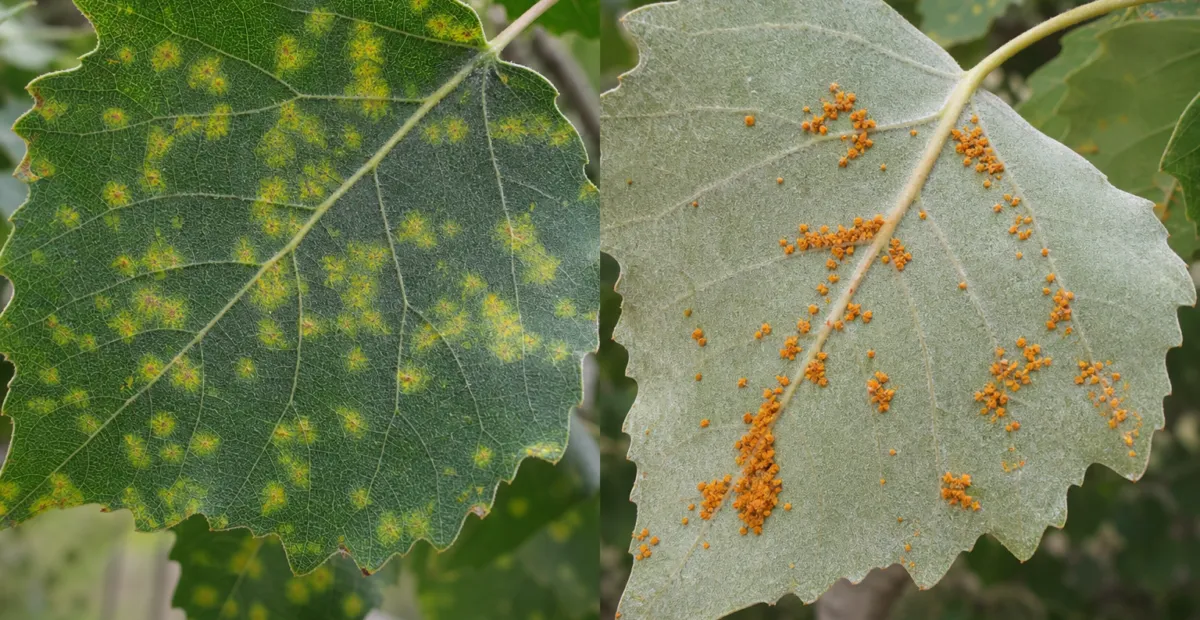
Poplar leaf rust is most recognizable by yellow to pale-brown spots on the upper leaf surface and orange-yellow, powdery pustules on the underside. Severe disease causes chlorosis, necrosis, early leaf drop and reduced seasonal growth. Young poplars, susceptible clones and trees in crowded nursery or plantation settings are at greatest risk.
The pathogen is a specialized rust fungus rather than a soilborne rot. Finding orange spores supports a rust diagnosis, but species-level identification may require urediniospore characters, host information and laboratory testing.
Symptoms and identification
- Small yellow, yellow-orange or pale-brown spots develop on the upper surface of poplar leaves.
- Bright orange to yellow, powdery uredinia form mainly on the underside; spores may rub onto a white cloth.
- Spots enlarge or become necrotic, and leaves may yellow, curl, dry and drop prematurely.
- Repeated or severe defoliation reduces height and diameter growth and can delay hardening-off, increasing vulnerability to winter injury.
- Late-season dark-brown to black crust-like telia may replace the orange uredinia on aging leaves.
Symptoms alone do not reliably distinguish M. larici-populina from other poplar rusts. Microscopic examination or molecular confirmation is advisable for unusual outbreaks, breeding material, interstate nursery stock or suspected new introductions.
Causes and spread
The disease spreads chiefly through windborne spores. Fallen infected poplar leaves can supply spring basidiospores, while nearby larches may support the alternate phase and generate aeciospores that return to poplars. Once orange uredinia appear, repeated urediniospore cycles can move through a planting and between nearby trees.
- Susceptible clones planted in monoculture or tight rows create a continuous host supply.
- Rain, dew, fog and high humidity support spore germination and infection when foliage remains wet.
- Wind can carry spores beyond the original tree, so removing one infected poplar may not stop an established regional source.
- Moving infected nursery stock or foliage can introduce the pathogen to new plantings.
Life cycle and persistence
This is a heteroecious, macrocyclic rust with five recognized spore stages. It normally alternates between poplar and larch.
- Telia overwinter on fallen poplar leaves. In spring, they produce basidiospores that are carried by wind to newly expanding larch needles.
- On larch, spermogonia and then yellow blister-like aecia develop. Aeciospores are released and carried back to poplar.
- On poplar leaves, aeciospores initiate orange uredinia. Urediniospores can repeat infection cycles during humid portions of summer and early fall.
- As leaves age, telia develop, and infected fallen leaves provide the overwintering stage for the next cycle.
In some regions, the fungus may also persist as mycelium or uredinial tissue in evergreen poplar foliage, so the classic two-host cycle is not the only possible survival route.
Treatment and control
For established landscape poplars, treatment is mainly aimed at protecting healthy new foliage and preventing repeated severe defoliation; leaves already covered with pustules will not be restored.
- Remove only severely affected leaves or small shoots when this can be done without excessive pruning or loss of canopy, and dispose of the material rather than leaving it beneath the tree.
- Correct crowding, poor airflow, drought stress and irrigation practices.
- In nurseries, plantations or high-value collections with a recurring history of damaging rust, coordinate a preventive fungicide program with a licensed applicator, extension specialist or plant-health professional.
- Timing, active ingredient, number of applications and resistance-management requirements must come from a current U.S. label and local recommendations; do not wait until extensive defoliation has occurred.
- Reassess the diagnosis if pustules are absent, symptoms are confined to veins or shoots, or the pattern does not match a foliar rust.
Low-impact and biological control
No reliably curative, broadly validated home-garden biological treatment should be assumed for this disease. Organic and low-input management is therefore primarily preventive and cultural.
- Plant documented rust-resistant or less susceptible poplar clones suited to the local U.S. climate and site.
- Rake and remove fallen poplar leaves where practical, particularly in nurseries and small plantings; compost only through a process that reliably destroys infected plant material.
- Thin crowded volunteer poplars and prune only as needed to improve airflow. Avoid unnecessary pruning wounds and disinfect tools between diseased plants when moving through a collection.
- Use drip or ground-level irrigation rather than wetting foliage, and irrigate early enough for leaves to dry.
- Reduce plant stress with appropriate soil moisture, mulch kept away from trunks, and site-appropriate fertility; healthy growth does not replace host resistance.
- Biological rust antagonists such as Sphaerellopsis and naturally occurring leaf-surface microbes have research interest, but consistent homeowner-level control is not established.
Prevention
- Choose resistant or tolerant poplar cultivars with performance data from a comparable U.S. region; resistance is clone- and pathogen-population-dependent.
- Inspect leaves weekly during humid spring and summer weather, focusing on lower leaf surfaces and the newest foliage.
- Space trees and nursery rows to promote air movement, and avoid overhead irrigation.
- Remove and dispose of heavily infected fallen leaves before the next spring infection period where feasible.
- Use clean, inspected nursery stock and isolate new poplar material until it has been monitored through a period of active growth.
- Where plantation design allows, assess whether nearby larches are contributing to the disease cycle; do not remove established trees without considering habitat, legal and safety issues.
- Record the cultivar, date, weather pattern and symptom progression. Submit representative samples to a university plant clinic or state diagnostic laboratory when species confirmation matters.
Interesting facts
- The species name reflects its association with larches (Larix) and poplars (Populus).
- The poplar stage can multiply clonally through repeated urediniospore cycles, allowing disease levels to increase rapidly during favorable weather.
- Larch usually shows limited damage compared with susceptible poplar clones, but it is important epidemiologically because it supports the sexual phase.
- Poplar rust populations vary genetically and pathogen races can overcome resistance in previously successful clones.
- Several Melampsora species occur on poplars in North America, so a photograph-based identification should be treated as provisional.
Use fungicides only when the product is legally authorized for poplar, the specific production site and this disease in the United States. Follow the current EPA-approved label exactly, including rate, timing, personal protective equipment, reentry interval and restrictions for nursery, landscape or forest use. Do not apply a product solely because it is labeled for another rust disease or another crop.