
Rhizoctonia Diseases
Rhizoctonia solani KühnRhizoctonia Diseases overview
Rhizoctonia solani is a soilborne fungus that causes damping-off, wirestem, root and crown rot, stem and stolon canker, aerial blight, and tuber or fruit blemishes. Disease expression varies greatly among fungal anastomosis groups and host plants. Young tissues are most vulnerable, especially when contaminated soil, plant debris, crowded growth, poor drainage, or prolonged leaf and soil moisture favor infection.
Typical conditions
Overview
Rhizoctonia solani is a filamentous soilborne fungus and decomposer that survives in soil, crop residue, thatch, infected plant material and, in some crops, on seed or planting material. It does not produce airborne spores as its primary means of spread. Instead, hyphae and persistent sclerotia contact susceptible tissue and grow through moist soil or plant surfaces.
The name covers genetically and biologically diverse populations grouped into anastomosis groups, or AGs. Disease name, host range, temperature preference and management response can therefore differ among crops. In home gardens, the most recognizable problems are seedling damping-off and root or crown rot; in potatoes, stem and stolon canker and black scurf are important forms.
Symptoms and identification
Symptoms depend on host, age, tissue and AG type. Common signs and symptoms include:
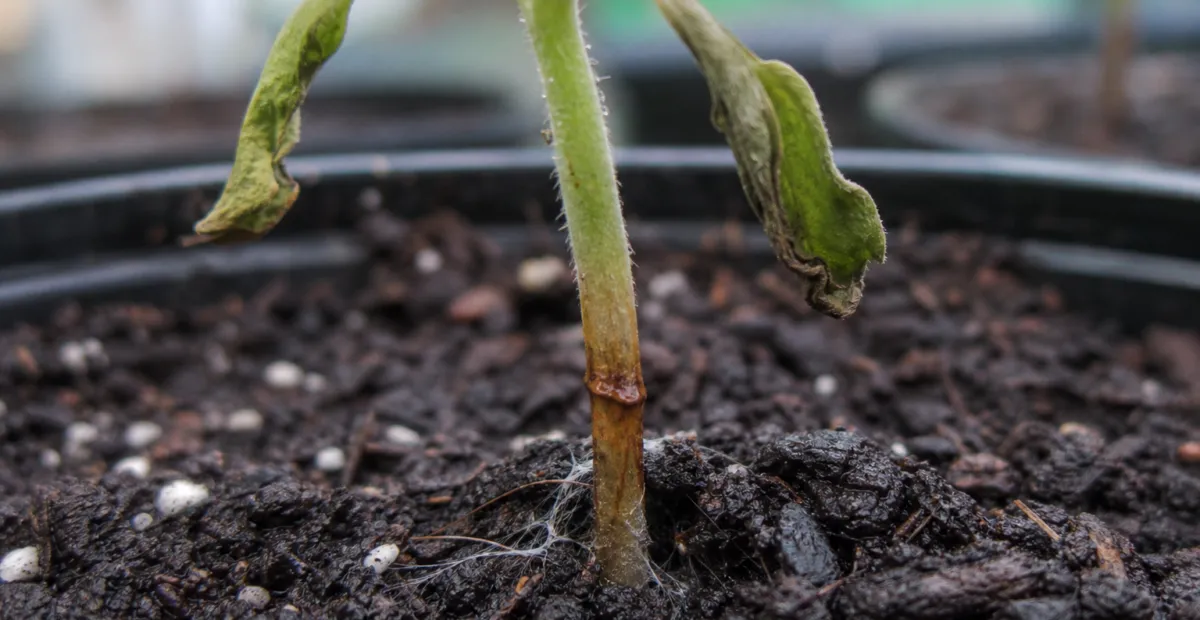
- Seeds decay or fail to emerge; emerged seedlings develop water-soaked, tan, reddish-brown or gray-brown lesions at the soil line and may collapse.
- Young stems may become constricted and remain as a thin, fibrous “wirestem.” Roots can be sparse, necrotic, sunken or rotted.
- Older plants may show stunting, wilting, yellowing, purpling, poor vigor, crown necrosis or uneven stands.
- Potato stems and stolons may develop reddish-brown sunken cankers; tubers may carry irregular black sclerotia known as black scurf.
- Some isolates cause aerial blight or fruit and foliage lesions, while turfgrass infections produce irregular brown patches or rings.
White, cobweb-like fungal growth may occasionally be visible in humid conditions, but its absence does not rule out the disease. Aboveground symptoms alone are not diagnostic.
Causes and spread
Inoculum is commonly introduced or redistributed in infested soil, plant debris, contaminated trays, tools, footwear, irrigation water, transplants, seed pieces and tubers. The fungus is a strong saprophyte and can persist by feeding on decomposing organic matter. It may attack tissue directly when hyphae contact a susceptible host, especially at the soil line or where plant tissue remains wet.
Spread is favored by moving contaminated soil, planting infected material, leaving diseased residue in place, and repeatedly growing susceptible crops in the same bed. The exact risk depends on the AG and crop; a population adapted to potato, for example, may not reproduce effectively on unrelated hosts.
Life cycle and persistence
Rhizoctonia solani survives between crops mainly as dark, melanized mycelium and sclerotia in soil, crop residue, thatch or infected planting material. When a susceptible host and favorable moisture are present, hyphae grow across the soil or plant surface. They may penetrate through natural openings or specialized structures called infection cushions, then colonize and kill plant cells.
After disease develops, the fungus can return to saprophytic growth on dead tissue and form new sclerotia. Disease is usually most severe while seedlings, sprouts, hypocotyls, roots, crowns, stolons or other juvenile tissues are vulnerable. Temperature preferences vary among AGs and hosts: cool, wet soil favors some seedling and potato diseases, while warm, humid conditions favor certain turf and foliar forms.
Treatment and control
There is no reliable cure for a badly girdled seedling, collapsed crown or advanced root rot. Remove affected seedlings and badly diseased plants with surrounding contaminated media or soil, and correct the moisture, drainage, sanitation or planting-depth problem that allowed infection. Replant only with healthy material in clean, well-drained media or a prepared bed.
For established plants, protect remaining tissue by reducing prolonged wetness, improving drainage and avoiding unnecessary root injury. In potatoes, use clean seed tubers, encourage rapid emergence and avoid leaving mature tubers in the soil longer than necessary after vine desiccation when black scurf or stem canker is a concern.
Because Rhizoctonia symptoms overlap with other soilborne diseases, consider a diagnostic laboratory when losses are significant, symptoms recur, or treatment decisions depend on identifying the pathogen and likely AG.
Low-impact and biological control
Organic and low-input management is primarily preventive and cultural. Use new or properly sanitized containers and fresh soilless propagation media; avoid reusing contaminated potting mix. Improve bed drainage, use raised beds where appropriate, reduce compaction, remove diseased plants promptly and manage irrigation carefully.
Biological products containing beneficial fungi or bacteria may reduce Rhizoctonia in some crops and production systems, but performance is strain-, crop-, soil- and label-dependent. Select only products registered for the intended use in the United States and follow the label. Well-matured compost can support biological activity, but it is not a dependable stand-alone treatment for heavily infested soil.
Prevention
- Start seeds in clean, well-drained, fresh propagation media using sanitized trays, pots and tools.
- Avoid overwatering, standing water, deep transplanting and dense, poorly ventilated growth. Water at the root zone and allow the surface to dry appropriately between irrigations.
- Use certified, vigorous, disease-free seed, transplants and potato seed tubers. Reject potato tubers with substantial black scurf or suspicious lesions.
- Remove severely diseased seedlings and plant debris; do not move contaminated soil between beds on tools, footwear or equipment.
- Improve drainage, reduce compaction and manage thatch. Rotate susceptible crops where practical, while recognizing that rotation is less effective when the relevant AG has a broad host range.
- For potatoes, promote rapid emergence by planting into suitable soil conditions, avoiding excessively early planting into cold soil, and preventing overwatering.
Interesting facts
- Rhizoctonia solani is not one uniform biological population; anastomosis groups differ in host preference, symptoms and environmental requirements.
- The potato form commonly called black scurf is produced by hardened fungal structures on the tuber surface, not by insect feeding.
- Many Rhizoctonia isolates are harmless decomposers, so finding Rhizoctonia-like hyphae does not automatically prove that it caused the observed disease.
- The pathogen is primarily soil- and residue-borne rather than dependent on wind-dispersed spores.
- Some diseases caused by R. solani affect only juvenile tissue, which is why rapid, uniform emergence can greatly reduce losses in crops such as potato.
Use fungicides only when the product is legally authorized for Rhizoctonia solani or the applicable disease on the specific crop and site in the United States. Follow the current label for crop, application timing, rate, personal protective equipment, reentry interval, preharvest interval and resistance-management requirements. Chemical treatment is most useful as part of an integrated program and may perform poorly when soil inoculum is high, the diagnosis is wrong, or cultural conditions remain favorable.