
 Source:
 Barley scald
Rhynchosporium communeBarley scald overview
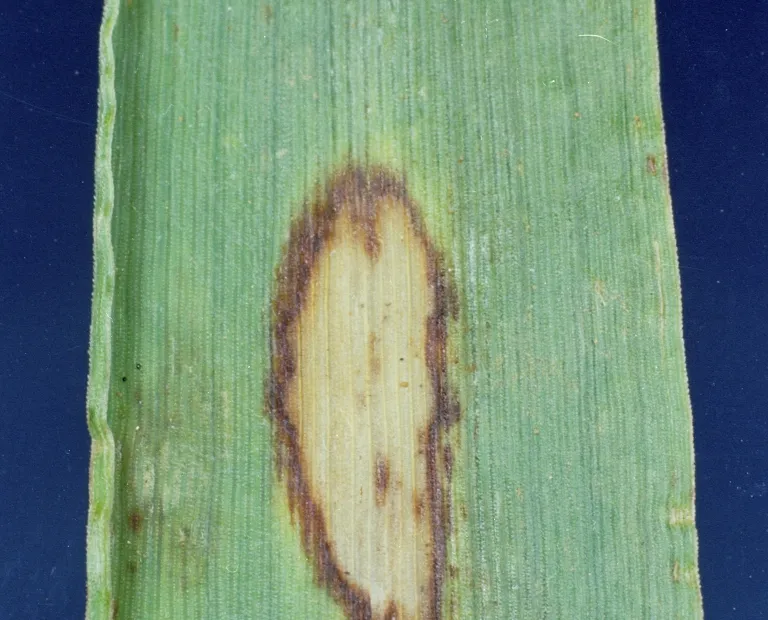
Barley scald is a cool-weather fungal leaf disease caused by Rhynchosporium commune, formerly often identified as R. secalis. It produces water-soaked gray-green lesions that become pale tan or straw-colored with dark brown margins, then merge and kill foliage. The disease is most important in wet barley-growing regions and can reduce grain yield and quality when upper leaves are damaged.
Typical conditions
Overview
Barley scald, also called leaf scald, is a foliar disease of barley caused by Rhynchosporium commune. The pathogen is especially important in cool, humid and rainy barley-growing areas, including parts of the United States. Disease severity varies with cultivar resistance, residue carryover, planting pattern and weather.
Older US and international extension references frequently use Rhynchosporium secalis. Because taxonomy and host specialization within the genus have been revised, laboratory confirmation may be needed when the exact species or host range matters.
Symptoms and identification
Early lesions are usually water-soaked, oval or lens-shaped, and gray-green to bluish gray. As they mature, centers become pale gray, tan or straw colored and develop a conspicuous dark brown margin. Lesions are generally not restricted by leaf veins.
- Lesions enlarge and merge into irregular bleached blotches.
- Leaf tips and sections beyond girdling lesions may collapse and die.
- Leaf sheaths are commonly affected; glumes, awns, heads and grain may be affected during severe or prolonged wet weather.
- Lower leaves often show the earliest and heaviest damage, but rapid epidemics can later reach upper canopy leaves.
Scald can resemble herbicide injury, frost damage, nutrient disorders and other cereal blotches. Field distribution, crop history and laboratory diagnosis should be considered when symptoms are atypical.
Causes and spread
The principal inoculum source is infected barley residue and volunteer barley. The fungus produces asexual conidia on infected tissue. Rain and irrigation splash move spores from residue or diseased lower leaves to nearby green tissue, allowing repeated infections up the canopy.
Infected seed or seedborne contamination can contribute to early disease, but residue and volunteer hosts are generally more important sources in field epidemics. Continuous barley, short rotations, dense canopies and reduced-tillage systems that leave infected residue on the soil surface increase risk.
Life cycle and persistence
Rhynchosporium commune survives between crops mainly as mycelium and viable inoculum on infected leaves, straw, stubble and volunteer barley. Under cool, wet conditions, it resumes growth and forms two-celled, colorless conidia in a surface film on lesions.
Rain splash carries conidia to new leaves, sheaths and occasionally heads. The disease is polycyclic: several infection cycles may occur during one season when foliage remains wet for extended periods. Symptoms can lag behind infection, so substantial pathogen development may occur before lesions are obvious. Hot, dry weather generally suppresses disease progress.
Treatment and control
Management is most effective when integrated. In commercial barley, consider a labeled foliar fungicide only when disease risk, crop growth stage, weather and the value of protecting the upper canopy justify treatment. Fungicides protect healthy tissue better than they restore leaves that are already extensively blighted.
- Prioritize protection of the upper canopy, especially the flag and second leaves, when disease is actively moving upward.
- Use products and rates permitted for barley and the specific disease in the United States.
- Follow resistance-management guidance, including label requirements concerning fungicide group rotation or mixtures.
- Do not rely on a late application after widespread leaf death.
For home or small-scale plantings, remove badly infected volunteer plants and avoid overhead irrigation. Once a barley crop is near maturity, sanitation and rotation planning are usually more useful than attempting to rescue severely damaged foliage.
Low-impact and biological control
No consistently reliable organic treatment eradicates established barley scald. The strongest nonchemical approach combines resistant varieties, crop rotation, clean seed, volunteer control and residue management.
- Use certified seed from a low-disease source.
- Rotate out of barley for at least one season where feasible.
- Manage infected residue by appropriate incorporation, decomposition or removal according to local soil-conservation practices.
- Reduce prolonged leaf wetness by avoiding unnecessary overhead irrigation and improving canopy airflow where practical.
- Monitor for symptoms early; biological products should be considered experimental unless specifically supported and legally labeled for the crop and disease.
Prevention
- Plant certified, high-quality seed and use cultivars with the best locally available scald resistance.
- Rotate barley with nonhost crops where practical, especially after a heavily diseased crop.
- Avoid planting directly into heavily infected barley residue when alternatives are available.
- Control volunteer barley and susceptible grass hosts around fields and planting areas.
- Use appropriate seeding rates and fertility practices to avoid excessively dense, humid canopies.
- Inspect lower leaves and field hotspots during cool, wet weather so management decisions are timely.
Resistance is not permanent: pathogen populations and cultivar reactions vary by region, so current regional variety and disease-management information is important.
Interesting facts
- The familiar name “barley scald” reflects the bleached, scorched appearance of coalescing lesions rather than heat injury.
- Rhynchosporium commune is a haploid fungus that produces distinctive beak-shaped, one-septate conidia.
- Visible symptoms may appear after a relatively long symptomless phase, allowing several pathogen generations before the crop looks severely diseased.
- Yield loss is strongly influenced by damage to upper leaves because those leaves contribute substantially to grain filling.
- Older references may call the pathogen R. secalis; this nomenclatural difference should be considered when comparing regional disease reports.
Use only fungicide products legally authorized in the United States for barley and barley scald or the applicable crop-disease use. Always follow the current EPA-approved label, including rate, timing, personal protective equipment, preharvest interval, rotational restrictions and resistance-management instructions. Product registrations and labels can change; consult your state extension service and current label before use.