
Black Rot of Grape
Phyllosticta ampelicida (formerly Guignardia bidwellii)Black Rot of Grape overview
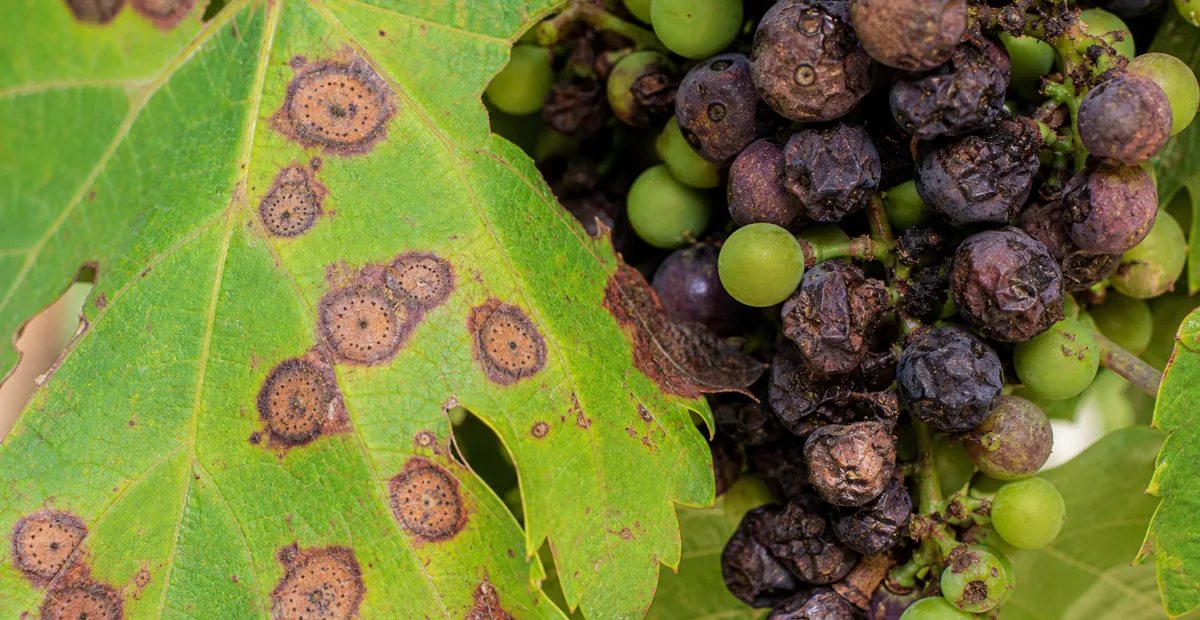
Black rot of grape, associated with the fungus currently known as Phyllosticta ampelicida and formerly Guignardia bidwellii, is a destructive disease of grapevines in warm, humid regions of the United States. Small tan leaf lesions may develop before infected berries turn brown, black, and hard, forming spore-producing “mummies.” Removing inoculum and protecting young tissues early in the season are essential.
Typical conditions
Overview
Black rot is one of the most important grape diseases in the eastern and central United States, where warm, humid weather and frequent rainfall favor infection. The pathogen attacks green grape tissues, with the greatest crop risk occurring when young berries and clusters are exposed during the period from early shoot growth through several weeks after bloom.
Leaf symptoms can resemble other grape leaf-spot diseases, so diagnosis should consider lesion shape, the presence of black pycnidia, fruit mummies, cultivar susceptibility, and weather history. Laboratory confirmation may be useful when symptoms are atypical or mixed infections are suspected.
Symptoms and identification
On young leaves, symptoms begin as small pale yellow, tan, or cream spots that enlarge into roughly circular reddish-brown or tan lesions, often with a darker purple-brown margin. Mature lesions may contain tiny black, pimple-like pycnidia, sometimes arranged in a loose ring near the margin. Numerous lesions can deform or prematurely senesce leaves.
Petiole, shoot, rachis, and tendril infections appear as dark, sunken or elongated lesions and may cause tissue girdling or shoot wilt. Blossom and cluster infections can remain inconspicuous until berries enlarge.
Infected berries commonly develop a small pale or brown spot, then turn brown, black, and shriveled. They may collapse within days and become hard, black “mummies” covered with black fruiting bodies. Affected berries may occur sporadically within an otherwise apparently healthy cluster.
Causes and spread
Spread begins when rain or irrigation wets overwintered mummies and infected tissue, releasing spores. Splashing water and wind-driven rain move spores to young grape leaves, shoots, flowers, and clusters. Lesions formed early in the season can produce secondary spores, so repeated wetting rapidly increases disease pressure.
Retained black mummies in the canopy are particularly hazardous, while dense foliage prolongs drying and shields infected tissue from sanitation. Warm temperatures near 65–80°F combined with prolonged leaf wetness are especially favorable, although exact infection requirements depend on tissue age and environmental conditions.
Life cycle and persistence
The fungus survives between seasons mainly in mummified berries and also in infected canes, tendrils, rachises, and other retained grape tissue. Fruiting bodies in this material produce airborne ascospores and rain-dispersed conidia.
Spring rain releases spores that infect young expanding leaves and other green tissues. After an incubation period, lesions produce pycnidia and additional conidia, allowing repeated secondary infections during wet weather. Infected berries become mummies that remain important inoculum sources. Young tissues are most susceptible; grape berries generally become considerably less susceptible several weeks after bloom, although the timing varies with cultivar and development.
Treatment and control
Remove and destroy infected berries, clusters, leaves, and accessible diseased tissue as soon as practical; do not leave black mummies hanging in the canopy or on the ground beneath the vine. Removal reduces inoculum but does not cure tissue that is already infected.
For valuable vines or recurring outbreaks, use a locally appropriate, preventive fungicide program beginning before or around bloom and continuing through the period when young berries are susceptible. Exact products and intervals depend on the state, grape type, production system, disease pressure, resistance-management needs, and current label. Once berries have become black mummies, sprays cannot reverse the damage.
After a severe outbreak, sanitation during dormancy and a stronger preventive program the following spring are usually more effective than attempting to rescue heavily diseased clusters late in the season.
Low-impact and biological control
In small plantings, sanitation is the most useful nonchemical measure. Remove and destroy mummified berries, infected clusters, and conspicuous diseased leaves during the growing season. During dormant pruning, remove infected canes and old cluster remnants, and clear fallen mummies from beneath the trellis.
Use an open trellis and canopy: prune overcrowded shoots, manage vines so clusters dry quickly, control excessive vigor, and avoid overhead irrigation. Weed control and adequate row spacing improve air movement. Choose grape cultivars with lower black-rot susceptibility where they are suitable for the local climate and intended use.
Organic production may use only materials permitted under the applicable organic standard and currently labeled for grapes and the target disease. Copper-based or other organically permitted products can provide protection in some programs, but performance, phytotoxicity risk, and legal status vary; rely on the current label and state or regional Extension guidance.
Prevention
- Remove all mummified grapes and old infected clusters from vines before spring growth; remove fallen mummies from the vineyard floor when practical.
- Prune out infected canes and improve trellis architecture so leaves and clusters dry quickly after rain.
- Maintain balanced vine vigor, avoid excessive nitrogen, and avoid overhead irrigation.
- Monitor young leaves and clusters from early shoot growth through several weeks after bloom, particularly after wet weather.
- Select locally adapted cultivars with improved black-rot resistance or lower susceptibility when establishing or replacing vines.
- Coordinate black-rot prevention with management of other early-season grape diseases, because overlapping protection windows can be important.
Interesting facts
- The disease was historically identified as Guignardia bidwellii; many current plant-health references use Phyllosticta ampelicida.
- Fruit mummies left hanging in the canopy can be especially important because spores are released close to new foliage and clusters.
- Symptoms on berries may appear weeks after infection, so apparently healthy fruit can already be infected.
- Susceptibility differs substantially among grape cultivars and species; a cultivar that performs well in a dry region may be difficult to manage in a humid vineyard.
Use only fungicide products legally authorized and currently labeled for black rot on grapes in your state and intended crop-use setting. Follow the current label exactly, including rate, timing, personal protective equipment, reentry interval, preharvest interval, and resistance-management directions. Product registrations and permitted uses can change; consult your state Extension recommendations and the label before application. Fungicides are primarily preventive and will not restore berries that have already become mummies.
Affected plants
The plants below are linked to this problem by structured host-plant data. The list updates automatically as new plant profiles are added.
 Tree Aeonium (Aeonium arboreum) care guideAeonium arboreum
 Apple tree (Malus domestica) care guideMalus domestica
 Gynura aurantiaca care guideGynura aurantiaca
 Rapeseed (Brassica napus) care guideBrassica napus
 Urnip rape (Brassica rapa) care guideBrassica rapa
 Collard greens (Brassica oleracea) care guideBrassica oleracea
 Multiceps Group (Brassica juncea Multiceps Group)Brassica juncea Multiceps Group
 Cymbidium insigne care guideCymbidium insigne
 Moth orchid (Phalaenopsis ‘Harlequin’)Phalaenopsis 'Harlequin'
 Begonia ‘Lucerna’Begonia 'Lucerna'
 Eve’s Needle Cactus (Austrocylindropuntia subulata) care guideAustrocylindropuntia subulata
 Echinocereus ‘Pentalophus’Echinocereus 'Pentalophus'