
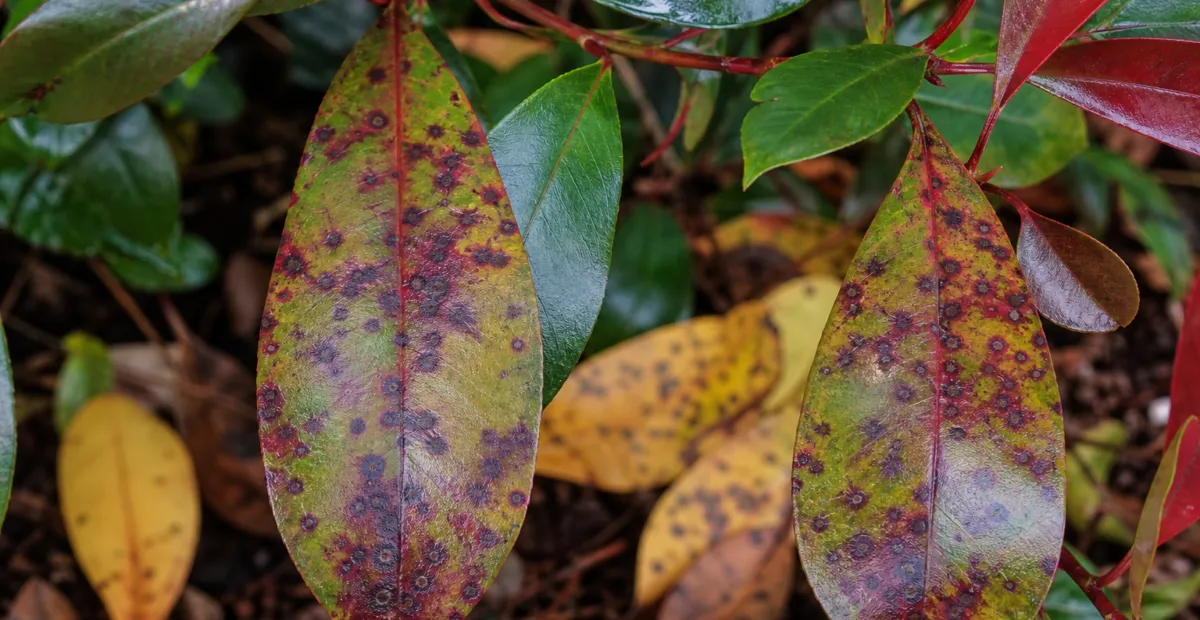
Entomosporium Leaf Spot
Diplocarpon mespili (synonym: Entomosporium mespili)Entomosporium Leaf Spot overview
Entomosporium leaf spot is a fungal disease of many woody plants in the rose family, especially red-tip photinia, Indian hawthorn, pear, quince, pyracantha, loquat, serviceberry and hawthorn. It begins as tiny red or purple spots, develops gray-brown centers and dark margins, and may cause severe premature leaf drop during wet periods, particularly when new foliage remains wet or air circulation is poor.
Typical conditions
Overview
Entomosporium leaf spot is caused by the fungus Diplocarpon mespili; Entomosporium mespili is a widely used synonym for the same pathogen. The disease primarily affects woody members of the rose family, especially evergreen landscape shrubs and young, actively expanding foliage.
Light infections are mainly cosmetic. Repeated or severe infections can cause extensive defoliation, reduce growth and increase susceptibility to other environmental stresses. A diagnosis should consider the host, the characteristic red-centered spotting and the tiny dark or pale fruiting structures in older lesions, because several unrelated leaf spot diseases can look similar.
Symptoms and identification
Initial symptoms are tiny, circular red, reddish-purple or maroon spots on young leaves. As lesions enlarge, their centers commonly become tan, gray or brown while the margins remain dark red, purple or maroon. On pear, margins may be thinner and browner.
Spots can merge into irregular dead blotches. Tiny black or dark fruiting bodies may develop in lesion centers; pale cream spore masses can be visible under magnification. Petioles and tender shoots may also be affected. Severe infections cause yellowing followed by early, sometimes heavy, leaf drop, particularly on photinia and Indian hawthorn.
Causes and spread
The pathogen survives in infected fallen leaves and, on evergreen hosts, may remain in diseased leaves on the plant. Some references also report survival in infected twig tissue or, for certain hosts, on retained fruit. Spores are spread primarily by splashing rain, irrigation water and contact with wet infected tissue.
New foliage is especially vulnerable. Dense plantings, prolonged leaf wetness, frequent rainfall, overhead irrigation, high humidity and reduced air movement promote infection and secondary disease cycles. Disease pressure is often greatest during wet spring and fall weather; in warm regions, infection may continue during other cool-to-mild wet periods.
Life cycle and persistence
On deciduous hosts, the fungus overwinters mainly as mycelium and spores in fallen leaves. On evergreen hosts such as photinia and Indian hawthorn, infected leaves can provide an additional year-round reservoir.
During wet weather, spores are released from infected tissue or leaf litter and splashed onto young foliage. After infection, lesions enlarge and produce new spore-forming structures, allowing repeated spread while leaves remain wet and susceptible. The sexual stage is associated with the name Diplocarpon, while the asexual form has traditionally been called Entomosporium.
Treatment and control
Remove heavily spotted fallen leaves and discard them. On evergreen shrubs, remove badly infected leaves where practical and prune out crowded interior growth during appropriate pruning periods. Avoid shearing that produces dense flushes of highly susceptible new foliage.
Fungicides are preventive rather than curative: they protect new tissue but do not restore existing lesions. If disease has been severe in previous years, treatment decisions should be based on host value, weather risk and the appearance of new growth. Begin only with products whose current U.S. label specifically permits use on the crop or ornamental site and disease, and apply with complete coverage of susceptible new foliage.
Low-impact and biological control
Use sanitation, dry-foliage irrigation and improved airflow as the primary low-impact controls. Remove infected leaf litter promptly, keep mulch or groundcover from trapping wet leaves against the plant, and avoid moving wet foliage or contaminated debris between plants.
For valuable landscape plants, properly labeled copper products may be part of an organic-oriented preventive program where permitted, but copper can injure foliage and is not a substitute for sanitation and moisture management. Confirm that the specific formulation is allowed for the intended crop or ornamental use in the United States and follow all label restrictions.
Prevention
- Choose less-susceptible cultivars or alternative plants when establishing a new hedge, especially where photinia or Indian hawthorn has a recurring history of severe disease.
- Space plants to allow air movement and avoid unnecessarily dense hedges. Prune selectively to improve ventilation without creating excessive succulent regrowth.
- Use drip, soaker or low-volume irrigation at the soil surface rather than overhead sprinklers. Water early enough for incidental moisture to dry quickly.
- Collect and remove fallen diseased leaves from beneath deciduous hosts and evergreen shrubs. Do not compost them unless the composting process reliably reaches pathogen-destroying temperatures.
- Maintain plant vigor with appropriate irrigation, soil drainage and site selection; avoid excessive nitrogen that encourages tender, dense growth.
Interesting facts
- The name Entomosporium refers to the insect-like appearance of the pathogen’s multicelled conidia when viewed microscopically.
- Diplocarpon mespili is the currently accepted scientific name in major taxonomic databases, while Entomosporium mespili remains common in horticultural and diagnostic literature.
- Red-tip photinia and Indian hawthorn are frequent landscape examples, but documented host lists extend across many genera of the rose family.
- Evergreen hosts can retain infected leaves through the year, making sanitation and moisture management especially important.
Do not use a pesticide solely because an active ingredient is mentioned in another reference. In the United States, use only a product currently registered and legally labeled for Entomosporium leaf spot or the applicable crop/ornamental site in your state; follow the current label for rate, timing, reentry, personal protective equipment, intervals and application limits. Fungicides protect uninfected new growth and generally cannot cure established lesions. Check with your state extension service or pesticide regulatory agency when label status is unclear.