
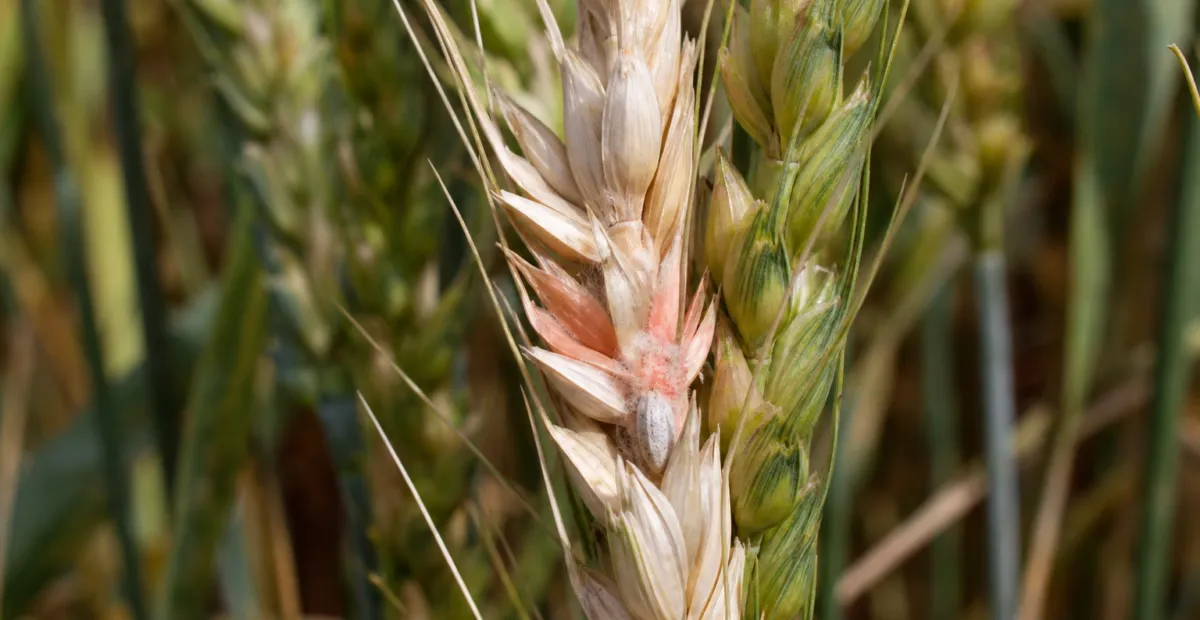
Fusarium head blight (scab)
Fusarium graminearum Schwabe sensu strictoFusarium head blight (scab) overview
Fusarium graminearum is a major cereal disease fungus in the United States, best known for Fusarium head blight, or scab, of wheat and barley. It causes premature bleaching of spikelets, shriveled “tombstone” kernels, yield loss and contamination with deoxynivalenol (DON, or vomitoxin). The same pathogen can also contribute to crown rot and Gibberella ear or stalk rot of corn.
Typical conditions
Overview
Fusarium graminearum is a fungus in the Fusarium graminearum species complex. In U.S. cereal production, its most important disease is Fusarium head blight (FHB) of wheat and barley. Infection is favored around flowering and early grain development, when spores reach exposed floral tissues during warm, humid or rainy weather.
The pathogen may also colonize roots, crowns, stems and senescing tissues. Disease expression varies with the crop, cultivar, pathogen population and weather. Several other Fusarium species can produce similar head-blight symptoms, so laboratory confirmation may be needed when diagnosis or grain marketing decisions are important.
Symptoms and identification
On wheat and barley, the first obvious symptom is premature bleaching of one or more spikelets. Bleached spikelets may occur at the top, middle or base of a head and can later expand until much of the head is white. The rachis below an infected spikelet may show brown discoloration.
Under warm, humid conditions, pinkish-orange to salmon-colored fungal growth may appear on glumes or the rachis. Infected kernels may be small, shriveled, lightweight and pale pink, gray or brown; these are commonly called tombstone kernels. Symptomless-looking grain can still carry DON.
On corn, the pathogen is associated with Gibberella ear rot, often producing pink to reddish mold between kernels, and Gibberella stalk rot, which may cause internal stalk discoloration, weakened stalks and lodging. Crown-rot symptoms in wheat can include brown crown tissue, premature senescence and poorly filled heads.
Causes and spread
The fungus survives and reproduces on infected or colonized cereal residue, especially corn stalks, wheat straw and other grass residues. During wet weather it produces asexual spores and, on suitable residue, sexual fruiting bodies called perithecia. Ascospores released from residue can move on air currents over considerable distances; conidia are spread mainly by rain splash and local movement of water or debris.
Infection risk is greatest when susceptible wheat or barley tissue is flowering or otherwise exposes floral structures, and when rainfall, high humidity or extended moisture keeps heads wet. Corn and small-grain residues increase local inoculum, but regional airborne inoculum means that residue management alone does not eliminate risk.
Life cycle and persistence
Fusarium graminearum overwinters as mycelium in crop residue. In spring and early summer, moisture stimulates sporulation. The sexual stage, historically named Gibberella zeae, forms blue-black perithecia on suitable debris and forcibly discharges airborne ascospores. The asexual stage produces canoe-shaped, multicelled macroconidia in sporodochia.
Spores germinate on susceptible plant surfaces, commonly around flowering in wheat and barley. The fungus grows through floral tissues into developing kernels, where it can reduce grain fill and produce trichothecene mycotoxins such as DON. Infected residue remaining after harvest becomes a new inoculum source for subsequent crops.
Treatment and control
FHB is difficult to eradicate after symptoms are visible because infection occurs before or around flowering and the fungus can already be established inside florets. Management is therefore preventive and integrated. In commercial wheat and barley, a locally labeled fungicide may reduce disease and DON when applied at the correct flowering window, but performance depends on product, timing, cultivar, weather and pathogen sensitivity.
For small plantings, remove and dispose of severely infected heads and avoid saving seed from visibly diseased grain. Do not use affected grain for human food or animal feed unless it has been properly evaluated under applicable grain-safety requirements. Confirm unusual whiteheads or suspected toxin problems with a qualified diagnostic or grain-testing laboratory.
Low-impact and biological control
There is no dependable home-garden organic cure once head blight is established. The most useful nonchemical measures are resistant or moderately resistant cultivars, rotation away from corn and small grains, removal or accelerated decomposition of infected residue, good airflow and avoidance of excessive nitrogen.
Commercial biological products containing microorganisms may have activity against FHB, but results are product- and timing-dependent and are generally less consistent than a complete integrated program. Use only products listed for organic production under the applicable U.S. certification system and legally registered for the crop and disease.
Prevention
- Choose cultivars with the best locally available FHB resistance and use official university variety-trial information when selecting seed.
- Rotate wheat or barley with a non-host crop such as soybean when practical; risk is generally higher after corn or another small grain.
- Promote rapid residue decomposition through appropriate crop-residue management, balanced fertility and agronomic practices suited to the field. No single tillage system reliably prevents FHB.
- Avoid excessive nitrogen or dense canopies that prolong humidity and delay drying.
- Use regional disease forecasting tools and scout wheat or barley at heading and flowering, especially after wet weather.
- Harvest promptly when grain is mature, clean harvested grain, and segregate or test suspect lots when DON contamination is possible.
Interesting facts
- The former sexual name Gibberella zeae is still widely encountered in agricultural literature, although the pathogen is generally discussed as Fusarium graminearum.
- DON, commonly called vomitoxin, can occur in grain that does not look severely diseased; visual sorting alone cannot reliably determine toxin concentration.
- FHB symptoms can resemble other causes of cereal whiteheads, including drought stress, insect injury, root or crown diseases and premature senescence.
- The pathogen has a broad association with cereals and grasses, but documented infection and disease severity vary among host species and regional pathogen populations.
- Weather during flowering is often more important for FHB outbreaks than the amount of visible disease in the previous crop alone.
Use only fungicides legally registered and currently labeled in the United States for the specific crop and disease. Follow the current product label for crop, application timing, rate, preharvest interval, worker protection, resistance-management instructions and permitted use sites. Do not apply an unverified pesticide program, and do not assume a product labeled for one cereal or Fusarium disease is legal or effective for another.