Diplodia seriata (black rot, frogeye leaf spot and canker fungus)
Diplodia seriata De Not. (synonym: Botryosphaeria obtusa)Diplodia seriata (black rot, frogeye leaf spot and canker fungus) overview
Diplodia seriata is a wood-colonizing ascomycete formerly often called Botryosphaeria obtusa. In U.S. orchards it is best known for apple black rot, frogeye leaf spot and limb cankers, while related disease forms and host importance vary by crop and region. The fungus commonly exploits dead tissue, wounds, winter injury, fire-blight damage, drought stress and mummified fruit.
Typical conditions
Overview
Diplodia seriata is primarily a canker, dieback and fruit-rot fungus rather than a single uniform disease. On apple, the recognized disease complex includes black rot of fruit, frogeye leaf spot and black-rot canker. On grapevine and other woody plants, it may occur within a broader Botryosphaeriaceae trunk-disease complex, where symptoms overlap with infections caused by other fungi.
The fungus can persist in dead branches, cankers, leaf litter and mummified fruit. Finding black, pimple-like pycnidia supports a Diplodia-type diagnosis, but pycnidia alone do not reliably distinguish D. seriata from related fungi. A plant diagnostic laboratory using culture and molecular methods is the most dependable way to confirm the species.
Symptoms and identification
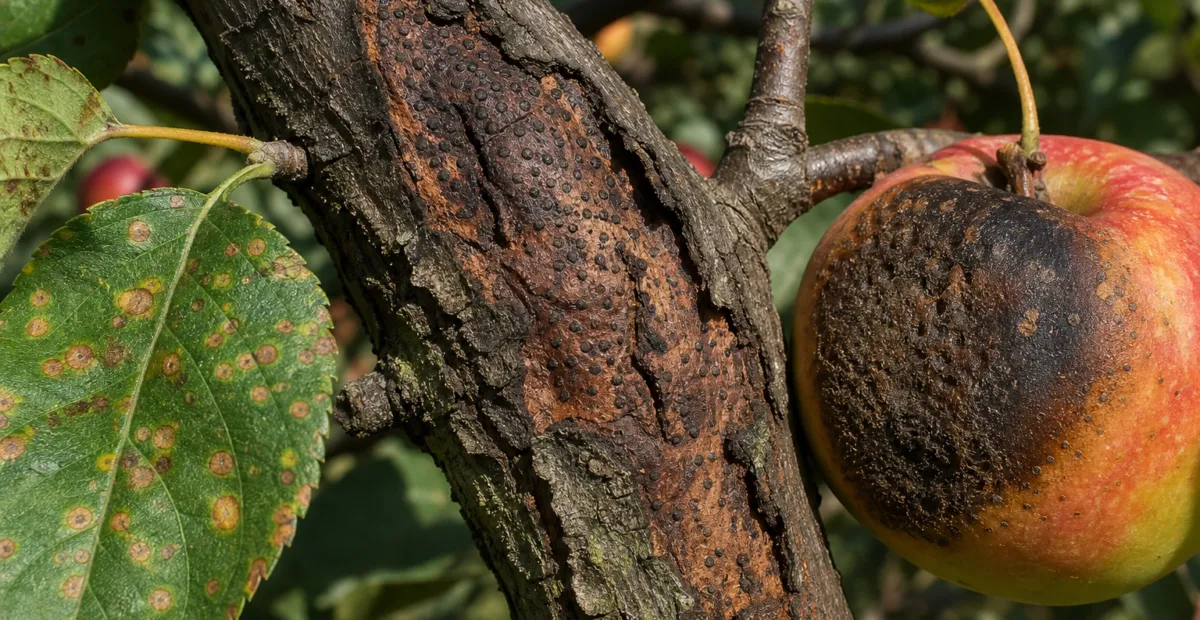
Symptoms depend strongly on the host. On apple, fruit develops light- to dark-brown rot, often beginning at the calyx or at an insect, hail or other wound. The rot enlarges and may become black, dry and shriveled. Leaves may develop circular tan or brown spots with darker margins, commonly called frogeye leaf spot.
On limbs and trunks, cankers may begin as slightly sunken reddish-brown bark, then become darker, cracked, rough and sometimes girdling. Black pycnidia may appear as small raised dots in dead bark. Shoots beyond a canker can wilt, flag, die back or fail to develop normally. Similar dieback and canker symptoms on grapevine, walnut, almond, citrus, oak, palm, pine and other hosts are not diagnostic by themselves because several Botryosphaeriaceae fungi produce comparable damage.
Causes and spread
The fungus spreads when rain, overhead irrigation, wind, insects or pruning tools move spores from pycnidia and infected debris to susceptible tissue. Wounds caused by pruning, hail, frost, sunburn, fire blight, insects or mechanical damage are important infection courts. Dead branches and mummified fruit serve as persistent inoculum sources. Drought, winter injury, poor nutrition, excessive crop stress and other conditions that weaken woody tissue increase disease expression, although a stressed plant is not proof of D. seriata infection.
Life cycle and persistence
Diplodia seriata survives in dead branches, perennial cankers, fallen leaves and mummified fruit. It produces asexual conidia in pycnidia and may also produce sexual ascospores. Spores are released during wet weather and are moved mainly by rain splash, wind and contaminated tools or insects.
Infections occur through wounds, natural openings or damaged young tissue. Apple leaf infection is favored by a wetting period of roughly four to five hours near 79°F, while fruit infection can occur with extended wetness around 68–75°F; actual thresholds vary with host, isolate and environment. The fungus may remain latent in wood and become active after drought, winter injury or other stress.
Treatment and control
Remove and destroy infected fruit, dead branches and mummified fruit as soon as practical. On branches, make pruning cuts into apparently healthy wood and avoid retaining stubs; heavily girdled limbs may need removal. For trunks or major scaffold limbs, consult a certified arborist or crop adviser because cutting into structural wood can create hazards and may not eliminate a systemic-looking dieback.
Fungicides are primarily preventive and have limited value once a canker has extensively colonized wood. If chemical control is considered, use only a currently labeled U.S. product for the exact crop and disease, and time applications according to the crop’s extension recommendations and label. Do not assume that a product labeled for apple black rot is legal or effective on grape, walnut, ornamental trees or trunk cankers.
Low-impact and biological control
There is no dependable curative organic treatment for deeply infected wood. Use an integrated sanitation-first approach:
- Prune out cankered, dead or flagging wood well below visible disease, cutting back to sound tissue when practical.
- Prune during dry weather and remove prunings from the orchard or landscape; do not leave infected wood beneath trees or vines.
- Remove mummified fruit, dead spurs and fallen diseased plant material before the next wet growing season.
- Disinfect pruning tools between visibly diseased plants or cuts when moving through valuable trees and vines.
- Reduce wounds by avoiding unnecessary pruning, protecting trunks from mechanical injury and managing insect damage.
- Maintain steady irrigation during drought, improve site drainage and avoid excessive nitrogen that produces weak, succulent growth.
- Improve canopy airflow and use drip or directed irrigation rather than routinely wetting foliage.
- Where permitted and appropriate, consult the current U.S. organic production rules and product label for preventive biological or mineral-based materials; these can reduce new infections but will not remove colonized wood.
Prevention
- Plant well-adapted, healthy nursery stock and inspect trees or vines for existing cankers and dead spurs.
- Remove dead wood and mummified fruit before spring spore release.
- Prune with clean, sharp tools in dry conditions; avoid large unnecessary cuts.
- Protect plants from drought, winter injury, sunscald, trunk damage and fire-blight-related dead wood.
- Use drip irrigation where feasible, maintain good canopy airflow and avoid prolonged leaf wetness.
- Monitor apple trees from bud break through harvest for frogeye spots, cankers and fruit rot.
- Submit representative symptomatic material to a state or university diagnostic laboratory when the crop is valuable, symptoms are extensive or a species-specific diagnosis will change management.
Interesting facts
- Diplodia seriata was historically widely referred to as Botryosphaeria obtusa.
- On apple, the same fungus can produce three conspicuous forms: fruit black rot, frogeye leaf spot and limb canker.
- The fungus is a vigorous saprophyte and may colonize dead tissue on many plants without causing active disease.
- Apple fruit infections caused by this organism can resemble other fruit rots, so symptom appearance alone is not sufficient for reliable identification.
- Diplodia-type cankers on grapevine are commonly discussed as part of a mixed Botryosphaeriaceae trunk-disease complex.
Use fungicides only when a product is currently legally authorized and labeled in the United States for the specific crop, disease and application site. Follow the current label exactly, including personal protective equipment, reentry interval, preharvest interval, resistance-management instructions and disposal requirements. Products labeled for apple black rot may not be legal or appropriate for other hosts or for trunk and branch cankers; fungicides generally protect healthy tissue and do not eradicate deeply colonized wood.
Affected plants
The plants below are linked to this problem by structured host-plant data. The list updates automatically as new plant profiles are added.