
 Source:
 Phosphorus deficiency
Phosphorus deficiency overview
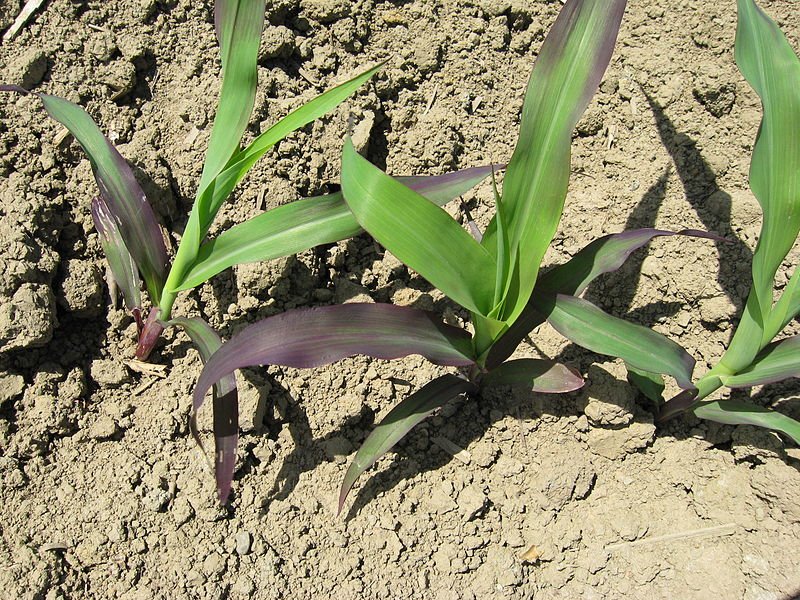
Phosphorus deficiency is a nutritional and soil-availability disorder that slows root and shoot growth, delays maturity, and may produce dark-green foliage with reddish-purple coloration, especially on older leaves. Symptoms are often triggered by cold, wet soil, unfavorable pH, compaction, drought, or damaged roots even when a soil test shows adequate total phosphorus.
Typical conditions
Overview
Phosphorus is an essential macronutrient involved in energy transfer, nucleic acids, root development, flowering, seed formation, and crop maturity. Because phosphate is relatively immobile in soil, roots must grow through the soil to intercept it. A plant can therefore show deficiency in soil containing substantial total phosphorus if the nutrient is chemically fixed, roots are restricted, or uptake is slowed by cold or excessive moisture.
In United States gardens and production fields, temporary phosphorus deficiency is common in young plants during cool spring weather. Tomato, corn, soybean, and cotton seedlings may show symptoms that lessen as soil warms and root growth resumes.
Symptoms and identification
- Slow, reduced, or uneven growth; short internodes; limited branching; and a sparse canopy.
- Older leaves may become unusually dark green, followed by reddish, bluish, or purplish coloration along veins, margins, or the underside of the leaf.
- Severe symptoms can include brown or necrotic leaf tips, yellowing followed by browning of older leaves, reduced flowering, delayed maturity, and lower yield.
- Tomato leaves may curl upward, with purple veins or interveinal tissue. Corn seedlings may be short with purple leaves, particularly early in the season.
- Symptoms are not diagnostic by color alone. Cold injury, genetic pigmentation, nitrogen or magnesium disorders, root diseases, herbicide injury, and drought can look similar.
Causes and spread
This disorder does not spread between plants like a pathogen. It develops when available phosphate in the root zone is insufficient or when roots cannot acquire it efficiently. Common causes include genuinely low soil-test phosphorus, strongly acidic or alkaline soil, cold wet spring soil, drought, compaction, poor aeration, root-feeding insects, root disease, transplant shock, and herbicide injury. Phosphorus is readily fixed by iron, aluminum, or calcium compounds, depending on soil reaction, so total soil phosphorus may overstate what plants can use.
Excess phosphorus fertilizer does not reliably correct a non-phosphorus problem and can contribute to runoff and water-quality damage. Confirm the diagnosis before applying additional phosphorus.
Life cycle and persistence
Phosphorus deficiency has no biological lifecycle. It usually begins in young plants or in the oldest leaves when root uptake cannot meet demand. Symptoms may intensify while soils remain cold, dry, waterlogged, compacted, or chemically unfavorable. In a temporary early-season deficiency, color and growth often improve after soil warms and roots expand. If the underlying shortage or root injury persists, symptoms progress to younger foliage, reduced flowering or seed production, delayed maturity, and yield loss. Existing damaged tissue may not return to normal even after nutrition improves.
Treatment and control
- Confirm the diagnosis with a soil test for pH and plant-available phosphorus. If soil results and symptoms disagree, submit representative leaves and roots to a state or university diagnostic laboratory.
- Correct pH only when the soil test indicates a need. Lime is used for acidic soils; sulfur or other acidifying practices may be recommended for excessively alkaline soils, but rates should be calculated from a soil test.
- If phosphorus is low, apply a fertilizer or amendment that supplies phosphorus at the recommended rate for the crop and soil. Incorporate or place it where roots can access it, while avoiding direct contact between concentrated fertilizer and seeds or roots.
- For a temporary cold-soil problem, warming the root zone, improving drainage, and supporting healthy root growth may be more effective than adding phosphorus.
- Repair root-zone problems such as compaction, drought, waterlogging, root disease, or insect injury. Do not expect severely damaged leaves to regain their original color.
- Recheck growth and, where appropriate, soil or tissue nutrient status before making repeat applications.
Low-impact and biological control
Organic management depends on diagnosis rather than a single universal product. Use mature compost or well-composted manure only when they fit the soil-test nutrient plan; repeated manure applications can build excessive phosphorus. Approved organic phosphorus sources may include rock phosphate or bone meal, but their usefulness depends on soil pH, product analysis, particle size, crop demand, and local conditions. Maintain good soil structure, moisture, drainage, and living roots, and minimize unnecessary tillage to support beneficial mycorrhizal fungi. Cover crops and mulches can reduce erosion and conserve moisture, but they do not substitute for correcting a confirmed phosphorus shortage.
Prevention
- Obtain a laboratory soil test before adding phosphorus; follow the test laboratory’s crop-specific recommendations.
- Maintain soil pH in the range appropriate for the crop. For many vegetables, approximately pH 6.0–7.0 is a useful target, but use the crop’s recommendation rather than a universal value.
- Improve drainage and avoid working wet soil. Reduce compaction with organic-matter management, suitable bed design, and careful traffic.
- Plant warm-season crops after soil has warmed sufficiently for active root growth; use seasonally appropriate transplants and avoid chilling root balls.
- Maintain even moisture without prolonged saturation, and inspect roots when symptoms are severe or unexpected.
- Use compost, manure, and fertilizer based on soil-test needs. Prevent erosion and runoff with mulch, cover crops, contouring, and vegetated buffer areas.
- Preserve beneficial mycorrhizal associations by limiting unnecessary soil disturbance and avoiding routine high-phosphorus applications.
Interesting facts
- Phosphorus moves very slowly through soil, so root growth and root-soil contact are central to uptake.
- Young plants may show temporary deficiency in cold soil even when available phosphorus is adequate on a soil test.
- Purple foliage is a useful clue but is not proof: some cultivars naturally accumulate purple pigments, and several stresses can cause similar coloration.
- Mycorrhizal fungi can expand the effective nutrient-absorbing network around roots and improve access to relatively immobile phosphorus.
- Phosphorus is generally less prone to leaching than nitrate, but erosion and surface runoff can transport it to water and promote algal growth.
Pesticides do not treat phosphorus deficiency. Use only fertilizers, soil amendments, or plant-nutrient products legally authorized for the crop and intended use in your country, and follow the current product label. Do not apply phosphorus routinely without a soil test; excessive phosphorus can run off into surface water and cause environmental damage.