
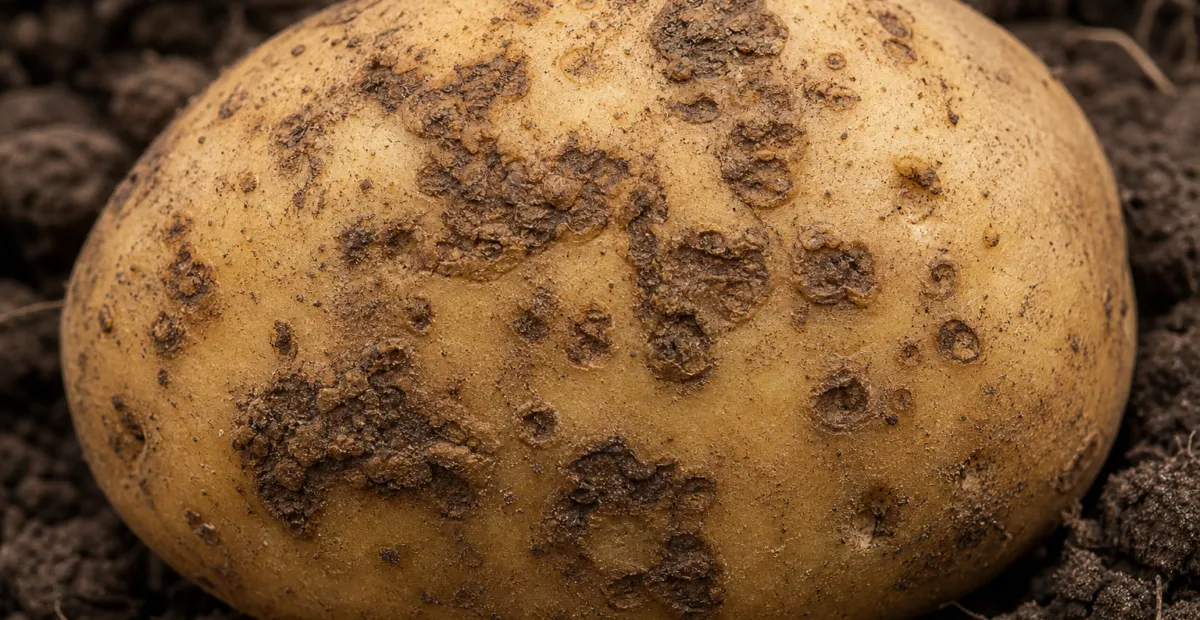
Potato common scab
Streptomyces scabiei (synonym: Streptomyces scabies)Potato common scab overview
Potato common scab is a soilborne bacterial disease associated with Streptomyces scabiei, formerly commonly called Streptomyces scabies. It causes rough, tan-to-brown, corky lesions that may be superficial, raised or deeply pitted on potato tubers and can also affect several taproot crops. Disease is favored by dry soil during early tuber or root formation, especially in neutral to alkaline soils.
Typical conditions
Overview
Streptomyces scabiei is a Gram-positive, filamentous, soilborne bacterium and one of several pathogenic Streptomyces species that cause common scab. In the United States, the disease is most important on potato (Solanum tuberosum), where it damages the tuber skin rather than producing a typical foliar disease.
Lesions range from superficial russeting to raised corky patches and deep pits. They often reduce appearance, grading quality and marketability more than total crop weight. Similar symptoms can be caused by other common-scab bacteria, so the name S. scabies should not be inferred from appearance alone.
Symptoms and identification
- Tan, brown or russet-colored corky lesions on potato tubers.
- Lesions may be shallow and superficial, raised, cracked, netted or deeply pitted.
- Scab patches are often irregularly distributed over the tuber surface and may expand as the tuber enlarges.
- Aboveground foliage usually appears normal, so the problem is commonly discovered at harvest.
- Carrot, radish, beet, parsnip, rutabaga and turnip roots may show rough, corky, cracked or sunken lesions.
- In seedlings, pathogenic strains can cause root stunting, swelling, necrosis or death, but this is less typical than tuber or root scab.
Causes and spread
The disease is caused by pathogenic strains of Streptomyces scabiei and, in many regions, closely related Streptomyces species. The organism is naturally soilborne and may be introduced or redistributed in infected seed potatoes, discarded tubers, infested soil, contaminated equipment, irrigation runoff and improperly managed organic amendments.
Risk is highest when soil becomes dry while young tubers or taproots are forming, particularly in warm, neutral-to-alkaline soils. Heavy disease in one season does not prove that S. scabiei is the only species present, because common-scab symptoms overlap among several pathogens.
Life cycle and persistence
The bacterium survives in soil and infected or discarded tubers and colonizes the rhizosphere of susceptible crops. Infection is concentrated while young tubers and storage roots are forming, when their protective skin is still developing. Pathogenic strains produce thaxtomin phytotoxins, which interfere with plant-cellulose formation and contribute to tissue death and cork formation.
After infection, lesions enlarge or become more conspicuous as the tuber or root expands. The organism can remain established in infested soil for several years. Spread occurs mainly through infected seed potatoes, infested soil, manure or compost containing infected crop residues, water movement and equipment or containers carrying soil.
Treatment and control
There is no dependable postharvest treatment that removes established common-scab lesions from a growing tuber. During the current season, maintain uniform moisture around developing tubers, avoid cultivating or injuring roots, and remove severely affected volunteer plants and cull tubers after harvest.
At harvest, gently dig and handle tubers to limit wounds, allow them to cure in a cool, dark, well-ventilated place, and sort heavily scabbed or damaged potatoes before storage. For the next crop, combine clean seed, a tolerant cultivar, nonhost rotation, soil-moisture management and sanitation. If symptoms are severe, recurrent or unusual, submit symptomatic tissue and soil through a state university plant diagnostic laboratory.
Low-impact and biological control
No universally reliable organic cure is available after tuber or root lesions have formed. Management is preventive and cultural:
- Plant certified, disease-free seed potatoes rather than saving scabby tubers for seed.
- Maintain even soil moisture from planting through early tuber initiation; in home gardens, use drip irrigation or a soaker hose and avoid allowing the root zone to dry severely.
- Rotate potatoes and susceptible root crops with nonhost crops, such as small grains or grasses, where space permits. Rotation alone may not eliminate the pathogen.
- Choose potato cultivars described by local extension or seed suppliers as common-scab tolerant; tolerance varies by cultivar and pathogen strain.
- Avoid adding fresh manure or incompletely composted material from livestock fed infected root crops.
- Remove volunteer potatoes and thoroughly clean soil from tools, bins and footwear before moving between beds.
- Organic amendments, cover crops and biological products may influence soil microbial communities, but use only approaches supported for the crop and site by local extension guidance and the product label.
Prevention
- Start with certified, clean seed potatoes and discard visibly scabby seed pieces.
- Keep soil consistently moist during the first several weeks of tuber formation; do not waterlog the bed.
- Test soil before changing pH or fertility. Do not lime a potato bed routinely, because higher pH can increase common-scab risk.
- Use tolerant cultivars suited to the region, recognizing that rankings may differ among pathogen strains and locations.
- Rotate potatoes, carrots, beets, radishes, parsnips, rutabagas and turnips with nonhost crops when practical.
- Control volunteer potatoes and remove cull tubers after harvest.
- Clean soil from cultivation equipment, harvest containers and footwear, especially before entering clean beds.
Interesting facts
- The currently accepted name is generally Streptomyces scabiei; Streptomyces scabies remains widely used in extension literature and older research.
- Only a small fraction of the many soil-dwelling Streptomyces species are plant pathogens.
- Common scab usually affects visual quality more than eating safety; affected potatoes should still be trimmed and evaluated for storage quality.
- Different pathogenic species and strains can vary in aggressiveness, host range and response to potato cultivars.
- Suppressive soils containing antagonistic microbial communities have been reported, but biological suppression is not yet reliably predictable for every garden or field.
Do not use a pesticide solely because a product mentions Streptomyces or common scab in an unrelated crop. In the United States, use only a product legally registered and currently labeled for common scab on the specific crop and site; follow the current EPA-approved label, rate, timing, personal-protective-equipment requirements and harvest interval. Chemical suppression is inconsistent, so prioritize irrigation, soil management, rotation, sanitation and cultivar choice.
Affected plants
The plants below are linked to this problem by structured host-plant data. The list updates automatically as new plant profiles are added.
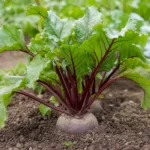 Beet (Beta vulgaris) care guideBeta vulgaris
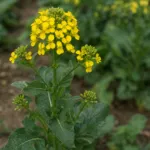 Ethiopian Rape (Brassica carinata) care guideBrassica carinata
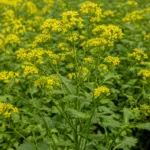 Brown Mustard (Brassica juncea) care guideBrassica juncea
 Rapeseed (Brassica napus) care guideBrassica napus
 Urnip rape (Brassica rapa) care guideBrassica rapa
 Collard greens (Brassica oleracea) care guideBrassica oleracea
 Wild carro (Daucus carota) care guideDaucus carota
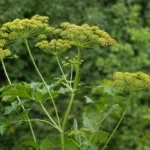 Parsnip (Pastinaca sativa) care guidePastinaca sativa
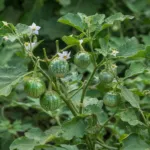 Solanum aethiopicum care guideSolanum aethiopicum
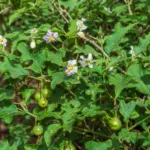 Solanum macrocarpon care guideSolanum macrocarpon
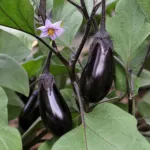 Eggplant (Solanum melongena) care guideSolanum melongena
 Garden Huckleberry (Solanum scabrum) care guideSolanum scabrum