
 Source:
Red sealing wax palm (Cyrtostachys renda) short overview
Cyrtostachys renda, the red sealing wax palm, is a clustering tropical palm recognized by its vivid scarlet crownshafts and arching, feather-like leaves. Native to wet tropical forests and swampy habitats of Southeast Asia, it needs warmth, high humidity and consistently moist but well-drained soil. In the United States, it is mainly a greenhouse, conservatory or indoor container plant except in reliably frost-free tropical climates.
Taxonomic classification
Red sealing wax palm (Cyrtostachys renda) care guide
Light and placement
Provide bright filtered light indoors, such as near an east- or west-facing window with sheer protection, or use a greenhouse position with filtered sun. Mature outdoor plants can accept more sun when roots remain moist, but harsh reflected heat and drying wind may scorch fronds. Low light produces stretched growth and dull color; excessive direct sun can bleach or burn leaves.
Watering and humidity
Keep the root zone evenly moist but never stagnant. Water thoroughly when the surface begins to dry, allowing excess water to drain fully; do not let the container sit in a saucer of water. Increase monitoring during hot, bright weather and reduce frequency only slightly in cool, dim conditions. High humidity helps prevent leaf-edge browning but does not replace proper drainage.
Soil and growing medium
Use a rich, moisture-retentive but well-drained mix with organic matter. A loam-based substrate amended with fine bark or coco coir works well in containers. Slightly acidic to neutral conditions are suitable; avoid strongly alkaline, limestone-heavy media and compacted soil.
Feeding
Feed during active warm growth with a complete palm fertilizer containing micronutrients, diluted according to the product label. Apply to already moist soil and reduce or stop feeding during cool, dim winter conditions or after repotting until new growth resumes. Avoid heavy applications, which can damage roots and cause salt buildup.
Growth and habit
This is a slow-growing, multi-stemmed palm that gradually forms a dense clump from basal shoots. It performs best when roots remain warm and evenly moist. Growth slows sharply with cool temperatures, low humidity, drought or low light, so container culture requires stable conditions rather than frequent corrective pruning.
Planting and repotting
Plant outdoors only in frost-free, humid climates, preferably during the warm rainy season. Set the palm at the same depth it was growing, with the crownshaft above the soil line. Allow room for the clump to expand and mulch around, not against, the stems. Protect young plants from strong wind and harsh afternoon exposure.
Repot in spring or early summer only when roots have filled the container. Move up one pot size, disturb the root ball as little as possible, and use a stable, heavy container because the clumping crown can become top-heavy. Re-establish evenly moist conditions promptly after transplanting.
Propagation and pruning
Propagation
Propagate from fresh seed or by carefully removing established suckers or offsets. Fresh seed germinates more reliably than old seed and should be sown in a warm, sterile, evenly moist medium. Offset division is best done during active warm growth and may be slow to re-establish.
Pruning
Little routine pruning is needed. Remove only fully dead, damaged or diseased fronds with clean tools, cutting the petiole close to the stem without injuring the crownshaft. Do not strip green leaves to control size; excessive cutting weakens the slow-growing clump.
Overwintering
Move containers indoors or into a heated greenhouse before nights approach 60°F. Keep the plant in bright filtered light, away from cold glass and forced-air heat, and maintain steady moisture without leaving roots waterlogged. Avoid cold drafts and do not fertilize heavily during the low-light winter period.
Uses
Primarily an ornamental specimen for tropical landscapes, conservatories, greenhouse collections and large indoor containers. It is valued for its vivid red crownshafts and architectural clumping habit. In its native region, limited local uses of stems and trunk material have been reported, but it is not recommended as a household food or medicinal plant.
Appearance
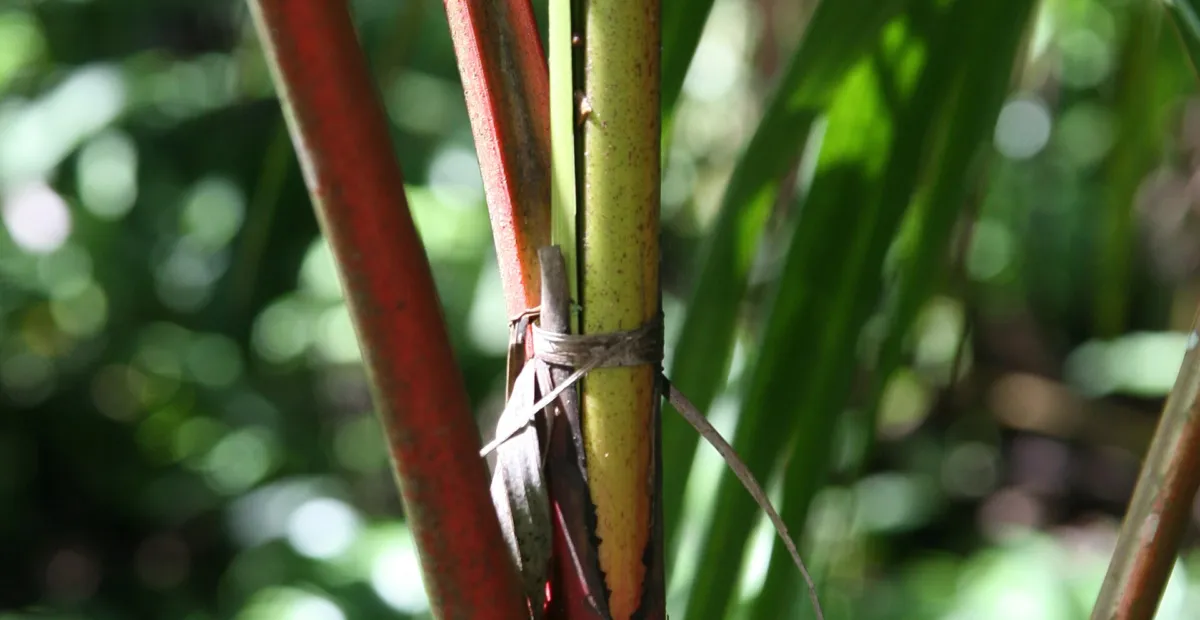
The palm forms several slender, upright stems in a clump. Its most diagnostic feature is the glossy scarlet to bright-red crownshaft and leaf bases, contrasting with long, arching pinnate fronds. Leaflets are narrow and regularly arranged, while mature inflorescences emerge below the crown. Fruits mature from green to dark bluish-black.
Flowering
Mature plants produce branched sprays of small greenish-white flowers below the crown. Flowering is reported in summer in cultivated temperate settings and can occur more broadly or intermittently in tropical climates. Flowers are followed by small ovoid fruits that mature dark bluish-black.
Pollination and visitors
The flowers are small and inconspicuous, and reliable species-specific documentation of the principal animal pollinator was not located. Some horticultural references describe the plant as bird-attracting, likely in relation to its fruit display, but this does not establish a primary flower pollinator.
Cyrtostachys renda photos
Click any photo for a larger view. Source, author and license are shown separately.
Diseases and pests
Diseases
Usually relatively disease-free when grown warm with good air circulation. Prevent problems by avoiding stagnant, waterlogged media, minimizing crown wetness in cool conditions, and isolating stressed plants. Persistent leaf spotting, crown decline or foul roots warrant checking drainage and root health before applying treatments.
Pests
Scale insects, spider mites and other sap-feeding pests may appear, especially in dry indoor air. Inspect leaf bases, petioles and undersides regularly. Improve humidity and airflow, isolate affected plants, remove light infestations manually, and use a labeled horticultural oil or insecticidal soap only as directed and after testing plant tolerance.
Toxicity and pollen
Reliable authoritative evidence establishing toxicity to people, dogs, cats or children was not located. Do not treat the plant as confirmed edible or confirmed non-toxic. Prevent chewing of leaves, stems, flowers, seeds and fruit, and contact a medical professional or veterinarian if ingestion causes symptoms.
- Typical season
- Not established for the United States
- Pollination / pollen
- Pollen from small palm flowers; dispersal and allergenicity not well documented
The species produces pollen as a flowering palm, but reliable evidence defining its airborne pollen burden or allergy importance in the United States was not located. Its tropical, insect-associated flowering habit does not justify assuming zero allergy risk. Keep flowering plants clean and avoid handling inflorescences if they cause irritation.
Native habitat
Native from Peninsular Thailand through western Malesia, including Malaya, Sumatra and Borneo. It grows in wet tropical forest, swampy ground and humid lowland habitats, often near persistently moist soils and waterways. Warm temperatures, abundant water and protection from drying exposure are central to its natural ecology.
Interesting fact
The scarlet crownshaft is the feature behind the names red sealing wax palm and lipstick palm. The species is native to wet tropical habitats and is associated with swampy forest conditions. Its bright red crownshafts distinguish it from many other palms in the genus. The species has been cultivated prominently in tropical botanical gardens.
Frequently asked questions (FAQ)
The most relevant questions about this plant, with short and direct answers.
🌱Quick care
What is the red sealing wax palm?⌄
The red sealing wax palm is Cyrtostachys renda, a tropical, clumping palm recognized by its bright red crownshafts and leaf bases. It is usually grown outdoors only in frost-free climates or indoors in a warm, humid space.
How much light does a red sealing wax palm need?⌄
Give a red sealing wax palm bright filtered light to partial sun. Mature plants can tolerate more direct sun when gradually acclimated, but intense indoor or hot afternoon sun may scorch the foliage.
How often should you water a red sealing wax palm?⌄
Water a red sealing wax palm whenever the surface begins to dry, keeping the mix consistently moist. Do not allow the container to remain stagnant and sour, even though this species tolerates very wet growing conditions.
Is the red sealing wax palm easy to grow indoors?⌄
The red sealing wax palm can be grown indoors, but it is demanding because it needs warmth, high humidity, bright light, and consistently moist soil. It generally performs best in a greenhouse, sunroom, or very humid indoor environment.
🌤️Environment and placement
Can a red sealing wax palm grow outdoors in the United States?⌄
A red sealing wax palm can grow outdoors year-round only in frost-free tropical or subtropical areas, generally USDA Zones 11–12. In most of the continental United States, grow it in a container and move it indoors before cold weather.
What temperature is too cold for a red sealing wax palm?⌄
Temperatures below about 55°F can cause stress, and frost or freezing temperatures can severely injure or kill a red sealing wax palm. Protect it indoors before the first frost or any forecast of sustained cool weather.
Can a red sealing wax palm tolerate full sun?⌄
A red sealing wax palm can tolerate full sun when mature and gradually acclimated, especially in humid tropical conditions. Bright filtered light or partial shade is safer for young, recently purchased, and indoor-grown plants.
Does a red sealing wax palm need high humidity?⌄
Yes, a red sealing wax palm benefits from high humidity, particularly indoors. Dry air can cause brown leaf tips, leaf-edge damage, and increased susceptibility to spider mites.
Can a red sealing wax palm grow near a pond?⌄
Yes, a red sealing wax palm can grow near a pond or other wet location if its base is not completely submerged. The soil should remain moist but still provide enough aeration around the roots.
💧Care and problems
Why are the leaves of my red sealing wax palm turning brown?⌄
Brown leaves on a red sealing wax palm are commonly caused by dry soil, low humidity, cold exposure, excessive salts, or intense sun. Keep the root zone evenly moist, raise humidity, and protect the plant from cold drafts and frost.
Why is my red sealing wax palm losing its red color?⌄
Red color may be weaker on young plants or when the palm lacks sufficient warmth, humidity, light, or maturity. Keep conditions consistently tropical; the vivid crownshaft color develops most reliably on healthy, established growth.
What pests affect a red sealing wax palm indoors?⌄
Spider mites and scale insects are the main indoor pests reported on red sealing wax palms. Inspect leaf undersides and stems regularly, isolate affected plants, and treat promptly with a suitable houseplant pest-control method.
Can a red sealing wax palm tolerate drought?⌄
No, a red sealing wax palm is poorly suited to drought and can wilt or develop damaged foliage when water-stressed. Check the pot frequently and keep the growing medium consistently moist.
Does a red sealing wax palm need fertilizer?⌄
A red sealing wax palm benefits from light, regular feeding during active growth with a balanced palm or houseplant fertilizer. Avoid heavy applications and fertilizer buildup, which can damage roots and brown the foliage.
🪴Planting and repotting
What soil is best for a red sealing wax palm?⌄
Use a rich, moisture-retentive but well-drained loam-based mix containing organic matter. The medium should hold water without becoming airless or remaining stagnant around the roots.
Can you grow a red sealing wax palm in a container?⌄
Yes, a red sealing wax palm grows well in a container when it receives adequate warmth, humidity, light, and water. Choose a pot with drainage holes and increase the container size only when the roots have substantially filled the current pot.
When should you repot a red sealing wax palm?⌄
Repot a red sealing wax palm when roots are densely circling the container, water runs through unusually quickly, or growth has stalled from overcrowding. Move it into a slightly larger pot during warm, active growth and avoid severe root disturbance.
How large does a red sealing wax palm get?⌄
In favorable tropical conditions, a red sealing wax palm can eventually reach roughly 25–50 feet outdoors, although container plants remain much smaller. Its clumping stems create a broad, multi-trunked form over time.
✂️Propagation and pruning
How do you propagate a red sealing wax palm?⌄
Propagate a red sealing wax palm from fresh seed or by carefully separating rooted suckers from an established clump. Fresh seed is generally more reliable because stored seed can lose viability quickly.
Can you grow a red sealing wax palm from seed?⌄
Yes, grow a red sealing wax palm from fresh seed sown in a warm, moist, well-drained medium. Germination may take several weeks, and seedlings require steady warmth, humidity, and moisture.
Can you propagate a red sealing wax palm from cuttings?⌄
No, ordinary stem cuttings are not a practical propagation method for a red sealing wax palm. Use fresh seed or divide a rooted sucker from the clump instead.
How should you prune a red sealing wax palm?⌄
Prune only fully dead, damaged, or diseased fronds from a red sealing wax palm, cutting them near the base without injuring the crownshaft. Do not remove healthy green fronds because excessive pruning weakens the palm.
⚠️Toxicity and safety
Is the red sealing wax palm toxic to cats or dogs?⌄
The toxicity of Cyrtostachys renda to cats and dogs is not sufficiently verified in the available core references. Keep it away from pets and children and prevent ingestion of leaves, seeds, or other plant parts.
Are red sealing wax palm fruits edible?⌄
The small fruits of a red sealing wax palm should not be eaten because their safety for people and pets is not established. Treat all plant parts as ornamental and avoid ingestion.
🌸Flowering and special interest
Does a red sealing wax palm flower?⌄
Yes, a mature red sealing wax palm can produce branched sprays of small greenish-white to cream flowers beneath the crown. Flowering is most likely in warm tropical conditions and may be rare indoors.
When does a red sealing wax palm bloom?⌄
A red sealing wax palm may bloom during summer in suitable cultivated conditions, while plants in consistently tropical climates can flower at other times of year. Indoor plants may not flower because they rarely receive enough warmth, space, or maturity.
Does a red sealing wax palm produce fruit?⌄
Yes, pollinated flowers can develop into small, one-seeded fruits that darken as they mature. Fruit production is uncommon on typical indoor specimens and requires a mature plant with suitable growing conditions and pollination.
Similar plants
 Mauritia flexuosa care guideMauritia flexuosa
 Nipa Palm (Nypa fruticans) care guideNypa fruticans
 Baleares Island date palm (Phoenix canariensis) care guidePhoenix canariensis
 Coco-de-mer (Lodoicea maldivica) care guideLodoicea maldivica
 Pelagodoxa henryana care guidePelagodoxa henryana
 Oenocarpus bacaba care guideOenocarpus bacaba