
Brown Spot Needle Blight
Lecanosticta acicolaBrown Spot Needle Blight overview
Brown spot needle blight is a fungal disease of pine needles caused by Lecanosticta acicola, formerly known under names including Mycosphaerella dearnessii and Scirrhia acicola. It produces brown, often yellow-haloed needle spots, premature needle shedding and thinning crowns. Repeated infection can reduce growth and seriously damage young pines, seedlings and susceptible landscape or plantation trees, especially during warm, wet weather.
Typical conditions
Overview
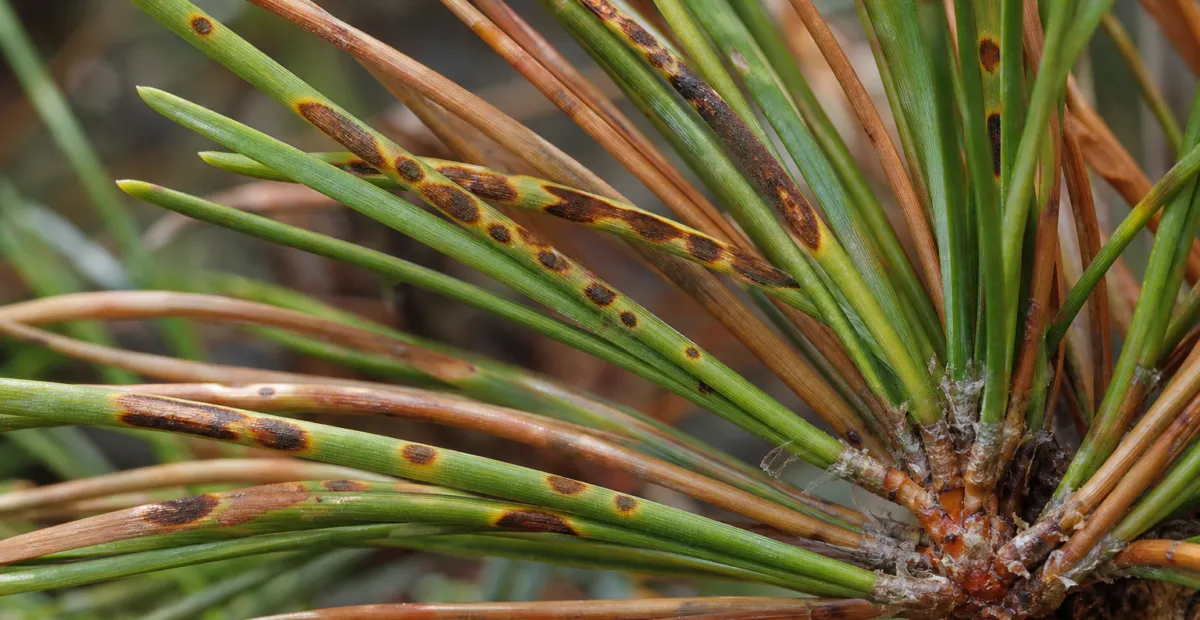
The disease begins as small yellow, brown, reddish-brown or resin-soaked spots on pine needles. Lesions may develop yellow halos, enlarge, and merge. Needle tips commonly die first while portions near the base remain green. Tiny black, oval to elongated fungal fruiting structures may break through the needle surface.
Infected needles often turn reddish-brown and drop prematurely, leaving sparse crowns, bare lower branches and tufts of newer needles near shoot tips. Repeated defoliation reduces growth and can be serious on seedlings and young trees. In mature trees, symptoms may also occur as part of a broader white pine needle disease complex.
Symptoms and identification
- Small yellow-to-brown or dark brown spots, sometimes surrounded by yellow halos.
- Brown needle tips, banding, resin-soaked lesions and eventual reddish-brown discoloration.
- Tiny black acervuli or stromata protruding through dead needle tissue.
- Premature needle shedding, most conspicuous on lower branches.
- Thin crowns, reduced growth and persistent bare areas after repeated infection.
Symptoms overlap with Dothistroma needle blight, Lophodermium needle cast, Diplodia tip blight, ozone injury and other causes of pine needle loss. Laboratory confirmation is advisable when management decisions are important.
Causes and spread
Lecanosticta acicola survives in infected needles that remain attached to branches and in fallen needle litter. It produces conidia and ascospores that move primarily with wind-driven rain, splashing water and wet-weather contact. Contaminated pruning tools can also transfer inoculum between trees.
Infection occurs when spores germinate on wet needles and enter through stomata or wounds. Warm temperatures, prolonged needle wetness, high humidity, dense canopies and poor air movement increase risk. New succulent growth is often especially vulnerable, although needles of several ages can be infected.
Life cycle and persistence
The fungus overwinters in dead or infected pine needles, attached foliage, needle litter and sometimes infected branch tissue. During favorable wet conditions, black fruiting structures release conidia and, where the sexual state is present, ascospores. Spores infect susceptible pine needles through natural openings or wounds.
Most infections occur during spring and other periods of persistent warm, wet weather, while visible browning and needle drop may develop weeks or months later. Fruiting structures can continue producing spores from needles on the tree or on the ground, allowing annual disease cycles where inoculum remains abundant.
Treatment and control
Remove and dispose of severely infected lower branches or small trees when this is practical, using clean tools during dry conditions. Do not expect pruning to cure the disease; it reduces inoculum and improves airflow. Maintain adequate water during drought, correct site stress, and avoid unnecessary wounds.
In nurseries, seedling beds and selected landscape situations, preventive fungicide applications may protect newly expanding needles when disease history and weather forecasts indicate sustained warm, wet conditions. Fungicides protect uninfected tissue; they do not restore dead needles. Large mature forest stands are generally managed primarily through silviculture because repeated chemical treatment is difficult and often uneconomical.
Because similar symptoms are caused by several fungi and abiotic stresses, submit representative needles to a university or state plant diagnostic laboratory when the diagnosis is uncertain.
Low-impact and biological control
- Rake and remove infected needle litter beneath valuable small trees where feasible; avoid spreading debris to healthy pines.
- Prune badly affected branches with disinfected tools during dry weather.
- Thin crowded pine plantings or remove nearby vegetation that keeps foliage wet and shaded.
- Use drip or root-zone irrigation rather than overhead sprinklers.
- Select less susceptible pine species or resistant seed sources for new plantings where locally appropriate.
- In longleaf pine ecosystems, prescribed burning may reduce infected litter and disease pressure when conducted by qualified professionals under an approved burn plan; it is not a general home-garden treatment.
Prevention
- Plant pines at spacing that allows mature crowns to remain open and well ventilated.
- Choose healthy, disease-free nursery stock and, where practical, pine seed sources with documented resistance or lower susceptibility.
- Favor species and provenances suited to the site; avoid repeatedly planting highly susceptible pines in chronically wet, crowded locations.
- Direct sprinklers away from foliage and irrigate the root zone rather than the crown.
- Improve air movement by removing competing vegetation and, where appropriate, selectively thinning crowded lower branches or stands.
- Prune during dry weather and disinfect tools between trees.
- Remove heavily infected fallen needles and branches where practical, especially around nursery stock and small landscape trees.
Interesting facts
- Lecanosticta acicola has been documented on more than 50 pine species and hybrids worldwide, but susceptibility and disease severity vary substantially among species, regions and tree ages.
- Longleaf pine seedlings in the grass stage are historically important hosts in the southeastern United States, while recent outbreaks have also affected loblolly pine plantations.
- Eastern white pine may show Lecanosticta acicola as one member of a wider white pine needle disease complex involving several fungi.
- Brown spot needle blight is often most severe in lower crowns, where humidity, splash dispersal and slower drying favor infection.
- Repeated annual defoliation can reduce growth; mortality is more likely in young or severely stressed trees than in otherwise vigorous mature pines.
Use chemical products only when necessary and only if they are legally authorized and currently labeled in the United States for the specific crop or site and the disease or applicable needle-blight use. Product registrations, labels, rates, protective-equipment requirements and site restrictions can change. Follow the current label exactly; do not treat based solely on a product name or on a label for a different host, disease or setting. Copper-based or chlorothalonil products may be labeled for some conifer nursery, orchard, forest or landscape uses, but availability and legal use must be verified locally. Apply preventively to susceptible new foliage rather than expecting sprays to reverse existing needle death.