
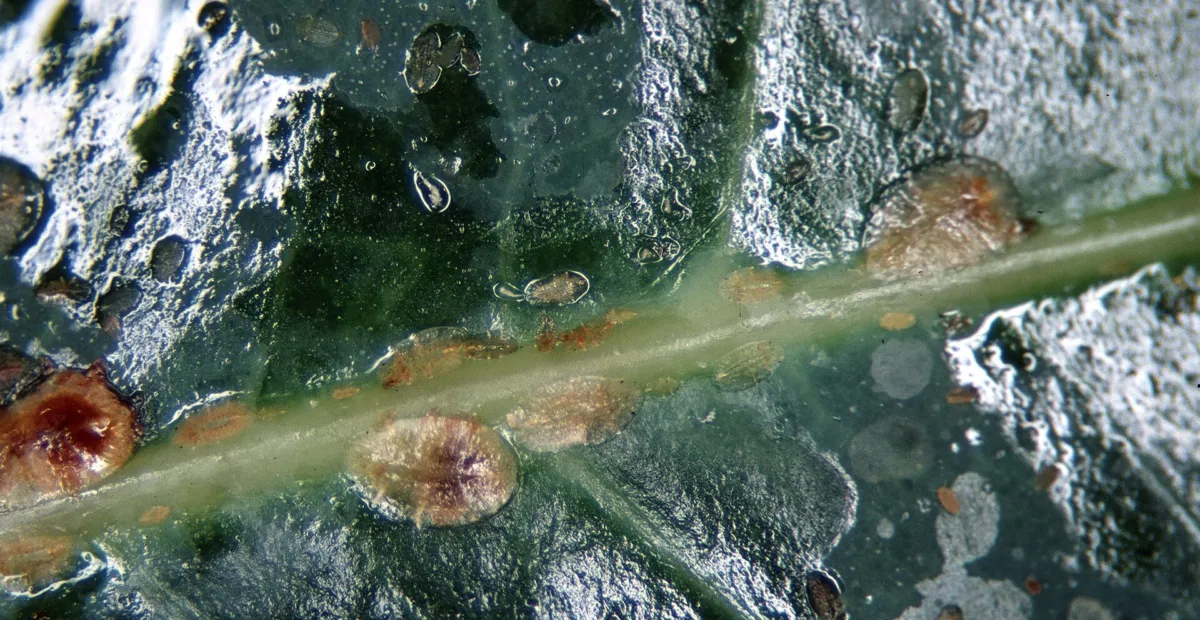
Brown Soft Scale
Coccus hesperidumBrown Soft Scale overview
Brown soft scale, Coccus hesperidum, is a sap-feeding soft scale insect found on citrus, avocado, holly, houseplants, and many other broadleaf plants in the United States. It produces sticky honeydew that supports black sooty mold and attracts ants. Light infestations are often tolerated, while persistent, heavy populations can weaken plants, reduce vigor, damage twigs, and lower fruit quality.
Typical conditions
Overview
Brown soft scale is a small, oval, slightly convex soft scale. Females and nymphs range from yellowish green or mottled yellow-brown to darker brown, and mature females are generally about 1/16 to 1/5 inch long. Unlike armored scales, the insect’s body forms the visible covering and cannot be lifted away as a separate shield.
It occurs on many broadleaf plants, especially broadleaf evergreens, citrus, avocado, holly, ornamental houseplants, palms, and some fruit and landscape trees. A few scales rarely cause meaningful injury, but ant-tended colonies or heavy infestations can become persistent.
Symptoms and identification
- Oval, flattened-to-convex yellow-brown or brown scales attached to leaves, petioles, twigs, and occasionally fruit.
- Sticky honeydew on foliage, branches, lower leaves, containers, or surfaces beneath the plant.
- Black sooty mold developing on honeydew-coated leaves and fruit.
- Yellowing, premature leaf drop, reduced growth, twig dieback, or lower yield when populations are heavy or plants are stressed.
- Ant activity around the plant, often indicating that ants are protecting honeydew-producing scales.
Mixed sizes in the same colony are useful for distinguishing brown soft scale from similar species such as citricola scale, which commonly has more synchronized development.
Causes and spread
Infestations begin when mobile first-instar crawlers disperse to new feeding sites. Crawlers can move between nearby plants, be carried on infested nursery stock, tools, clothing, plant debris, wind-driven movement, or splashing water. Brown soft scale can also spread indoors when infested houseplants are moved or grouped closely.
Warm conditions, lush succulent growth, crowded plantings, poor air movement, plant stress, and repeated broad-spectrum insecticide use favor outbreaks indirectly by disrupting parasitoids and predators. Ants commonly increase survival by harvesting honeydew and defending scales from natural enemies.
Life cycle and persistence
Brown soft scale generally reproduces without a significant male component in many US populations. Females produce eggs beneath the body over an extended period, especially during summer; eggs hatch quickly and the mobile crawlers settle after a short searching period.
After settling, nymphs molt twice and develop into females. Several overlapping generations may occur each year—commonly three to five under favorable conditions—so eggs, crawlers, nymphs, and adults can be present together. Populations are often greatest from midsummer through early fall, although scales may remain on evergreen hosts throughout the year. On deciduous hosts, some nymphs overwinter on twigs or bark.
Treatment and control
Confirm that the insects are brown soft scale rather than armored scale, mealybugs, aphids, or citricola scale. If the plant is vigorous and natural enemies are present, monitoring may be preferable to treatment. Remove accessible scales by hand, with a soft brush, or by washing foliage; repeated attention is needed because eggs and settled scales remain attached.
For a localized infestation, prune affected material and improve ant control. Horticultural oils or insecticidal soaps can be useful against crawlers and young nymphs when thoroughly applied to labeled plant surfaces. Coverage is critical, but avoid spraying drought-stressed plants, tender new growth, open flowers, or heat-stressed foliage. Repeat monitoring and treatment only as permitted by the product label and only when living scales remain.
In commercial citrus or other crops, treatment decisions should be based on scouting, crop stage, natural-enemy activity, and local extension recommendations. Heavy infestations may require professional diagnosis and a crop-specific IPM plan.
Low-impact and biological control
- Conserve parasitoid wasps, especially Metaphycus and Coccophagus species, and predatory lady beetles such as Rhyzobius and Chilocorus where locally established.
- Control honeydew-tending ants so natural enemies can reach the scales.
- Use hand removal, pruning, water washing, horticultural oil, or insecticidal soap when these materials are compatible with the crop and legally labeled.
- Favor spot treatment over whole-plant spraying when colonies are localized.
- Inspect for parasitism: darkened scales and small round exit holes may indicate that parasitoids are already suppressing the population.
Prevention
- Inspect new plants carefully, especially leaf undersides, stems, leaf axils, and tight foliage, and isolate suspicious plants before placing them with a collection.
- Prune out and discard heavily infested twigs or leaves where practical; bag or remove debris rather than composting severely infested material.
- Manage ants with exclusion, sanitation, reduced access to plants, and bait-based control used according to its label. Do not rely on spraying ants on foliage alone.
- Avoid unnecessary broad-spectrum insecticides that can destroy scale parasitoids, lady beetles, and other beneficial organisms.
- Maintain even irrigation, appropriate fertilization, good light, and adequate spacing without encouraging excessive soft growth.
- Monitor monthly and more frequently from spring through early fall, using a hand lens to look for crawlers and newly settled nymphs.
Interesting facts
- Brown soft scale is unusual among soft scales because it can produce several overlapping generations each year.
- Different-sized scales occurring together are an important field clue for separating it from citricola scale.
- Honeydew, rather than direct feeding injury, is often the most conspicuous problem in landscape and houseplant settings.
- Ants may protect colonies, while parasitoids and predatory lady beetles can provide substantial biological control.
- Reports of host plants are broad and vary by region; a record on a plant does not necessarily mean that serious damage is expected.
Use only pesticide products legally authorized for brown soft scale on the specific crop or ornamental plant in your country and state. Follow the current label exactly, including crop/site, rate, timing, personal protective equipment, reentry, pollinator precautions, and harvest restrictions. Product registrations and permitted uses change; do not apply a pesticide based only on a general recommendation or on a label for a different crop.
Affected plants
The plants below are linked to this problem by structured host-plant data. The list updates automatically as new plant profiles are added.
 Apple tree (Malus domestica) care guideMalus domestica
 Musa acuminata care guideMusa acuminata
 Sweet wild banana (Musa balbisiana) care guideMusa balbisiana
 Musa basjoo care guideMusa basjoo
 Musa itinerans care guideMusa itinerans
 Flowering Banana (Musa ornata) care guideMusa ornata
 Darjeeling banana (Musa sikkimensis) care guideMusa sikkimensis
 Abaca (Musa textilis) care guideMusa textilis
 Pink Banana (Musa velutina) care guideMusa velutina
 European Ivy (Hedera helix) care guideHedera helix
 Noble Orchid (Cymbidium goeringii) care guideCymbidium goeringii
 Cymbidium insigne care guideCymbidium insigne