
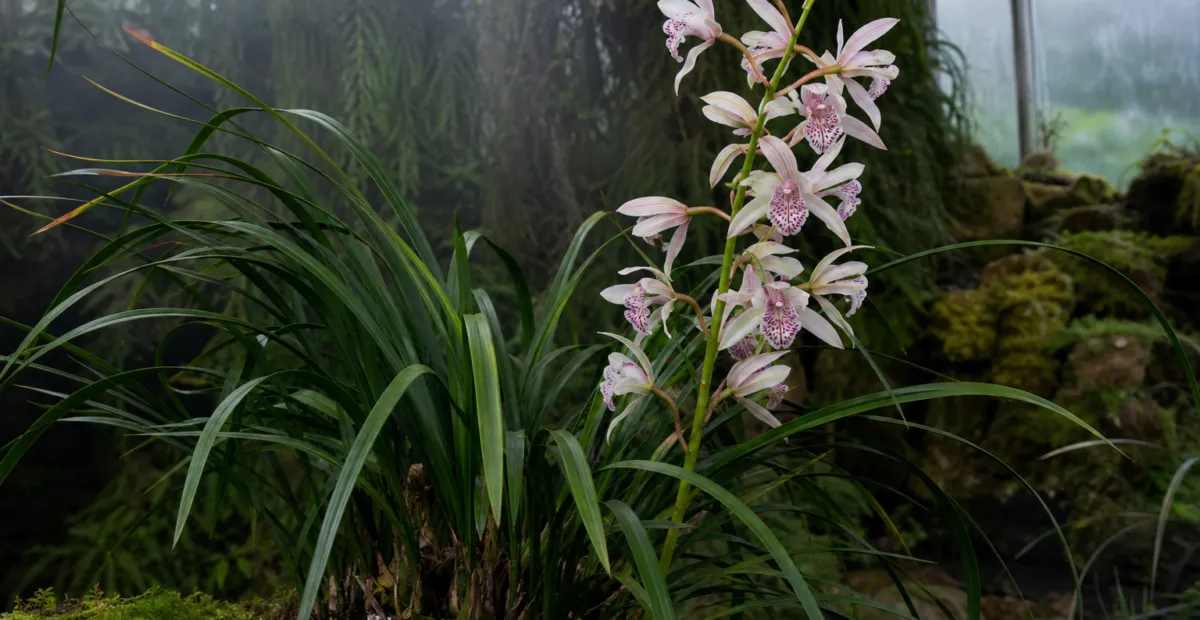
 AI-generated illustration
Cymbidium insigne short overview
Cymbidium insigne is a large, evergreen terrestrial orchid from cool, elevated cloud-forest habitats in Thailand, Vietnam, and Hainan, China. It forms substantial pseudobulbs and arching clumps of narrow leaves, then produces tall autumn-to-spring flower spikes bearing several to many long-lasting white, cream, or pale pink blooms. In the United States, it is best grown in a cool greenhouse, sheltered patio setting, or bright indoor space with strong seasonal temperature variation.
Taxonomic classification
Cymbidium insigne care guide
Light and placement
Give bright filtered light or partial shade, ideally near an east- or west-facing window indoors or under 50–70% shade outdoors. A cool, bright greenhouse is particularly suitable. Pale green leaves and weak growth suggest insufficient light; bleached, yellowing, or scorched patches indicate excessive direct sun. Strong light is useful for flowering, but midday summer sun may burn the leaves.
Watering and humidity
Water thoroughly when the upper layer of the mix is approaching dryness, allowing excess water to drain completely. Keep the plant more evenly moist while new leaves and pseudobulbs are developing in spring and summer, then reduce watering as flower spikes mature and keep the mix only lightly moist in winter. Never leave the container standing in water. Humidity is helpful, but wet foliage in stagnant air encourages disease.
Soil and growing medium
Use a coarse, airy terrestrial-orchid medium containing fine bark, perlite or pumice, and moisture-retentive organic material without becoming compacted. The roots need both moisture and oxygen, so ordinary dense potting soil is unsuitable. A slightly acidic to neutral reaction is appropriate. Repot when the medium decomposes, drainage slows, or the plant has outgrown its container.
Feeding
Feed during active spring and summer growth with a balanced orchid fertilizer diluted to about one-quarter to one-half the label rate every two to four weeks. Flush the pot periodically with plain water to limit salt buildup. Reduce or stop feeding when growth has matured and during cool winter conditions, especially if the plant is not actively producing roots or leaves.
Growth and habit
This species develops successive ovoid pseudobulbs into a substantial, clump-forming plant. Mature pseudobulbs can support flowering spikes from their bases, so avoid removing healthy older bulbs. Good flowering depends on strong light, mature growth, and cool nights in late summer and autumn. Divide only when the clump is large enough to retain several vigorous pseudobulbs in each section.
Planting and repotting
Use a container only slightly larger than the root mass and provide generous drainage holes. Position the pseudobulbs at the surface, with the newest growth facing into available space. Do not bury the bulbs or pack the medium tightly around the roots. After planting or division, keep the medium lightly moist and provide bright filtered light while roots re-establish.
Repot in spring after flowering or when the potting medium has broken down. Move the plant into a container only modestly larger than the root system. Remove decomposed material, trim only dead roots, and keep firm pseudobulbs above the medium. Avoid frequent disturbance because recovery is slower when roots are repeatedly damaged.
Propagation and pruning
Propagation
The practical method is division during spring repotting, separating a large clump into sections with several healthy pseudobulbs and active roots. Seed propagation requires specialized orchid-flasking techniques and a sterile culture environment because orchid seeds lack substantial food reserves. Allow divided plants time to establish before heavy feeding.
Pruning
Remove a spent flower spike only after flowering has finished and the spike has yellowed or dried. Cut it close to the base with sterilized pruners. Remove dead leaves, dry sheaths, and fully shriveled pseudobulbs, but retain firm green pseudobulbs because they store energy and may support future growth.
Overwintering
In most of the United States, move the plant indoors or into a frost-free greenhouse before the first freeze. Provide bright light, cool nights, and reduced watering while growth is resting. A winter night range around 50–57°F is useful for flowering, while prolonged freezing, saturated roots, and hot indoor rooms can cause decline or prevent bud development.
Uses
Primarily grown as a specimen orchid, greenhouse plant, container plant, and long-lasting cut flower. It is also historically important in Cymbidium hybrid breeding. In the United States, dependable flowering generally requires cool autumn and winter conditions, making a cool greenhouse or sheltered coastal climate more suitable than a warm indoor room.
Appearance
The plant has prominent egg-shaped, slightly flattened pseudobulbs enclosed by basal sheaths. Each growth carries several long, narrow, semi-rigid leaves that arch outward. Tall erect to arching racemes rise from the base of mature new pseudobulbs. The relatively large flowers have a conspicuous three-lobed lip and occur in close-set groups along the spike.
Flowering
Flower spikes typically emerge from the bases of newly matured pseudobulbs from autumn into spring. A spike may carry roughly 10–30 close-set flowers, each about 2.8–3.5 inches across. The blooms are long-lasting and show a prominent three-lobed lip. Cool nights and a noticeable day-to-night temperature drop help initiate and sustain flowering in cultivation.
Pollination and visitors
The unstriped form has been documented as pollinated by female workers of Bombus eximius, with queens contributing less often. Cymbidium flowers use a pollinium-transfer mechanism in which a visiting bumblebee can acquire the pollen masses while exiting the flower. The flowers are associated with pollination by floral deception rather than a clearly documented nectar reward.
Cymbidium insigne photos
Click any photo for a larger view. Source, author and license are shown separately.
Diseases and pests
Diseases
Prevent root and pseudobulb rot with a porous medium, drainage, careful watering, and good air movement. Brown or black soft tissue should be isolated and cut away with sterilized tools. Avoid prolonged leaf wetness and remove fallen debris. If fungal or bacterial spotting spreads, improve ventilation and consider a labeled orchid fungicide or bactericide according to its US label.
Pests
Watch for scale, mealybugs, aphids, thrips, and spider mites, especially in dry indoor conditions or crowded greenhouses. Inspect leaf bases, pseudobulbs, and flower spikes regularly. Isolate infested plants, remove light infestations mechanically, and use insecticidal soap or horticultural oil only when the label permits orchid use; avoid treating flowers in hot conditions.
Related diseases and pests
Only Plant Doctor profiles whose host data indicate this plant may be affected are shown here.
 PestBrown Soft ScaleCoccus hesperidum
 DiseaseBacterial soft rotPectobacterium carotovorum
 PestGreenhouse thripsHeliothrips haemorrhoidalis
 DiseaseBlack Root RotBerkeleyomyces basicola
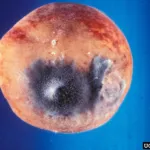 DiseaseRhizopus soft rotRhizopus stolonifer
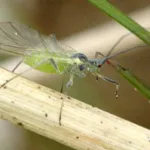 PestGreen Peach AphidMyzus persicae
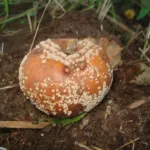 DiseaseEuropean brown rotMonilinia fructigena
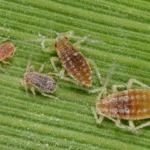 PestMealy Plum AphidHyalopterus pruni (Geoffroy, 1762)
Toxicity and pollen
A species-specific toxicology assessment for Cymbidium insigne was not located. The ASPCA database does not provide a confirmed entry for this exact species, so absence from that list should not be treated as proof of complete safety. Prevent chewing or ingestion, and contact a veterinarian or poison service if a pet develops symptoms after eating plant material. Wear gloves if handling causes skin irritation.
- Typical season
- Typically autumn through spring when flowering
- Pollination / pollen
- Sticky pollinia packaged in discrete masses rather than freely airborne pollen
Orchid pollen is packaged as sticky pollinia rather than released as a large cloud of loose, wind-dispersed grains. This suggests relatively low airborne exposure compared with wind-pollinated plants, but it does not prove that sensitive people cannot react. Direct contact with flowers or handling plant material may still cause irritation in susceptible individuals.
Native habitat
Cymbidium insigne occurs in highland primary cloud forests at approximately 3,280–8,530 feet elevation. It grows terrestrially in shallow, sandy soils among sandstone rocks, often beneath or near low shrubs. Its native conditions combine cool temperatures, seasonal moisture, bright but filtered light, and excellent drainage.
Interesting fact
Cymbidium insigne was described by Rolfe in 1904. The species became a significant influence in the development of modern large-flowered Cymbidium hybrids. Its tall spikes can exceed 3 feet and may carry more than two dozen flowers. The species is terrestrial rather than a typical tree-dwelling epiphyte. Its pollination can involve floral deception.
Frequently asked questions (FAQ)
The most relevant questions about this plant, with short and direct answers.
🌱Quick care
What is Cymbidium insigne?⌄
Cymbidium insigne is a species of boat orchid in the orchid family Orchidaceae. It is native to parts of southern China and mainland Southeast Asia, where it grows in wet, often mountainous habitats.
Is Cymbidium insigne easy to grow?⌄
Cymbidium insigne is moderately easy to grow when given bright light, steady moisture, good drainage, and cool conditions for flowering. It is less forgiving of heat, stagnant air, and waterlogged roots.
How much light does Cymbidium insigne need?⌄
Give Cymbidium insigne bright filtered light to partial shade. A bright east-facing window or a shaded south- or west-facing location is usually suitable, while harsh hot afternoon sun can scorch the foliage.
How often should I water Cymbidium insigne?⌄
Water Cymbidium insigne thoroughly whenever the surface of the mix is nearly dry, keeping the roots evenly moist during active growth. Reduce watering in winter, but do not allow the pseudobulbs to remain shriveled for long.
What type of soil does Cymbidium insigne need?⌄
Use a free-draining terrestrial orchid mix that retains some moisture without becoming soggy. A commercial Cymbidium mix or a blend containing fine bark, perlite, and moisture-retentive organic material is appropriate.
🌤️Environment and placement
Can Cymbidium insigne grow outdoors in the United States?⌄
Cymbidium insigne can grow outdoors in mild U.S. climates if it receives bright filtered light and protection from frost. In colder areas, move it into a bright, cool greenhouse, sunroom, or sheltered indoor location before freezing weather.
What temperature does Cymbidium insigne need to flower?⌄
Cool nights are important for flowering, with fall and winter nighttime temperatures around 50–60°F often beneficial. Prolonged heat, especially nights consistently above about 65°F, can reduce or prevent flowering.
Can Cymbidium insigne tolerate frost?⌄
Cymbidium insigne should be protected from frost. Brief cool exposure may not cause immediate damage, but freezing temperatures can injure leaves, roots, and developing flower spikes.
What humidity is best for Cymbidium insigne?⌄
Moderate humidity around 40–60% is generally suitable for Cymbidium insigne. Good air movement is essential when humidity is high because it helps reduce fungal problems and flower spotting.
Where should I place Cymbidium insigne indoors?⌄
Place Cymbidium insigne near a bright east-facing window or near a south- or west-facing window filtered by a sheer curtain. Keep it away from heating vents, hot glass, and sudden temperature changes while it is in bud.
💧Care and problems
Why is my Cymbidium insigne not flowering?⌄
The most common reasons are insufficient light, excessive warmth, or inadequate seasonal temperature change. Increase bright filtered light and provide cool fall and winter nights while avoiding severe drying or excessive fertilizer.
Why are Cymbidium insigne leaves turning dark green?⌄
Dark green leaves usually indicate that Cymbidium insigne is receiving too little light for strong growth and flowering. Move it gradually to a brighter filtered location, watching for bleaching or scorch.
Why are Cymbidium insigne leaves yellowing?⌄
Yellow leaves may result from natural aging, excessive light, poor roots, or overwatering. Check the roots and potting mix first, because constantly wet conditions can cause root decline and yellow foliage.
How should I fertilize Cymbidium insigne?⌄
Fertilize Cymbidium insigne lightly and regularly during active growth with a balanced orchid fertilizer, following the product label. Flush the pot with plain water periodically to reduce fertilizer-salt buildup, and fertilize little or not at all during winter.
Does Cymbidium insigne need good air circulation?⌄
Yes, Cymbidium insigne benefits from gentle, continuous air circulation. Moving air helps leaves dry, reduces fungal disease risk, and is especially useful when the plant is grown in humid conditions.
What pests affect Cymbidium insigne?⌄
Cymbidium insigne may be affected by scale, aphids, mealybugs, spider mites, and thrips. Inspect leaf bases and new growth regularly, isolate infested plants, and use a labeled treatment according to its directions.
🪴Planting and repotting
When should I repot Cymbidium insigne?⌄
Repot Cymbidium insigne after flowering or in early spring when the potting mix has broken down or the plant has outgrown its container. Avoid repotting simply because the plant is blooming or producing a new spike.
What kind of pot is best for Cymbidium insigne?⌄
Choose a sturdy pot with excellent drainage and enough room for roughly two years of new growth. Cymbidiums can become top-heavy, so a heavier container or a well-balanced pot helps prevent tipping.
Should Cymbidium insigne be planted in regular potting soil?⌄
No, regular houseplant soil usually holds too much water around the roots. Plant Cymbidium insigne in a free-draining orchid mix designed for terrestrial or Cymbidium orchids.
How deeply should I plant Cymbidium insigne pseudobulbs?⌄
Set the pseudobulbs at the same depth they were previously growing, leaving the newest growth near the surface. Burying the pseudobulbs deeply can keep them too wet and encourage rot.
✂️Propagation and pruning
How do I propagate Cymbidium insigne?⌄
The most practical home method is division of a mature clump into sections containing several healthy pseudobulbs and active growth. Make clean cuts, remove damaged roots, and pot the divisions in a well-drained orchid mix.
Can Cymbidium insigne be grown from seed?⌄
Cymbidium insigne can be grown from seed, but orchid seed normally requires sterile laboratory culture with a suitable fungal or nutrient medium. Seed propagation is therefore not a practical home-gardening method.
Can I propagate Cymbidium insigne from a flower stem?⌄
No, a cut flower stem will not normally produce a new Cymbidium insigne plant. Propagation is done from divisions, backbulbs under suitable conditions, seed culture, or specialized tissue culture.
When is the best time to divide Cymbidium insigne?⌄
Divide Cymbidium insigne in early or mid-spring, preferably after flowering and when new growth is beginning. Each division should retain multiple viable pseudobulbs and enough healthy roots to establish quickly.
Should I cut off old Cymbidium insigne flower spikes?⌄
Yes, remove a spent flower spike at its base once flowering has finished. Cymbidium insigne does not rebloom from the same spike, and removing it allows the plant to direct energy toward new growth.
⚠️Toxicity and safety
Is Cymbidium insigne toxic to cats or dogs?⌄
Species-specific toxicity for Cymbidium insigne is not firmly established. Keep the plant and potting materials out of reach of pets and contact a veterinarian or poison-control service if ingestion causes symptoms.
Can Cymbidium insigne harm people?⌄
Cymbidium insigne is not specifically established as poisonous to people, but its narrow leaves can have sharp tips that may cause minor scratches. Handle the foliage carefully and keep fertilizer, pesticides, and potting materials away from children.
🌸Flowering and special interest
When does Cymbidium insigne bloom?⌄
Cymbidium insigne commonly flowers during the cooler part of the year, although timing varies with clone, growing conditions, and climate. Cool autumn nights, adequate light, and mature pseudobulbs support flower initiation.
How long do Cymbidium insigne flowers last?⌄
Cymbidium flowers can remain attractive for several weeks when kept cool and protected from heat, direct harsh sun, and wet flowers. A stable location helps prevent premature bud or flower drop.
How can I encourage Cymbidium insigne to bloom again?⌄
Provide strong filtered light, vigorous spring and summer growth, and cooler nights in fall and winter. Avoid excessive nitrogen, chronic overwatering, and warm indoor conditions during the period when flower spikes should form.
What do Cymbidium insigne flowers look like?⌄
Cymbidium insigne produces showy flowers on upright spikes, commonly in white to pink or related pastel shades with markings on the lip. Individual flowers are relatively large, often about 3 inches across, though size varies by form.
Similar plants
 Azure Monkshood (Aconitum carmichaelii) care guideAconitum carmichaelii
 Monkshood (Aconitum ‘Stainless Steel’)Aconitum 'Stainless Steel'
 Monkshood (Aconitum ‘Bressingham Spire’)Aconitum 'Bressingham Spire'
 Golden full moon maple (Acer shirasawanum ‘Aureum’)Acer shirasawanum 'Aureum'
 Globosum (Acer platanoides ‘Globosum’)Acer platanoides 'Globosum'
 Striped maple (Acer pensylvanicum) care guideAcer pensylvanicum