
 Source:
 Seiryu (Acer palmatum ‘Seiryu’) short overview
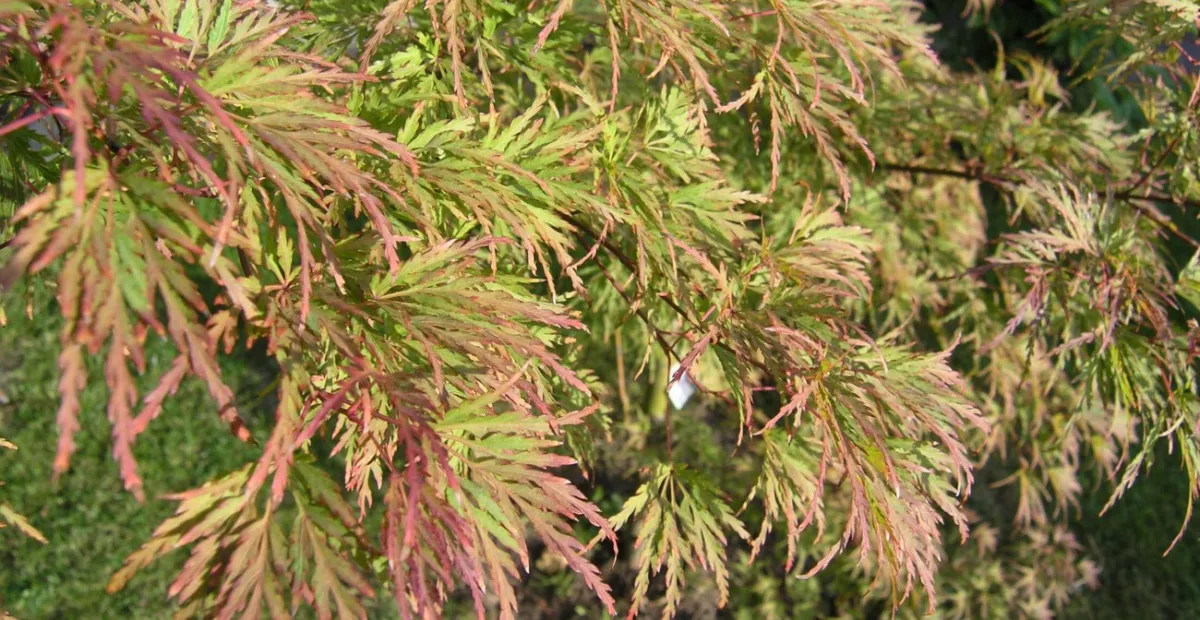
Acer palmatum 'Seiryu' is a distinctive upright laceleaf Japanese maple valued for its finely dissected green leaves, elegant branching, and vivid orange, red, and yellow fall color. Unlike many dissected Japanese maples, it forms a broadly columnar small tree rather than a weeping mound. Give it moist, well-drained soil, shelter from drying winds, and partial shade where summers are hot. Acer palmatum 'Seiryu' is an upright laceleaf Japanese maple with finely dissected green leaves, graceful branching, and strong orange-red fall color.
Taxonomic classification
Seiryu (Acer palmatum ‘Seiryu’) care guide
Light and placement
Grow in full sun to partial shade, with morning sun and afternoon protection preferred in hot climates. East- or north-facing positions, dappled woodland light, or shelter from a building are useful. Too much intense heat, reflected light, drought, or wind can cause brown leaf margins and premature leaf drop; too little light produces weaker growth and less autumn color.
Watering and humidity
Water deeply when the upper few inches of soil begin to dry, then allow excess water to drain. Keep newly planted trees evenly moist through the first two growing seasons. Increase frequency during summer heat, but do not keep roots saturated. A 2–3-inch mulch layer helps moderate soil temperature and moisture without touching the trunk.
Soil and growing medium
Use fertile, moisture-retentive but well-drained loam with plenty of organic matter. Slightly acidic to neutral soil is suitable. Avoid chronically waterlogged ground and heavily compacted clay; improve drainage before planting rather than relying on frequent surface amendments.
Feeding
Apply a balanced, slow-release fertilizer in early spring only if growth is weak or soil testing indicates a need. A thin surface layer of compost can help improve soil structure. Avoid high-nitrogen feeding late in the season, during drought, or immediately after transplanting; excessive lush growth is more prone to scorch and winter injury.
Growth and habit
Forms a strong central framework with upright to broadly columnar branching and a refined, layered silhouette. The cultivar is more architectural than weeping laceleaf types, so routine structural pruning is usually light. Allow the main framework to develop before removing only crossing, damaged, or poorly placed branches.
Planting and repotting
Plant in spring or fall while temperatures are moderate. Set the root flare level with, or slightly above, the surrounding soil and water deeply to settle the root zone. Mulch 2–3 inches deep without touching the trunk. Allow adequate room for the mature canopy and protect new plantings from reflected heat and drying wind.
Repot container plants in late winter or early spring before bud break, moving up only one pot size. Preserve the root ball, remove circling roots sparingly, and use a free-draining woody-plant mix. Large specimens are best root-pruned and repotted gradually rather than severely disturbed at once.
Propagation and pruning
Propagation
Commercially, preserve the cultivar by grafting onto compatible Acer palmatum rootstock. Softwood cuttings may root under controlled conditions but are less dependable than grafting. Seed does not reliably reproduce the named cultivar and should not be used to make exact clones.
Pruning
Prune lightly in late winter or summer after the strongest sap flow, removing dead, crossing, rubbing, or weakly attached branches. Preserve the natural layered structure and avoid topping. Do not make large cuts unnecessarily; Japanese maples heal slowly compared with many vigorous landscape trees.
Overwintering
Outdoor trees are hardy in much of USDA Zones 5–8, but young plants benefit from a thick, loose mulch layer over the root zone and protection from drying winter wind. Container plants have less root insulation than in-ground trees; move them to a sheltered location or insulate the container during severe freezes, while maintaining dormancy rather than bringing them into a warm room.
Uses
Primarily an ornamental specimen for residential landscapes, woodland edges, Japanese-style gardens, courtyards, patios, and large containers. Its finely divided foliage and upright form provide structure without the broad footprint of many shade trees. It has no established culinary or medicinal use in this profile.
Appearance
The defining feature is the combination of an upright habit and deeply dissected, lace-like leaves. Leaf lobes are narrow and finely cut, while the branches create a layered, airy outline. New stems and mature bark are subtle gray-brown rather than brightly colored. Autumn foliage may progress through yellow, orange, and red before leaf fall.
Flowering
Small reddish flowers appear in spring, usually before or with the expanding foliage. They are ornamental at close range but are not the principal feature of this cultivar; winged samaras may follow after pollination.
Pollination and visitors
The small spring flowers can be visited by bees and other small insects, but this cultivar is grown for foliage and form rather than as a major pollinator plant. Available evidence supports a conservative low-attraction rating rather than a high-value pollinator designation.
Acer palmatum 'Seiryu' photos
Click any photo for a larger view. Source, author and license are shown separately.
Diseases and pests
Diseases
Watch for Verticillium wilt, leaf scorch, cankers, and root problems associated with poor drainage or trunk injury. Reduce stress with consistent moisture, good air circulation, careful mulching, and avoidance of unnecessary root disturbance. Remove severely affected material and sanitize tools; diagnose wilt before replanting with another susceptible maple.
Pests
Potential pests include aphids, caterpillars, gall mites, scale insects, and borers. Inspect new growth and branch unions regularly. Encourage natural enemies, avoid routine broad-spectrum insecticides, and use targeted treatment only when damage is persistent or threatens establishment. Prevent stress and trunk wounds, which make trees more vulnerable.
Toxicity and pollen
No reliable evidence indicates significant human or companion-animal toxicity for Acer palmatum 'Seiryu'. Normal gardening precautions still apply: do not ingest ornamental plant material, prevent pets from chewing large quantities, and seek medical or veterinary advice if unusual symptoms follow ingestion.
- Typical season
- Spring
- Pollination / pollen
- Primarily insect-dispersed pollen
This is a spring-flowering, insect-pollinated maple with relatively inconspicuous flowers. Airborne pollen exposure is expected to be limited compared with strongly wind-pollinated trees, but sensitive individuals can still react to pollen or plant debris. Avoid assuming zero allergy risk.
Native habitat
The species is native to Japan, Korea, and nearby regions of East Asia, where it occurs in temperate woodland environments with seasonal rainfall, fertile soils, and protection from severe exposure. Garden performance is best where roots stay cool and evenly moist while foliage receives good light.
Interesting fact
Unlike many laceleaf Japanese maples, 'Seiryu' has an upright, broadly columnar habit rather than a cascading form. Its finely dissected leaves can turn through yellow, orange, and red in autumn. The cultivar has received the Royal Horticultural Society Award of Garden Merit.
Frequently asked questions (FAQ)
The most relevant questions about this plant, with short and direct answers.
🌱Quick care
What is Acer palmatum 'Seiryu' commonly called?⌄
Acer palmatum 'Seiryu' is commonly called Seiryu Japanese maple or upright laceleaf Japanese maple. It is a deciduous cultivar valued for finely dissected foliage and an upright, tree-like habit rather than the cascading form typical of many laceleaf maples.
How big does Acer palmatum 'Seiryu' get?⌄
Acer palmatum 'Seiryu' typically grows about 10 to 15 feet tall and 8 to 12 feet wide. Mature size varies with climate, soil, rootstock, and growing conditions, and established specimens may occasionally become larger.
Is Acer palmatum 'Seiryu' upright or weeping?⌄
Acer palmatum 'Seiryu' has an upright, broad-rounded habit. Its deeply cut leaves are lace-like, but the branches form a small tree instead of the low, cascading canopy associated with many dissected-leaf Japanese maples.
What USDA zones are best for Acer palmatum 'Seiryu'?⌄
Acer palmatum 'Seiryu' is generally hardy in USDA Zones 5 through 8. In colder areas, protect young trees from drying winter winds, while in hot Zone 8 locations, afternoon shade and consistent soil moisture can reduce heat stress.
🌤️Environment and placement
How much sun does Acer palmatum 'Seiryu' need?⌄
Acer palmatum 'Seiryu' grows in full sun to partial shade. It can take more sun in cooler regions, but morning sun with afternoon shade is usually safer in hot areas because its delicate new leaves can scorch.
Can Acer palmatum 'Seiryu' grow in full sun?⌄
Acer palmatum 'Seiryu' can grow in full sun when soil moisture is dependable and summer temperatures are moderate. In the southern United States or exposed hot sites, provide afternoon shade and protection from reflected heat.
Where is the best place to plant Acer palmatum 'Seiryu'?⌄
Plant Acer palmatum 'Seiryu' in a sheltered location with well-drained, fertile soil and morning sun or filtered light. Avoid hot, dry exposures, strong prevailing winds, and places where pavement or walls intensify summer heat.
What type of soil does Acer palmatum 'Seiryu' prefer?⌄
Acer palmatum 'Seiryu' prefers moist, fertile, organically rich, well-drained loam that is slightly acidic to neutral. It tolerates several soil textures, but compacted or permanently soggy ground increases the risk of root problems.
Does Acer palmatum 'Seiryu' need acidic soil?⌄
Acer palmatum 'Seiryu' grows best in slightly acidic soil, although it can tolerate near-neutral conditions if drainage and fertility are good. Avoid routine soil acidification unless a soil test shows that the planting site needs it.
How much water does Acer palmatum 'Seiryu' need?⌄
Acer palmatum 'Seiryu' needs moderate, consistent moisture, especially while young and during hot, dry weather. Water deeply when the soil begins to dry, but do not keep the root zone saturated.
Can Acer palmatum 'Seiryu' tolerate drought?⌄
Acer palmatum 'Seiryu' has limited drought tolerance and may develop leaf scorch when the root zone becomes dry. Established trees handle short dry periods better than young trees, but regular deep watering is still important during summer drought.
Is Acer palmatum 'Seiryu' suitable for a small yard?⌄
Acer palmatum 'Seiryu' can suit a small yard if its mature spread of roughly 8 to 12 feet is allowed. Its upright form provides vertical interest without the broad, low footprint of many weeping laceleaf maples.
💧Care and problems
How do you care for Acer palmatum 'Seiryu'?⌄
Give Acer palmatum 'Seiryu' well-drained fertile soil, regular moisture, shelter from drying wind, and sun appropriate to your climate. Apply a light organic mulch over the root zone, keeping it a few inches away from the trunk.
Why are the leaves of Acer palmatum 'Seiryu' turning brown?⌄
Brown leaf edges or tips on Acer palmatum 'Seiryu' usually indicate leaf scorch caused by heat, drought, wind, root disturbance, or excessive sun. Keep the soil evenly moist, mulch the root zone, and provide afternoon shade in hot conditions.
Why is Acer palmatum 'Seiryu' losing leaves in summer?⌄
Summer leaf drop on Acer palmatum 'Seiryu' is commonly associated with severe heat, drought, leaf scorch, transplant stress, or root problems. Check soil moisture and drainage first, then move or shade container plants if the site is excessively hot.
Does Acer palmatum 'Seiryu' need fertilizer?⌄
Acer palmatum 'Seiryu' usually needs only modest fertilization when planted in fertile soil. If growth is weak, use a balanced, slow-release fertilizer according to the label in spring, and avoid excess nitrogen that can produce soft, vulnerable growth.
What pests affect Acer palmatum 'Seiryu'?⌄
Potential pests of Acer palmatum 'Seiryu' include aphids, scale, borers, root weevils, and mites. Inspect new growth and the undersides of leaves regularly, and address problems early with cultural controls or a properly labeled treatment.
What diseases affect Acer palmatum 'Seiryu'?⌄
Acer palmatum 'Seiryu' can be affected by stem cankers, leaf spots, anthracnose, verticillium wilt, botrytis, fusarium, and root rots. Good drainage, careful watering, sanitation, and avoiding trunk or root injuries help reduce disease risk.
🪴Planting and repotting
When should Acer palmatum 'Seiryu' be planted?⌄
Plant Acer palmatum 'Seiryu' in fall through early spring while temperatures are mild and the tree is dormant or beginning growth. Container-grown trees can be planted at other times if the root ball is kept moist and heat stress is minimized.
How do you plant Acer palmatum 'Seiryu' in the ground?⌄
Dig a hole no deeper than the root ball and several times wider, set the tree with its original root flare and soil level, then backfill with native soil and water thoroughly. Finish with a 2- to 3-inch mulch layer kept away from the trunk.
Can Acer palmatum 'Seiryu' be grown in a container?⌄
Acer palmatum 'Seiryu' can be grown in a large container with excellent drainage, but it requires more frequent watering than an in-ground tree. Choose a pot that is stable and proportionate to the root ball, and protect it from extreme summer heat and winter exposure.
How often should Acer palmatum 'Seiryu' be repotted?⌄
Repot container-grown Acer palmatum 'Seiryu' when roots circle densely, emerge from drainage holes, or the plant dries unusually quickly. Repotting or modest root pruning is generally safest in late winter or early spring before strong new growth.
✂️Propagation and pruning
Can Acer palmatum 'Seiryu' be grown from seed?⌄
Acer palmatum 'Seiryu' can produce viable winged seeds, but seedlings will not reliably retain the cultivar’s upright habit or finely dissected foliage. To reproduce the named cultivar accurately, use vegetative propagation from a verified plant, commonly grafting.
How is Acer palmatum 'Seiryu' propagated?⌄
Acer palmatum 'Seiryu' is most reliably propagated vegetatively, especially by grafting, so the distinctive cultivar traits are preserved. Seed propagation is useful for growing Japanese maples generally, but it does not produce guaranteed clones of 'Seiryu'.
When should Acer palmatum 'Seiryu' be pruned?⌄
Prune Acer palmatum 'Seiryu' lightly in late fall through winter while the tree is dormant. Remove dead, damaged, crossing, or poorly placed branches, and avoid heavy pruning because the cultivar’s natural structure is one of its main ornamental features.
Can Acer palmatum 'Seiryu' be pruned to stay small?⌄
Acer palmatum 'Seiryu' can be kept somewhat smaller with selective structural pruning, but it should not be repeatedly sheared. Remove individual branches during dormancy and maintain a natural canopy rather than cutting back large portions of the crown.
⚠️Toxicity and safety
Is Acer palmatum 'Seiryu' toxic to people or pets?⌄
No significant toxicity is documented for Acer palmatum 'Seiryu'. Even so, prevent children and pets from chewing ornamental plant material, and contact a medical or veterinary professional if a large amount is ingested or symptoms occur.
🌸Flowering and special interest
Does Acer palmatum 'Seiryu' flower?⌄
Acer palmatum 'Seiryu' produces small reddish to reddish-purple flowers in spring, usually around April depending on local climate. The flowers are ornamental but relatively subtle compared with the cultivar’s finely textured foliage and fall color.
What color does Acer palmatum 'Seiryu' turn in fall?⌄
Acer palmatum 'Seiryu' commonly develops yellow, orange, red, or combinations of these colors in fall. The intensity depends on temperature, sunlight, moisture, and the tree’s overall health.
What does Acer palmatum 'Seiryu' look like in spring and summer?⌄
Acer palmatum 'Seiryu' emerges with green leaves often tipped or flushed with red, then becomes predominantly green in summer. The leaves are deeply dissected and lace-like, creating a fine texture on its upright, layered branches.
Similar plants
 Bigleaf maple (Acer macrophyllum) care guideAcer macrophyllum
 Tatar Maple (Acer tataricum) care guideAcer tataricum
 Acer palmatum care guideAcer palmatum
 Amur Maple (Acer tataricum ginnala) care guideAcer tataricum ginnala
 Bloodgood (Acer palmatum ‘Bloodgood’)Acer palmatum 'Bloodgood'
 Père David’s Maple (Acer davidii) care guideAcer davidii