
 Source:
 Bigleaf maple (Acer macrophyllum) short overview
Bigleaf maple is a majestic deciduous tree native to moist forests, riparian corridors, and canyons of the Pacific Northwest and coastal California. Its enormous, deeply lobed leaves are the largest among maples, while small greenish-yellow flowers appear in hanging clusters in early spring. Give it ample room, cool conditions, reliable moisture, and well-drained soil; shallow roots and vigorous growth make it best suited to parks, woodland edges, and spacious landscapes.
Taxonomic classification
Bigleaf maple (Acer macrophyllum) care guide
Light and placement
Grow in full sun to partial shade. Full sun supports the strongest crown and best growth where summers remain cool; afternoon shade is useful in hotter inland locations. Morning sun with protection from intense late-day heat can reduce leaf scorch. Sparse growth and smaller leaves may indicate insufficient light, while scorched margins, premature browning, and wilt despite moist soil suggest excessive heat or drought.
Watering and humidity
Water deeply and slowly when the upper several inches of soil begin to dry, keeping the root zone evenly moist but not waterlogged. Young trees need regular summer irrigation for several years, especially away from the maritime Northwest. Mature trees tolerate short dry periods better than prolonged drought, but hot, dry conditions can cause scorch and decline. Humidity is helpful but does not replace soil moisture.
Soil and growing medium
Use deep, fertile soil that drains freely while remaining evenly moist. Loam, sandy loam, gravelly alluvial soil, and humus-rich woodland soil can all work if roots do not dry out. Slightly acidic to neutral conditions are preferred, although the species tolerates a broader range. Avoid chronically stagnant water and severely compacted urban soil.
Feeding
Feed only when growth is weak or a soil test shows a deficiency. Apply a thin layer of finished compost or a balanced, slow-release tree fertilizer in early spring, following the product label. Avoid high-nitrogen feeding late in the season, which can encourage soft growth and delay hardening.
Growth and habit
A fast-growing, long-lived tree in open, moist sites, often developing a broad rounded crown and a shallow, spreading root system. It can regenerate strongly from stumps and root crowns. Choose the site carefully because mature trees and post-cutting sprouts can become difficult to manage in confined landscapes.
Planting and repotting
Plant in fall or early spring when the soil is workable. Set the root flare level with or slightly above the surrounding grade, never burying the trunk base. Allow at least 40–75 feet of clearance for a mature specimen, and mulch broadly without touching the bark. Water deeply during the first several summers.
This is a large landscape tree and is not suitable for long-term container culture. Transplant young nursery trees while dormant, preserving the root ball and watering consistently through establishment. Avoid cutting or disturbing the shallow root system unnecessarily.
Propagation and pruning
Propagation
Seed is the standard method. Fresh samaras benefit from 60–120 days of cold stratification, and sowing soon after ripening can work. The species also sprouts vigorously from stumps and root crowns and may be propagated from stem cuttings, though vegetative propagation is less routine for home gardeners.
Pruning
Prune during dormancy to remove dead, damaged, crossing, or poorly attached branches and to establish a strong structure in young trees. Avoid topping. Because branches and crowded stems can be vulnerable in storms, use gradual structural pruning rather than large cuts on mature specimens.
Overwintering
No routine winter protection is needed in suitable zones. Protect young trunks from sunscald and animal browsing where necessary, maintain mulch over the root zone without touching the trunk, and avoid late-season nitrogen. In colder inland sites, establish trees before winter and water deeply before the ground freezes if autumn is dry.
Uses
A valuable ornamental shade and habitat tree for large properties, parks, woodland plantings, riparian restoration, and native landscapes. Its wood is used for lumber, furniture, flooring, veneer, and fuel. Sap can be processed into syrup, although yields are generally lower than sugar maple. Do not treat historical ethnobotanical uses as modern medical advice.
Appearance
Recognized by enormous opposite, palmate leaves with three to five deep lobes, often 8–12 inches across, glossy green upper surfaces, and paler undersides. Young stems are smooth and gray-brown; mature bark becomes darker, furrowed, and scaly. The petioles can exude milky sap when detached. Hanging samara clusters follow flowering.
Flowering
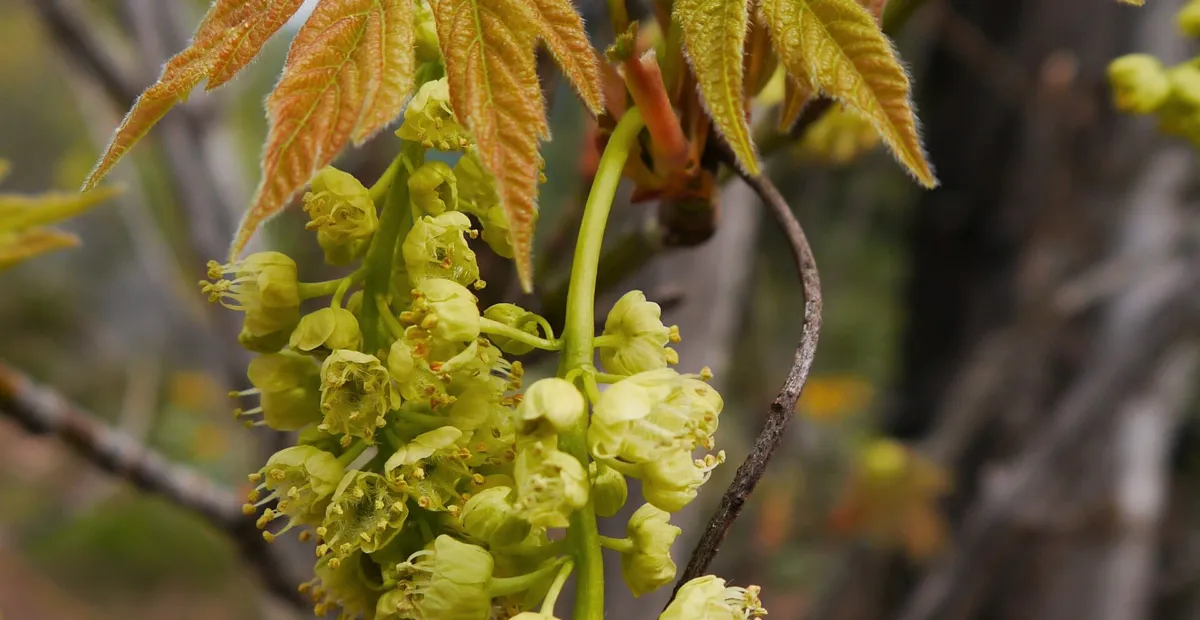
Small greenish-yellow flowers are arranged in hanging racemes and commonly open before or with leaf emergence. Individual flowers are inconspicuous, but mature trees can carry many clusters. Flowering is usually early spring, with timing ranging from late March in southern areas to June at northern or high-elevation sites.
Pollination and visitors
Early flowers provide nectar and pollen for mining bees, mason bees, bumble bees, and honey bees. The bloom period can be valuable when relatively few other trees are flowering. Flowers are insect-visited; the principal documented visitors are bees and other insects rather than a single specialist pollinator.
Acer macrophyllum photos
Click any photo for a larger view. Source, author and license are shown separately.
Diseases and pests
Diseases
Generally dependable, but stressed trees may develop common maple problems such as cankers, decay, leaf spots, or verticillium wilt. Prevent injury, improve drainage, avoid drought stress, and remove heavily infected material. Do not use routine fungicides without a confirmed diagnosis.
Pests
Watch for aphids, scale insects, caterpillars, borers, and occasional defoliators. Healthy established trees usually tolerate minor insect damage. Improve vigor first; use targeted controls only when damage is persistent or threatens young trees.
Toxicity and pollen
No well-established species-specific toxicity classification was located in the reviewed authoritative horticultural and forestry sources. Do not assume that absence of a listing proves safety; prevent children and pets from consuming leaves, bark, seeds, sap, or other plant material, and contact a poison-control or veterinary service after a significant ingestion.
- Typical season
- Late winter through spring, generally March–May in much of the United States range
- Pollination / pollen
- Airborne tree pollen from spring flowers
Bigleaf maple releases airborne pollen during its spring flowering period. Maple pollen is represented in clinical and allergy-related pollen materials, but species-specific exposure intensity and prevalence are not well quantified. People with seasonal tree-pollen sensitivity may wish to limit exposure during bloom and keep windows closed during high-pollen conditions.
Native habitat
Native from southeastern Alaska and British Columbia through western Washington and Oregon to California. It is characteristic of moist forests, riparian terraces, floodplains, canyons, mixed-evergreen forests, and woodland edges, with best development where roots can access moisture before the dry season.
Interesting fact
Its leaves are commonly up to about 12 inches wide and are the largest among maples. Large trees support mosses, lichens, ferns, birds, mammals, and insects. The species can sprout rapidly after cutting or top-kill and is useful in riparian restoration.
Frequently asked questions (FAQ)
The most relevant questions about this plant, with short and direct answers.
🌱Quick care
What is bigleaf maple?⌄
Bigleaf maple (Acer macrophyllum) is a large, deciduous maple native to the Pacific Coast of North America. It is recognized for its exceptionally large leaves, broad crown, yellow-green spring flowers, and paired winged fruits.
How big does bigleaf maple get?⌄
Bigleaf maple commonly grows about 50–75 feet tall and wide, although exceptional trees can exceed 80 feet. Give it substantial horizontal and vertical space because its mature crown can become broad and spreading.
How fast does bigleaf maple grow?⌄
Bigleaf maple can grow rapidly when young, especially in deep, fertile, moist soil with adequate sunlight. Growth slows as the tree matures and is usually less vigorous in hot, dry, compacted, or poorly drained locations.
🌤️Environment and placement
Where does bigleaf maple grow naturally?⌄
Bigleaf maple is native to western North America from British Columbia through Washington and Oregon into California. It is most characteristic of moist woods, stream corridors, floodplains, canyons, and other cool, mesic sites.
What USDA hardiness zones are suitable for bigleaf maple?⌄
Bigleaf maple is generally suitable for USDA Zones 5 or 6 through 9, depending on the source and local conditions. It performs best where summers are relatively cool and soils remain reliably moist.
Does bigleaf maple grow in full sun or shade?⌄
Bigleaf maple grows in full sun to partial shade and is reasonably shade tolerant. In hot inland climates, afternoon shade and consistent soil moisture can reduce heat and drought stress.
Can bigleaf maple grow in hot or humid climates?⌄
Bigleaf maple is usually better adapted to the cool, moist climate of the Pacific Northwest and coastal California than to hot, humid summers. It may struggle outside its native climate unless provided with deep soil, regular moisture, and protection from extreme heat.
What soil is best for bigleaf maple?⌄
The best soil is moist, fertile, well-drained loam or alluvial soil with good organic matter. Bigleaf maple can tolerate gravelly or somewhat dry soils in suitable climates, but it does not perform well in persistently saturated soil.
Can bigleaf maple tolerate wet soil or flooding?⌄
Bigleaf maple tolerates periodic or short-term flooding, particularly in riparian settings, but it does not tolerate prolonged saturation. Avoid locations where water remains around the roots for extended periods.
💧Care and problems
How often should I water bigleaf maple?⌄
Water bigleaf maple deeply whenever the upper soil begins to dry, keeping the root zone evenly moist rather than constantly soggy. Newly planted trees need regular irrigation during dry periods, while established trees may need supplemental water during summer drought.
Does bigleaf maple need fertilizer?⌄
Bigleaf maple usually needs little fertilizer when planted in fertile soil and mulched regularly. Test the soil before feeding, and correct a documented nutrient deficiency rather than applying high-nitrogen fertilizer routinely.
Why are bigleaf maple leaves turning brown?⌄
Brown leaf edges or premature leaf drop are commonly caused by drought, heat, root stress, or transplant shock. Check soil moisture, improve mulch coverage, and avoid fertilizer while the tree is under water stress.
What pests and diseases affect bigleaf maple?⌄
Bigleaf maple has relatively few consistently serious insect pests, but it can be affected by verticillium wilt, root rots, decay fungi, and other problems associated with wounds or stressed roots. Good drainage, proper watering, and careful pruning help reduce risk.
Why is my bigleaf maple losing branches or developing decay?⌄
Large wounds, weak branch unions, and decay fungi can cause branch dieback or structural failure in bigleaf maple. Have significant defects assessed by a qualified arborist, especially when the tree is near buildings, roads, or play areas.
🪴Planting and repotting
When is the best time to plant bigleaf maple?⌄
Plant bigleaf maple during the dormant season, typically in fall after leaf drop or in late winter before active growth begins. In areas with frozen ground or severe winter weather, plant in early spring after the soil becomes workable.
How do I plant a bigleaf maple tree?⌄
Plant it with the root flare level with or slightly above the surrounding soil, in a wide hole no deeper than the root ball. Backfill with native soil, water thoroughly, and apply a 2–4-inch mulch layer without touching the trunk.
How far from a house should I plant bigleaf maple?⌄
Plant bigleaf maple well away from buildings, sidewalks, overhead utilities, and septic systems because it develops a large crown and substantial root system. A distance of at least 30 feet from structures is a reasonable starting point, with more space preferred for unrestricted growth.
Can bigleaf maple be grown in a container?⌄
Bigleaf maple is not a good long-term container plant because it becomes a large tree with extensive roots and high water needs. A container may be used temporarily for a young nursery tree, but it should be planted outdoors before becoming root-bound.
✂️Propagation and pruning
How do you propagate bigleaf maple from seed?⌄
Collect mature paired samaras in late summer or fall and sow fresh seed promptly, because fresh seed generally germinates more reliably. Protect the seed from drying and rodents, and expect natural germination to occur during the cool, moist season.
Can bigleaf maple be propagated from cuttings?⌄
Bigleaf maple can be propagated from stem cuttings, although success is less predictable than with some smaller maples. Use healthy juvenile material, a sterile well-drained medium, consistent humidity, and rooting conditions appropriate for woody cuttings.
Does bigleaf maple regrow from a stump?⌄
Yes, bigleaf maple often sprouts vigorously from cut stumps and can produce many shoots. This ability is useful for regeneration but may create dense, weakly attached sprouts that require selective removal if the tree is being managed ornamentally.
When should I prune bigleaf maple?⌄
Prune bigleaf maple during the dormant season or during a dry period when disease pressure is lower, removing dead, damaged, crossing, or poorly attached branches. Avoid excessive pruning because large wounds can invite decay.
Can bigleaf maple be pollarded or heavily topped?⌄
Heavy topping is not recommended for bigleaf maple because it creates weakly attached shoots, large wounds, and decay-prone branch stubs. If size reduction is necessary, use selective reduction cuts performed by a qualified arborist.
⚠️Toxicity and safety
Is bigleaf maple toxic to people or pets?⌄
Species-specific toxicity information for bigleaf maple is limited, so avoid eating its leaves, seeds, bark, or sap and prevent pets or children from ingesting plant material. Contact a poison-control service or veterinarian if ingestion causes symptoms.
Is bigleaf maple safe to plant near pets or livestock?⌄
Bigleaf maple is not generally highlighted as a major landscape-poisoning plant, but species-specific safety data are limited. Prevent livestock and pets from consuming large amounts of leaves, seeds, or bark, particularly fallen material.
🌸Flowering and special interest
When does bigleaf maple bloom?⌄
Bigleaf maple usually blooms in early spring, often before or as the leaves emerge. Flowering can occur from March at low elevations and in southern parts of its range to June at higher elevations or farther north.
What do bigleaf maple flowers look like?⌄
The flowers are small, fragrant, yellow-green, and arranged in hanging clusters called racemes. Male and female or functionally different flowers may occur in the same cluster or on the same tree.
Does bigleaf maple produce maple seeds?⌄
Yes, bigleaf maple produces paired winged fruits called samaras, commonly known as maple helicopters. They mature from late summer into fall and are dispersed mainly by wind, with some remaining on the tree into winter.
Do bigleaf maple flowers support pollinators?⌄
Bigleaf maple flowers are visited and pollinated by insects, including bees and other small flower-visiting insects. The tree also provides seeds, buds, cover, or nesting habitat used by birds and mammals.
Similar plants
 Red maple (Acer rubrum) care guideAcer rubrum
 Red Snakebark Maple (Acer capillipes) care guideAcer capillipes
 Tatar Maple (Acer tataricum) care guideAcer tataricum
 He Norway maple (Acer platanoides) care guideAcer platanoides
 Paperbark Maple (Acer griseum) care guideAcer griseum
 Boxelder (Acer negundo) care guideAcer negundo