
Salt stress
Salt stress overview
Salt stress is an environmental disorder caused by excessive soluble salts in the root zone, irrigation water, fertilizer residues, compost, or deicing-salt runoff. It creates a drought-like condition, disrupts nutrient balance, damages roots and leaves, and may reduce growth or yield before obvious symptoms appear. Diagnosis requires separating salinity from drought, disease, fertilizer burn, and specific nutrient disorders.
Typical conditions
Overview
Plants growing in salty soil may behave as though they are drought-stressed even when the soil appears moist. High concentrations of dissolved salts lower the water potential of the root-zone solution, making it harder for roots to absorb water. Sodium, chloride, boron and other ions can also accumulate to toxic levels or interfere with nutrient uptake.
Salt stress is not a contagious disease and has no pathogen lifecycle. Injury varies greatly with plant species, cultivar, rootstock, plant age, salt type, exposure duration, soil texture, drainage and weather. Seeds and young seedlings are commonly more sensitive than established plants. Yield or growth may decline before dramatic leaf symptoms are visible.
Symptoms and identification
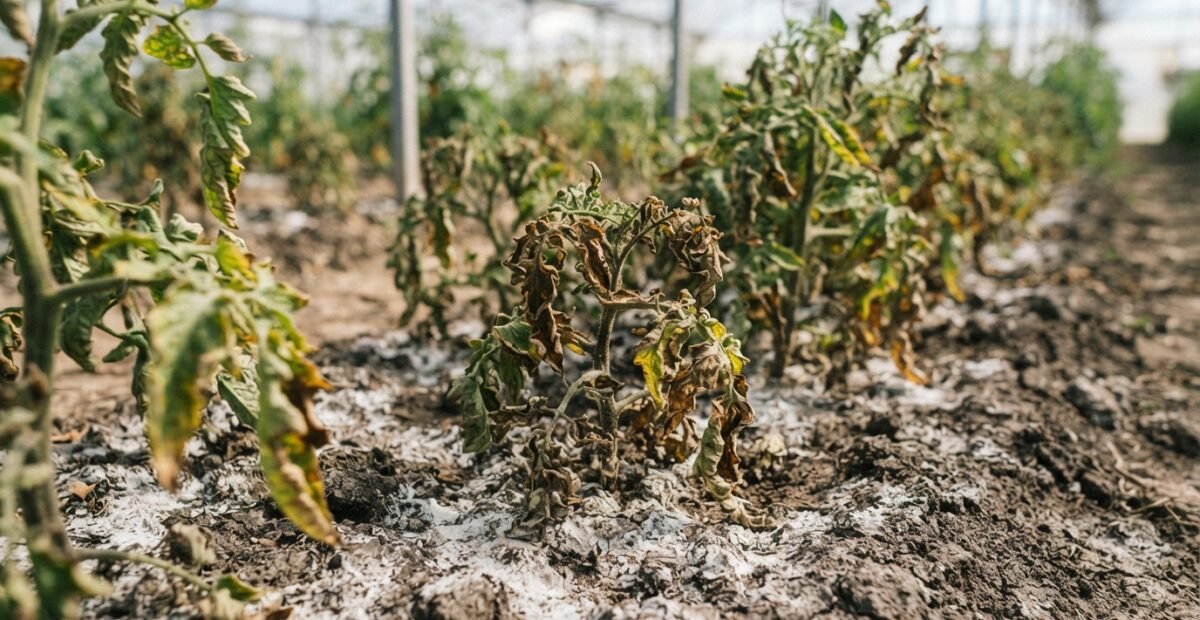
Common above-ground symptoms include slow or stunted growth, reduced flowering or fruiting, poor vigor, delayed germination, uneven emergence, wilting despite moist soil, and premature leaf or needle drop.
- Brown, dry or necrotic leaf margins and tips
- Yellowing followed by scorch, especially on older or exposed foliage
- Leaf curling, smaller leaves and shortened shoots
- Dieback of buds, twigs or branches in severe cases
- Reduced root growth and poor establishment
- White or pale salt deposits on soil, containers or hardscape
- Crusting, poor infiltration and persistent wet or dry patches where sodium has degraded soil structure
Sprinkler irrigation with saline water may produce direct burn on young leaves, while deicing salt may cause damage on the road-facing side of shrubs and evergreens. These signs can resemble drought, fertilizer burn, root disease or nutrient deficiency, so visual diagnosis alone is unreliable.
Causes and spread
Salts may accumulate when evaporation exceeds rainfall or irrigation leaching, particularly in arid and semiarid regions of the United States, poorly drained sites, raised beds over compacted subsoil, containers without adequate drainage, and areas affected by coastal saltwater intrusion.
- Saline irrigation water or contaminated well water
- Repeated applications of soluble fertilizer, especially when overapplied
- High-salt manure, compost, potting media or irrigation additives
- Runoff and splash from sodium chloride deicers
- Shallow saline groundwater or upward movement of salts as soil dries
- Low rainfall, high temperatures and strong evaporation
- Sodic soil conditions that disperse clay, reduce infiltration and restrict root growth
Salt is not biologically spread from plant to plant. The affected area usually expands through irrigation, runoff, fertilizer movement, evaporation and repeated deposition.
Life cycle and persistence
Salt stress has no biological lifecycle. It develops as soluble salts enter the soil or foliage, accumulate in the root zone or on leaf surfaces, and remain concentrated when water evaporates without adequate drainage or leaching.
Initial exposure causes osmotic stress and reduced water uptake. Continued exposure may lead to root injury, specific-ion toxicity, nutritional imbalance and impaired soil structure. Symptoms often intensify during hot, dry weather and may appear first in seedlings, container plants, low areas, road-facing beds or irregular patches. If the salt source is removed and the root zone is successfully flushed, new growth may recover; dead tissue will not become green again.
Treatment and control
First identify and stop the salt source. Submit separate soil samples from affected and unaffected areas, and test irrigation water if it may be contributing. Measure salinity rather than relying only on visible crusts or leaf scorch.
Where drainage is adequate, apply enough good-quality water to move soluble salts below the active root zone, allowing water to drain away. Do not simply add small amounts of water repeatedly, because this can leave salts concentrated near roots. Avoid prolonged saturation, which can deprive roots of oxygen and encourage root disease.
- Flush salt from containers through open drainage holes; replace severely contaminated media.
- Remove or wash salt deposits from foliage with clean water when appropriate, especially after deicing or saline sprinkler exposure.
- Improve drainage, correct compaction and use raised beds or amended soil where site conditions permit.
- For sodic soils, use a laboratory diagnosis before applying gypsum; gypsum is not a universal cure for all salinity problems.
- Prune only dead or irreversibly damaged tissue after the risk of further exposure has passed.
- Replace plants that cannot tolerate the corrected site conditions with suitable salt-tolerant species.
Low-impact and biological control
Salt stress is managed primarily through cultural and physical measures rather than a pesticide treatment. Use clean irrigation water, improve drainage, apply mature low-salt organic matter over time, and mulch to reduce evaporation and salt movement toward the soil surface.
- Redirect salty runoff and place contaminated snow away from plants.
- Use drip irrigation or careful hand watering to keep saline water off leaves.
- Leach soluble salts with good-quality water when drainage allows.
- Use cover crops, organic matter and soil-structure improvements appropriate to the site.
- Select locally adapted, salt-tolerant plants instead of repeatedly replacing sensitive plants in a persistently saline location.
Do not add large amounts of compost, manure or fertilizer without knowing their salt content. Biological controls do not cure salt stress, although maintaining healthy roots and beneficial soil biology may improve resilience after the salt source is corrected.
Prevention
Prevent salt stress by identifying salt sources before planting and by monitoring both soil and irrigation water. Choose plants with tolerance appropriate to the site, especially near roads, sidewalks, coastlines and irrigation systems with measurable salinity.
- Test soil electrical conductivity and, when relevant, sodium adsorption ratio or exchangeable sodium percentage.
- Have irrigation water tested for electrical conductivity, sodium, chloride and boron when salinity is suspected.
- Apply fertilizer according to soil-test and crop recommendations; avoid heavy single applications and do not fertilize drought-stressed plants.
- Improve drainage and avoid compacted layers that prevent water from moving below the root zone.
- Use drip or low-volume irrigation where practical to reduce salt deposition on foliage.
- Keep deicing salt and salt-contaminated snow away from planting beds; use physical snow barriers and compatible alternatives where appropriate.
- Maintain organic matter with mature, low-salt amendments, but test uncertain composts or manures before use.
Interesting facts
- Salt-stressed plants may wilt even when the soil is wet because the root-zone solution holds water too strongly for easy uptake.
- Visible plant damage can underestimate the problem; sensitive crops may lose growth or yield before severe scorch develops.
- Seedbeds can be especially vulnerable because evaporation concentrates salts near the soil surface where young roots develop.
- Species and cultivars differ widely in tolerance, and a plant that survives saline soil may still be injured by salt deposited directly on its leaves.
- Sodium can damage soil physical structure as well as plants by dispersing clay and reducing infiltration.
No pesticide controls salt stress. Use only soil amendments or other products legally authorized for the specific crop, site and problem in the United States, and follow the current product label. Apply gypsum only when soil testing indicates a sodium-related soil-structure problem and professional or extension guidance supports its use; gypsum does not remove soluble salts by itself.
Affected plants
The plants below are linked to this problem by structured host-plant data. The list updates automatically as new plant profiles are added.
 Field maple (Acer campestre) care guideAcer campestre
 Paperbark Maple (Acer griseum) care guideAcer griseum
 Downy Japanese Maple (Acer japonicum) care guideAcer japonicum
 Boxelder (Acer negundo) care guideAcer negundo
 Acer palmatum care guideAcer palmatum
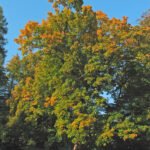 He Norway maple (Acer platanoides) care guideAcer platanoides
 Sycamore maple (Acer pseudoplatanus) care guideAcer pseudoplatanus
 Red maple (Acer rubrum) care guideAcer rubrum
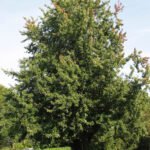 Silver maple (Acer saccharinum) care guideAcer saccharinum
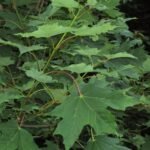 Sugar maple (Acer saccharum) care guideAcer saccharum
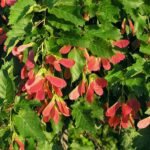 Tatar Maple (Acer tataricum) care guideAcer tataricum
 Amur Maple (Acer tataricum ginnala) care guideAcer tataricum ginnala