Oriental Fruit Moth
Grapholita molestaOriental Fruit Moth overview
The oriental fruit moth, Grapholita molesta, is a tortricid moth whose larvae attack young shoots first and later tunnel into ripening fruit or, less often, almond hulls and kernels. Peaches and nectarines are the principal U.S. hosts, but apples, pears, plums, apricots, cherries, almonds and quinces may also be affected. Reliable management depends on correct identification, pheromone monitoring, sanitation, mating disruption and well-timed IPM decisions.
Typical conditions
Overview
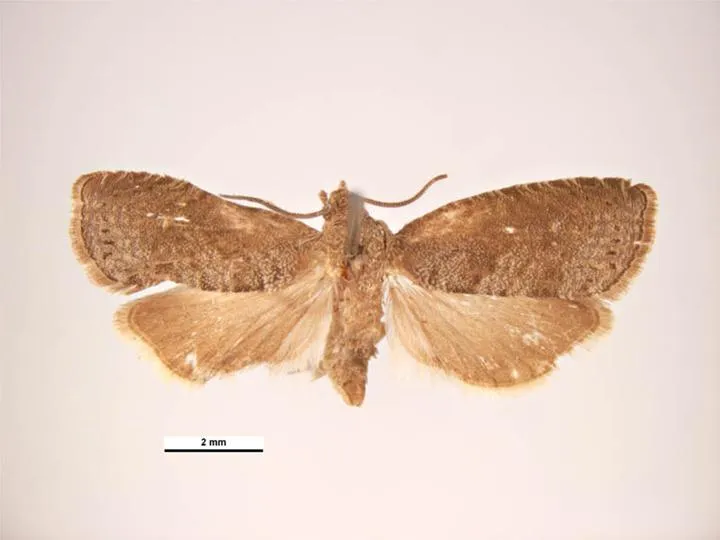
Adults are small, gray, and about 0.4 inch long, with narrow wings and darker markings. Eggs are flat, pale disks laid mainly on leaves or young shoots. Larvae begin white with a dark head and become pinkish or pale orange with a brown head; mature larvae are about 0.5 inch long. A black anal comb on the underside of the last abdominal segment can help distinguish them from codling moth larvae, but confirmation may require an experienced diagnostician.
In peaches and nectarines, early generations commonly cause shoot strikes: terminal shoots wilt, flag, and die after the larva tunnels inside. Later generations enter fruit, often at the stem end or where fruits touch, and tunnel toward the pit. Internal feeding may be inconspicuous until harvest, when fruit contains a larva, frass, browning, premature drop or a damaged pit cavity.
Symptoms and identification
- Wilted, drooping or dead terminal shoots, often called shoot strikes or flagging, especially on young peach and nectarine trees.
- Small tunnel openings, silk, frass or a brownish plug in damaged shoots.
- Fruit entry at the stem end, side or between touching fruit; external evidence may be slight.
- Internal tunnels extending toward the pit, reddish-brown frass, browning, premature fruit drop and wormy fruit at harvest.
- On almonds, larvae may feed between hull and shell, producing reddish-brown frass; kernel injury is less common.
Causes and spread
Spread occurs when adult moths move among nearby peach, nectarine, apricot, plum, cherry, almond, apple, pear or quince trees and lay eggs on suitable shoots or foliage. Infested orchards, neglected backyard trees, volunteer host plants, dropped fruit and unmanaged pruning debris can maintain local populations. Larvae are protected inside shoots, fruit, hulls or cocoons, so moving infested plant material can transport the pest.
Risk is often higher where peach or nectarine orchards are adjacent to apple or pear plantings. Warm weather shortens development and can increase the number of generations, but local flight timing and injury patterns vary by region.
Life cycle and persistence
Oriental fruit moth usually overwinters as a mature, inactive larva in a tightly woven cocoon in bark crevices, pruning debris, leaf litter or protected material near the tree base. In spring, it pupates in the cocoon and adults emerge, mate and lay eggs on leaves or young shoots.
New larvae tunnel into tender shoot tips during the first generations, causing flagging. Later generations may attack shoots, green fruit and nuts; as fruit matures, fruit becomes the preferred feeding site. Larvae leave feeding sites when mature and pupate in protected locations. The number of generations varies with climate: three to six may occur, while five or six are reported in warm California production areas. In the United States, flight timing varies substantially by region and season.
For monitoring, pheromone traps establish a local biofix at the first male catch. Degree-day models commonly use a 45°F lower threshold and a 90°F upper threshold, but model timing should be validated for the local orchard rather than treated as a universal calendar.
Treatment and control
Begin with diagnosis and monitoring. Examine wilted shoot tips by splitting them lengthwise, and cut suspicious fruit open to look for a pinkish larva, brown head, tunnel and frass. Pheromone traps can detect adult flights; inspect traps weekly and combine captures with shoot-strike and fruit sampling.
For commercial orchards, pheromone mating disruption is commonly preferred where feasible. If insecticides are necessary, timing must target newly hatched larvae before they tunnel deeply into shoots or fruit. Extension programs often use a local biofix and degree-day accumulation, with a 45°F lower threshold and 90°F upper threshold; published treatment windows differ by crop, region, product and generation. Follow current state extension recommendations and the product label.
In home orchards, sanitation, removal of damaged shoots and fruit, reduction of nearby unmanaged hosts, and well-timed pheromone-based monitoring may be more practical than routine spraying. Severe or recurring infestations may require advice from a county Extension office or licensed fruit-tree pest professional.
Low-impact and biological control
Use an integrated approach rather than attempting to kill exposed adults after larvae have entered shoots or fruit.
- Hang species-specific pheromone traps before expected spring emergence and inspect them weekly. Record captures, shoot strikes and fruit injury to determine whether intervention is warranted.
- Use pheromone mating disruption where the orchard size, crop value, product availability and surrounding moth pressure make it practical. It works best when installed before or at the beginning of adult flights and when neighboring sources are considered.
- Prune out and destroy wilted, tunneled shoot tips during scouting, especially on young trees. Remove dropped or infested fruit and dispose of it rather than leaving it beneath trees.
- Conserve parasitoids and predators by avoiding unnecessary broad-spectrum sprays, maintaining suitable flowering resources, and managing weeds without destroying all noncrop habitat.
- In certified-organic production, use only inputs permitted by the current organic standard and crop label. UC IPM identifies mating disruption and certain labeled spinosad formulations as organically acceptable options, but certification and state-label status must be verified before use.
Prevention
- Inspect trees weekly from spring through harvest for wilted shoot tips, entry holes, frass and internal fruit injury.
- Remove and destroy infested shoot tips and fallen or mummified fruit; do not compost suspect material unless the composting process reliably destroys insects.
- Prune for an open, manageable canopy and remove dead wood and loose bark that provide protected sites.
- Coordinate monitoring and management across neighboring host orchards when possible, because moths move between crops.
- Install pheromone traps before the first expected flight. Use local extension guidance and local degree-day data rather than fixed national dates.
- Favor selective controls and mating disruption to conserve parasitoids and reduce insecticide resistance and secondary pest outbreaks.
Interesting facts
- The pest can shift among host tissues and host species as the season progresses: young shoots are important early, while ripening fruit becomes more attractive later.
- Peach and nectarine are generally primary hosts; apple and pear are often secondary hosts but can suffer serious injury under suitable conditions.
- Oriental fruit moth larvae do not always leave an obvious external fruit scar, so cutting suspicious fruit open is often necessary for diagnosis.
- The larva’s black anal comb is a useful diagnostic character, although it is best assessed with a hand lens or microscope.
- The parasitoid Macrocentrus ancylivorus can provide substantial biological control where broad-spectrum insecticides are minimized.
Use insecticides only when monitoring and crop injury justify treatment, and only products legally authorized and currently labeled for oriental fruit moth on the specific crop in your state and country. Follow the current label for rate, timing, protective equipment, reentry interval, preharvest interval, worker and pollinator protections, and resistance-management requirements. Do not rely on a pesticide schedule copied from another crop, state or season.
Affected plants
The plants below are linked to this problem by structured host-plant data. The list updates automatically as new plant profiles are added.