Salt spray injury
Salt spray injury overview
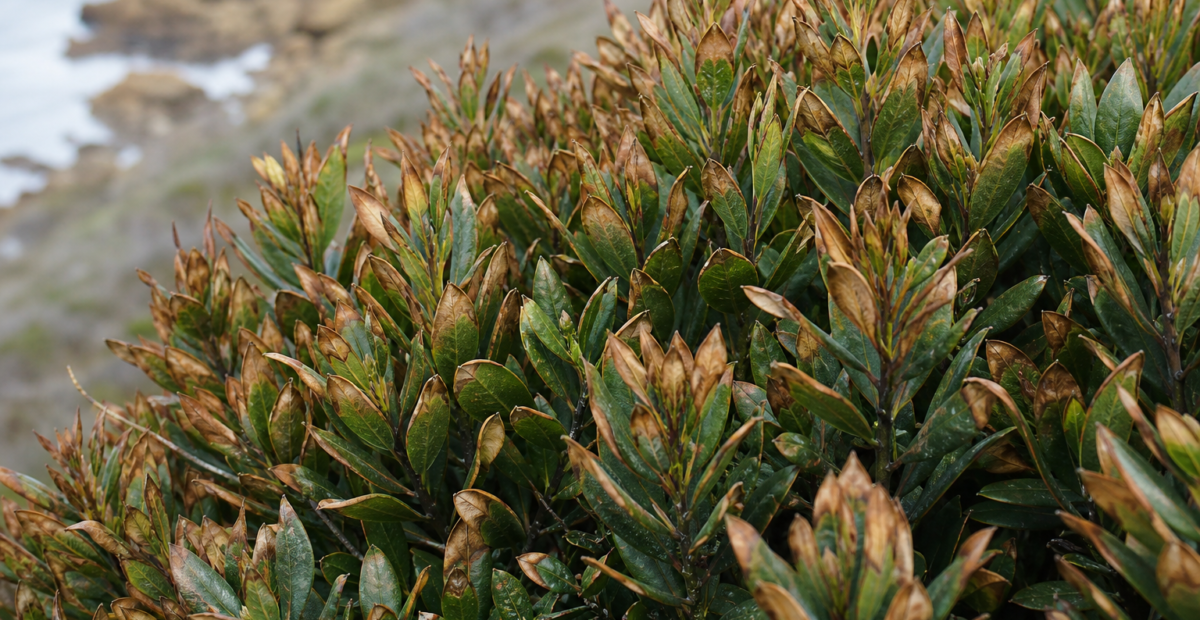
Salt spray injury is a noninfectious environmental disorder caused when windborne seawater or salty deicing-solution droplets deposit on foliage and young shoots. It commonly produces one-sided browning on exposed plants, scorched leaf margins, dead buds, premature leaf or needle drop, and reduced growth. Severity depends on salt concentration, wind, exposure duration, plant age, tissue tenderness, and species tolerance.
Typical conditions
Overview
Salt spray injury occurs when airborne salt settles on leaves, needles, stems, buds, or flowers. In the United States it is most familiar in exposed coastal landscapes, beachfront plantings, roadsides, and properties near heavily salted pavement. Sea-salt aerosols are driven inland by onshore winds, while winter traffic can create salt-laden spray from wet pavement and slush.
This disorder is often confused with drought, winter burn, wind scorch, fertilizer burn, or foliar disease. A useful diagnostic clue is directional damage: the side facing the ocean, road, or prevailing spray-bearing wind is usually worse than sheltered foliage. Salt tolerance varies substantially among species, cultivars, plant parts, and exposure conditions.
Symptoms and identification
- Tan, gray, reddish-brown, or dark-brown necrosis beginning at leaf tips and margins.
- Scorched or desiccated evergreen needles, especially on the outer and windward canopy.
- Death of tender shoots, terminal buds, flowers, or newly expanding leaves.
- Premature leaf or needle drop, thinning crowns, stunted growth, and twig dieback after severe exposure.
- Wilting despite apparently adequate soil moisture when salt disrupts water uptake or causes foliar dehydration.
- White or pale salt residues may remain on foliage after droplets dry, although residues are not always visible.
- Roadside turf may show long tan-to-brown strips or irregular dead areas beside treated pavement after snowmelt.
Causes and spread
The immediate cause is deposition of soluble salts, most commonly sodium chloride, on plant surfaces. Important sources include breaking waves, sea fog, storm-driven seawater, saltwater flooding, brackish irrigation, and aerosolized deicing solutions from roads, driveways, and sidewalks.
Salt enters primarily through wet foliage and small wind-created abrasions or cuticular openings. As droplets evaporate, salts become concentrated and can damage cell membranes, draw water from tissues, and cause ion toxicity. Repeated exposure during windy weather increases injury. Salt is not contagious and does not spread biologically from plant to plant, although the same wind, road, storm, or irrigation source can affect an entire area.
Life cycle and persistence
This disorder has no biological lifecycle. Injury follows a repeating exposure sequence: salty droplets contact exposed tissue, water evaporates, salt concentration rises, cells are injured, and damaged tissue becomes necrotic. New growth produced after exposure may remain healthy if salt deposition decreases.
In coastal sites, exposure may be chronic or episodic, with the highest damage during strong onshore winds, heavy surf, hurricanes, and winter storms. Road-salt injury commonly becomes evident during late winter or spring snowmelt, while coastal spray injury can occur throughout the year and may be most visible after prolonged dry, windy periods.
Treatment and control
- Confirm the exposure pattern and rule out drought, winter burn, herbicide drift, fertilizer injury, insects, and infectious diseases.
- Rinse salt from foliage with abundant fresh water when conditions permit. Repeat after additional deposition, using gentle water pressure and avoiding runoff into sensitive surface waters.
- Thoroughly water the root zone to leach accumulated salts below the active root zone, but only where drainage is adequate. Do not repeatedly saturate poorly drained soil.
- Do not fertilize severely stressed plants until active recovery is evident. Excess fertilizer can increase osmotic stress.
- After the risk of further salt exposure has passed, prune dead twigs back to healthy tissue using clean tools. Avoid heavy pruning during heat, drought, or active storm stress.
- Replace plants that are repeatedly exposed and consistently decline with better-adapted species or relocate them to a sheltered site.
Recovery depends on injury severity, plant age, weather, and whether buds and roots remain alive. Brown needles and dead leaves will not regain their color, but surviving buds may produce new growth.
Low-impact and biological control
There is no curative organic pesticide because salt spray injury is not caused by a pest or pathogen. Practical nonchemical management includes fresh-water rinsing, careful root-zone leaching, organic mulch, improved drainage, wind reduction, sanitation pruning, and replacement with locally appropriate salt-tolerant plants.
Use compost or other soil amendments only when they are mature, low in soluble salts, and appropriate for the site. Avoid manure, compost, fertilizers, or soil products with high electrical conductivity or sodium content. In coastal landscapes, favor locally native or regionally tested plants rather than assuming that every beach or dune species will tolerate an inland roadside salt problem.
Prevention
- Choose species and cultivars documented as tolerant of the local level of salt spray, wind, drought, and soil salinity; tolerance to salt spray is not the same as tolerance to saltwater flooding.
- Place sensitive ornamentals behind buildings, fences, dunes, or layered plantings that reduce direct wind exposure, while avoiding barriers that interfere with protected coastal habitat or erosion-control requirements.
- Set trees and shrubs well back from roads and pavement where practical; a setback of about 7 feet from roadways is recommended by University of Minnesota Extension for reducing salt-spray exposure.
- Use clean water to rinse foliage after known salt deposition when plants can be safely irrigated and runoff will not damage nearby waterways or structures.
- Improve soil drainage, maintain organic matter, and apply a 2- to 4-inch organic mulch layer without piling it against stems.
- Keep irrigation water tested where brackish or reclaimed water is used, and avoid unnecessary sodium or chloride inputs.
- For roads and walkways, reduce deicer use through timely snow removal, calibrated application, and less-salt alternatives where they are legally and operationally suitable.
Interesting facts
- Salt spray can shape coastal shrubs into one-sided or wind-sculpted forms because exposed terminal buds are repeatedly killed while sheltered shoots survive.
- Maritime salt can enter plants mainly through aerial tissues, so a plant may be injured even when its root-zone soil is not saline.
- Salt spray exposure helps determine which plant communities occur at different distances and elevations from the shoreline.
- Evergreens often show conspicuous injury because damaged needles remain visible for months and the foliage is exposed year-round.
- Salt tolerance is tissue-specific: a plant may tolerate salty soil better than direct foliar spray, or tolerate occasional spray but fail under repeated winter road-salt exposure.
No pesticide treatment is recommended for salt spray injury. Use only products legally authorized for the specific crop and problem in your country, and follow the current label. Fertilizers, soil conditioners, or foliar products should not be used as a substitute for removing or preventing salt exposure; obtain site-specific advice before applying any product to stressed plants.
Affected plants
The plants below are linked to this problem by structured host-plant data. The list updates automatically as new plant profiles are added.