
 Source:
 Black Birch (Betula nigra) short overview
Betula nigra, documented in the United States as Black Birch, is a fast-growing native tree of streambanks, floodplains, swamps, and other moist lowlands across the eastern United States. Its cinnamon, reddish-brown bark peels in papery layers, giving the tree strong winter interest. It performs best in full sun with consistently moist, acidic to neutral soil and is especially useful for rain gardens, riparian plantings, erosion control, wildlife habitat, and informal shade-tree groupings.
Taxonomic classification
Black Birch (Betula nigra) care guide
Light and placement
Give full sun for the strongest growth, denser form, and best fall color; partial shade is tolerated, especially in hot climates. Orient the tree where the canopy receives at least 6 hours of direct light, while the root zone is protected by mulch. Sparse growth, small leaves, or premature summer leaf drop can indicate inadequate light or drought; scorched foliage usually reflects heat or moisture stress rather than excessive sunlight alone.
Watering and humidity
Water deeply and slowly whenever the upper several inches of soil begin to dry, with extra attention during the first two growing seasons and summer drought. Keep the root zone consistently moist rather than alternating between flooding and severe drying. A 2- to 3-inch organic mulch layer helps stabilize soil temperature and moisture, but keep mulch off the trunk. Humidity is usually secondary to reliable soil moisture.
Soil and growing medium
Use a moisture-retentive but oxygenated soil such as loam, sandy loam, or clay loam improved with organic matter where needed. Good drainage is still important around compacted sites. The species tolerates acidic conditions well and generally performs from about pH 4.5 to 7.5; high-pH soils may increase the risk of iron chlorosis.
Feeding
Feed only when growth is weak or a soil test indicates a deficiency. In established landscape soil, a 2- to 3-inch layer of compost or organic mulch is usually preferable to routine fertilizer. If fertilizer is needed, apply a slow-release, balanced product in early spring at the label rate; do not fertilize drought-stressed, newly transplanted, or late-season trees.
Growth and habit
This species establishes quickly and commonly develops a multi-trunked, open to pyramidal habit. Fast juvenile growth makes it useful for rapid landscape structure, but moisture stress can cause premature summer leaf drop and a thinner canopy. The tree may shed twigs and interior leaves, so it fits informal or naturalistic settings better than highly manicured spaces.
Planting and repotting
Plant in fall or early spring when the tree is dormant. Set the root flare level with or slightly above the surrounding soil, water deeply after planting, and apply a 2- to 3-inch mulch layer without touching the trunk. Allow ample room for the mature canopy and avoid sites where falling twigs will clog gutters.
Not normally suited to long-term container culture. If a young tree is temporarily grown in a container, transplant it while dormant into the landscape before roots become crowded, keeping the root flare at soil level.
Propagation and pruning
Propagation
Sow fresh seed promptly after collection or use cold-moist stratification for stored seed. Surface-sow or barely cover the small seeds, keep them evenly moist, and provide light. Softwood or semi-hardwood cuttings may root under controlled conditions, but seed is the standard practical method.
Pruning
Prune sparingly during the dormant season, removing competing leaders, damaged limbs, or poorly attached branches. Avoid late winter and spring pruning when sap is running because cuts may bleed heavily. Do not remove the naturally attractive exfoliating bark, and never top the tree.
Overwintering
No special winter protection is normally needed in USDA Zones 4–9. Water thoroughly before the ground freezes where autumn is dry, maintain mulch over the root zone, and protect young trunks from mechanical injury and animal browsing. In colder northern sites, avoid late-season nitrogen that could delay hardening.
Uses
A strong ornamental and ecological tree for rain gardens, stream buffers, erosion-control plantings, woodland edges, naturalized areas, and informal shade groupings. The exfoliating bark provides winter interest, while foliage, twigs, buds, and seeds support wildlife. It is not recommended as a food or medicinal plant without specialist guidance.
Appearance
The tree is recognized by reddish-brown to cinnamon bark that peels in thin papery sheets and remains attractive through winter. Mature bark develops scaly ridges while younger stems retain smoother, brighter tones. Leaves are alternate, simple, ovate to diamond-shaped, sharply and doubly serrated, and usually 2–3.5 inches long. The crown is often open and multi-stemmed.
Flowering
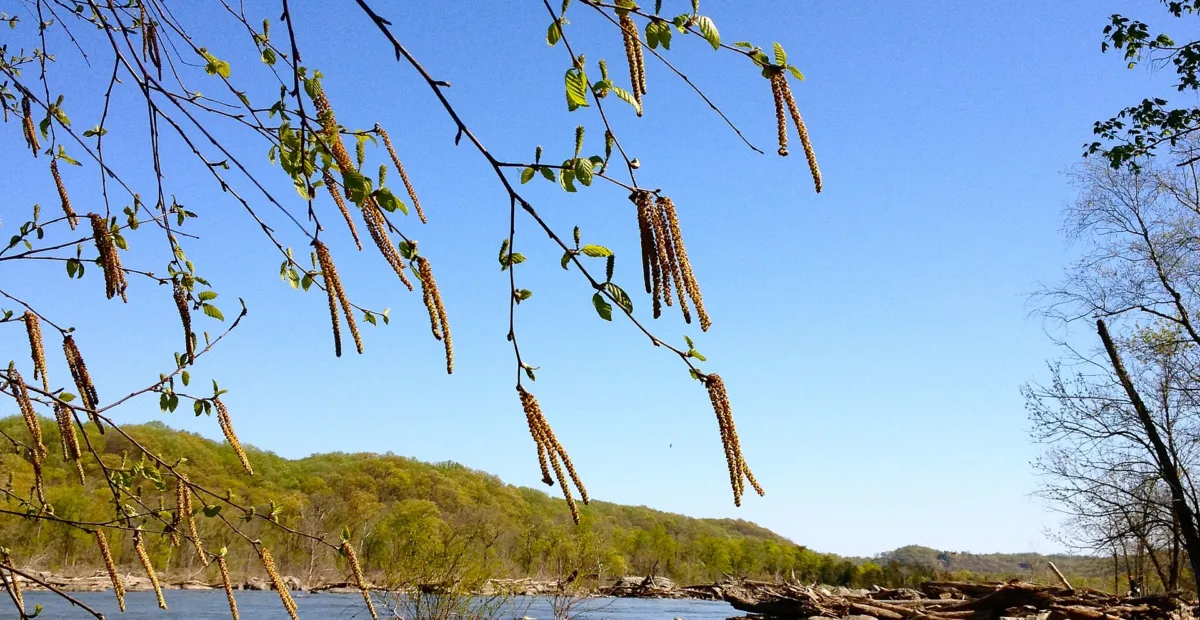
This monoecious species bears separate male and female catkins on the same tree. Pendulous brown male catkins are conspicuous, while smaller upright green female catkins are less noticeable. Catkins form in fall and open in early spring, around the time new leaves emerge. The resulting cone-like catkin fruits mature and release small nutlets in spring.
Pollination and visitors
The flowers are wind-pollinated rather than animal-pollinated. Wildlife value is nevertheless documented: the tree supports caterpillars, including mourning cloak butterfly larvae, and its seeds and vegetative parts are used by birds and small mammals.
Betula nigra photos
Click any photo for a larger view. Source, author and license are shown separately.
Diseases and pests
Diseases
Maintain air circulation, avoid chronic drought, and prevent trunk or root injury. Possible problems include leaf spot, cankers, anthracnose, and root decay, especially where trees are stressed or poorly planted. Remove badly affected branches during dry dormant weather and improve irrigation and drainage rather than relying on routine spraying.
Pests
Birch leafminer, bronze birch borer, aphids, scale insects, and sawfly larvae may occur. Reduce risk by choosing a moist site, avoiding trunk wounds, mulching correctly, and watering during drought. Confirm the pest before treatment; use targeted, label-approved controls only when damage is significant.
Related diseases and pests
Only Plant Doctor profiles whose host data indicate this plant may be affected are shown here.
Toxicity and pollen
No reliable authoritative source located in this review establishes Betula nigra as a specifically poisonous plant for humans or pets. Do not treat that absence as proof of edibility or complete safety: discourage ingestion of leaves, bark, catkins, or seeds, and contact Poison Control or a veterinarian after a concerning exposure.
- Typical season
- Late winter through spring, typically February–April depending on region
- Pollination / pollen
- Airborne wind-dispersed tree pollen
Male catkins release airborne pollen in a short early-spring period. Birch pollen can trigger seasonal allergy symptoms in susceptible people, and river birch is described as a potentially significant allergen despite its relatively brief release period. Avoid placing mature trees immediately beside frequently used windows if household members are highly pollen-sensitive.
Native habitat
Native primarily to the eastern United States, especially along streams, riverbanks, floodplains, swamps, and moist bottomlands. It is associated with alluvial soils and low to medium elevations, tolerates periodic wetness, and can colonize disturbed moist ground. Although moisture-loving, it can survive occasional drier conditions once established.
Interesting fact
River birch is one of the few birches that combines good heat tolerance with strong wet-soil adaptation. It is the only birch species in its native range described by the U.S. Forest Service as spring-fruiting. Its root crown can resprout after fire, and its tiny seeds are dispersed by both wind and water.
Frequently asked questions (FAQ)
The most relevant questions about this plant, with short and direct answers.
🌱Quick care
What is Black Birch (Betula nigra)?⌄
Black Birch (Betula nigra) is a cold-hardy North American birch commonly known for its peeling reddish-brown bark and preference for moist ground. It is also widely called river birch, red birch, or water birch in the United States. ([srs.fs.usda.gov](https://www.srs.fs.usda.gov/pubs/misc/ag_654/volume_2/betula/nigra.htm?utm_source=openai))
How much sun does Black Birch need?⌄
Black Birch grows best in full sun but also tolerates partial shade. Trees generally develop stronger growth and denser foliage with several hours of direct sunlight each day. ([srs.fs.usda.gov](https://www.srs.fs.usda.gov/pubs/misc/ag_654/volume_2/betula/nigra.htm?utm_source=openai))
How often should you water Black Birch?⌄
Water Black Birch deeply whenever the soil begins to dry, keeping the root zone consistently moist. Extra irrigation is especially important during summer heat, drought, and the first few years after planting. ([plants.ces.ncsu.edu](https://plants.ces.ncsu.edu/plants/betula-nigra/?utm_source=openai))
Is Black Birch cold hardy?⌄
Yes, Black Birch is cold hardy across much of the eastern and central United States. Its exact performance depends on the cultivar, local exposure, and whether the roots are protected from drying winds and drought. ([research.fs.usda.gov](https://research.fs.usda.gov/feis/species-reviews/betnig?utm_source=openai))
🌤️Environment and placement
Where should I plant Black Birch?⌄
Plant Black Birch in a sunny to partly shaded location with deep, moisture-retentive soil and enough room for a large tree. It is well suited to rain gardens, streamside settings, low areas, naturalized landscapes, and lawns away from structures. ([umass.edu](https://www.umass.edu/agriculture-food-environment/landscape/fact-sheets/birch-culture?utm_source=openai))
Can Black Birch grow in wet soil?⌄
Yes, Black Birch is one of the better landscape trees for moist or periodically wet soil. It tolerates waterlogged conditions and moderate flooding, but prolonged or continuously deep flooding can still cause stress or death. ([srs.fs.usda.gov](https://www.srs.fs.usda.gov/pubs/misc/ag_654/volume_2/betula/nigra.htm?utm_source=openai))
Can Black Birch grow in clay soil?⌄
Black Birch can grow in clay soil if the site remains moist and drains adequately enough to avoid stagnant conditions. Improve compacted ground before planting, but do not place the tree in a permanently sealed or poorly aerated planting hole. ([research.fs.usda.gov](https://research.fs.usda.gov/feis/species-reviews/betnig?utm_source=openai))
Can Black Birch tolerate dry soil?⌄
Black Birch tolerates occasional dryness better than many wetland trees, but it performs poorly when repeatedly exposed to hot, dry conditions. Mulch and deep watering help prevent drought stress, leaf drop, and pest problems. ([research.fs.usda.gov](https://research.fs.usda.gov/feis/species-reviews/betnig?utm_source=openai))
How large does Black Birch get?⌄
Black Birch commonly reaches about 40 to 70 feet tall with a broad, spreading canopy. Give it substantial overhead and lateral space, particularly when planting a multi-stemmed specimen. ([umass.edu](https://www.umass.edu/agriculture-food-environment/landscape/fact-sheets/birch-culture?utm_source=openai))
Can I plant Black Birch next to my house?⌄
Black Birch is usually best planted away from houses, driveways, and gutters because its mature canopy is large and it can shed twigs. Keep the planting site clear of utility lines and allow room for roots and branches to expand. ([plants.ces.ncsu.edu](https://plants.ces.ncsu.edu/plants/betula-nigra/?utm_source=openai))
💧Care and problems
Why are Black Birch leaves turning yellow?⌄
Yellow leaves may result from drought stress, excessive heat, or iron chlorosis caused by alkaline or high-pH soil. Check soil moisture and pH before applying fertilizer, because correcting the planting conditions is more reliable than treating symptoms alone. ([umass.edu](https://www.umass.edu/agriculture-food-environment/landscape/fact-sheets/birch-culture?utm_source=openai))
Why does Black Birch lose leaves in summer?⌄
Black Birch may shed interior leaves during summer drought, heat, or other moisture stress. Maintain consistent soil moisture and a cool mulched root zone, while recognizing that some interior leaf drop can occur naturally. ([plants.ces.ncsu.edu](https://plants.ces.ncsu.edu/plants/betula-nigra/?utm_source=openai))
Does Black Birch need fertilizer?⌄
Black Birch usually does not need fertilizer when planted in suitable, fertile soil. Test the soil and confirm a nutrient deficiency before fertilizing, because stimulating extra growth can increase water demand and stress the tree. ([ipm.ucanr.edu](https://ipm.ucanr.edu/home-and-landscape/bronze-birch-borer/?utm_source=openai))
What pests affect Black Birch?⌄
Black Birch can be affected by birch leaf miner, bronze birch borer, and other birch pests, although it is generally more resistant to bronze birch borer than many white-barked birches. Keeping the tree adequately watered is an important part of prevention. ([umass.edu](https://www.umass.edu/agriculture-food-environment/landscape/fact-sheets/birch-culture?utm_source=openai))
How can I recognize bronze birch borer damage on Black Birch?⌄
Warning signs include dieback beginning in the upper crown, raised bark ridges, winding galleries beneath the bark, and small D-shaped exit holes. These symptoms can have other causes, so confirm the pest before using insecticides or removing major limbs. ([extension.umn.edu](https://extension.umn.edu/lawns-and-landscapes-minnesota/metallic-wood-boring-beetles?utm_source=openai))
🪴Planting and repotting
When is the best time to plant Black Birch?⌄
Plant Black Birch during the dormant season, typically in fall after leaf drop or in early spring before active growth begins. Avoid planting into hot, dry soil, and water thoroughly after planting. ([plants.ces.ncsu.edu](https://plants.ces.ncsu.edu/plants/betula-nigra/?utm_source=openai))
How do I plant Black Birch?⌄
Plant Black Birch with the root flare level with or slightly above the surrounding soil, backfill with the excavated soil, and water deeply. Apply a broad, shallow layer of mulch over the root zone, keeping it away from the trunk. ([plants.ces.ncsu.edu](https://plants.ces.ncsu.edu/plants/betula-nigra/?utm_source=openai))
Can Black Birch be grown in a container?⌄
Black Birch is generally unsuitable as a long-term container plant because it becomes a large, fast-growing tree with extensive roots. A container may be used temporarily for a young tree, but it should be planted outdoors before the root system becomes crowded.
✂️Propagation and pruning
How do you propagate Black Birch from seed?⌄
Collect the small cone-like fruits when they are still green enough to prevent the seeds from scattering, then separate and sow the seeds on or just beneath moist soil. Germination is favored by light and consistently moist conditions, and young seedlings require ample moisture. ([srs.fs.usda.gov](https://www.srs.fs.usda.gov/pubs/misc/ag_654/volume_2/betula/nigra.htm?utm_source=openai))
Can Black Birch be propagated from cuttings?⌄
Seed propagation is the better-documented method for Black Birch. Reliable general guidance on rooting ordinary stem cuttings is limited, while young trees can also regenerate from vigorous stump sprouts. ([srs.fs.usda.gov](https://www.srs.fs.usda.gov/pubs/misc/ag_654/volume_2/betula/nigra.htm?utm_source=openai))
How do you prune Black Birch?⌄
Black Birch usually needs only structural pruning to remove dead, damaged, crossing, or poorly attached branches. Prune during the dormant season, but avoid late winter and early spring when birch sap is running and cuts may bleed heavily. ([plants.ces.ncsu.edu](https://plants.ces.ncsu.edu/plants/betula-nigra/?utm_source=openai))
Can Black Birch be grown as a multi-stemmed tree?⌄
Yes, Black Birch is commonly grown as a multi-stemmed specimen, which highlights its peeling bark and natural form. Select the strongest trunks early and remove competing or weakly attached stems while the tree is young. ([umass.edu](https://www.umass.edu/agriculture-food-environment/landscape/fact-sheets/birch-culture?utm_source=openai))
⚠️Toxicity and safety
Is Black Birch toxic to dogs or cats?⌄
No specific toxicity classification for Black Birch has been confirmed in the supplied plant record. Because formal pet-safety data can vary by database and exposure, prevent pets from chewing large quantities of leaves, twigs, bark, or seeds and contact a veterinarian if illness occurs.
Is Black Birch safe to plant around children?⌄
Black Birch is commonly used as an ornamental and native landscape tree, but its falling twigs, large size, and exposed roots or low branches can create ordinary landscape hazards. Plant it away from play areas, buildings, and locations where falling branches could cause injury. ([plants.ces.ncsu.edu](https://plants.ces.ncsu.edu/plants/betula-nigra/?utm_source=openai))
🌸Flowering and special interest
Does Black Birch flower?⌄
Yes, Black Birch produces separate male and female catkins, with flowering typically occurring in spring. The flowers are not showy, but the tree is notable among birches for producing fruit in spring rather than primarily in fall. ([srs.fs.usda.gov](https://www.srs.fs.usda.gov/pubs/misc/ag_654/volume_2/betula/nigra.htm?utm_source=openai))
When does Black Birch produce seeds?⌄
Black Birch produces small cone-like fruiting structures in spring, and the lightweight seeds can disperse quickly in moist habitats. Collect them promptly when the structures are mature enough to release seed but have not fully shattered. ([srs.fs.usda.gov](https://www.srs.fs.usda.gov/pubs/misc/ag_654/volume_2/betula/nigra.htm?utm_source=openai))
Why is the bark of Black Birch peeling?⌄
Peeling bark is a normal and characteristic feature of Black Birch, especially on younger stems and branches. The bark ranges from reddish brown to salmon and tan, providing ornamental interest throughout the year. ([plants.ces.ncsu.edu](https://plants.ces.ncsu.edu/plants/betula-nigra/?utm_source=openai))
Does Black Birch attract wildlife?⌄
Yes, Black Birch provides food and cover for wildlife, including birds and other organisms that use its buds, twigs, foliage, and seeds. Its value is greatest when incorporated into native, riparian, rain-garden, or naturalized plantings. ([plants.usda.gov](https://plants.usda.gov/DocumentLibrary/factsheet/pdf/fs_beni.pdf?utm_source=openai))
Similar plants
 Azure Monkshood (Aconitum carmichaelii) care guideAconitum carmichaelii
 Monkshood (Aconitum ‘Stainless Steel’)Aconitum 'Stainless Steel'
 Monkshood (Aconitum ‘Bressingham Spire’)Aconitum 'Bressingham Spire'
 Golden full moon maple (Acer shirasawanum ‘Aureum’)Acer shirasawanum 'Aureum'
 Globosum (Acer platanoides ‘Globosum’)Acer platanoides 'Globosum'
 Striped maple (Acer pensylvanicum) care guideAcer pensylvanicum
Sources and data reliability
GBIF + Wikidata exact taxon (P225) – localized label/alias – local common name
iNaturalist – localized genus name
Betula nigra, river birch | US Forest Service Research and Development
Bronze Birch Borer / Home and Landscape / UC Statewide IPM Program (UC IPM)
Bronze birch borer and twolined chestnut borer | UMN Extension