
 AI-generated illustration
Shirazz (Acer palmatum ‘Shirazz’) short overview
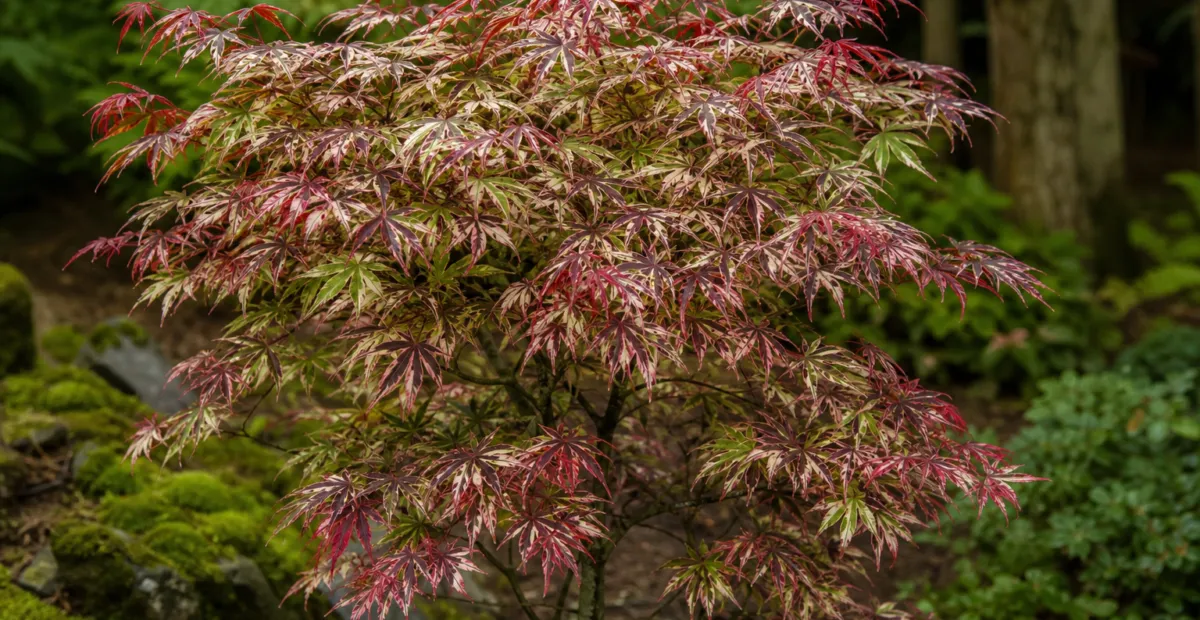
Acer palmatum 'Shirazz' is a distinctive variegated Japanese maple valued for its changing foliage rather than showy flowers. New leaves emerge burgundy-red with vivid pink edging, mature through olive green with irregular cream and rose markings, and finish with warm orange-red tones. This upright, spreading cultivar performs best in a sheltered site with filtered light, evenly moist but well-drained acidic to neutral soil, and protection from drying wind and intense afternoon sun.
Taxonomic classification
Shirazz (Acer palmatum ‘Shirazz’) care guide
Light and placement
Give bright filtered light or partial shade, ideally with morning sun and afternoon protection. East- or north-facing positions are often safer than hot western exposures. Too much sun, wind or dry soil causes tan leaf margins and patches of scorch; too little light can reduce color contrast and produce weaker, less dense growth. Shelter the canopy while keeping the root zone evenly moist.
Watering and humidity
Water deeply when the upper soil begins to dry, then allow excess water to drain fully. Keep the root zone evenly moist during establishment and during hot summer weather, but never saturated. Container plants may need frequent checks in summer; reduce watering after leaf fall while preventing the root ball from becoming bone dry. Mulch helps stabilize moisture.
Soil and growing medium
Use a moisture-retentive but freely draining loam amended with organic matter. Slightly acidic to neutral soil is preferred; avoid persistently waterlogged ground and highly alkaline conditions, which can reduce nutrient availability. A thick organic mulch helps moderate root temperature and moisture, but keep it away from the trunk flare.
Feeding
Feed in early spring as growth begins with a balanced, slow-release fertilizer at the label rate, or apply a modest layer of finished compost around the root zone. Do not overfeed, especially with high nitrogen, because soft vigorous growth is more prone to scorch and winter injury. Stop routine fertilizing by midsummer so shoots can harden before dormancy.
Growth and habit
This cultivar develops an upright, spreading framework that may become arching with age. Growth is generally slow to moderate, and grafted plants retain the named foliage only above the graft. Its layered branching and fine-textured canopy reward careful siting more than frequent pruning.
Planting and repotting
Plant in spring or fall while temperatures are moderate. Set the root flare level with or slightly above the surrounding soil and keep any graft union well above ground. Allow about 8–12 feet for a specimen with room to develop, adjusting spacing for the intended form. Mulch broadly, water deeply during establishment, and protect the young canopy from hot, drying wind.
Repot container-grown plants in late winter or early spring before active growth, only when roots have filled the container. Move into a pot just one size larger, preserve the graft union above the soil line, and use a free-draining acidic-to-neutral mix. Water thoroughly after repotting and shelter the plant while new roots establish.
Propagation and pruning
Propagation
Commercial plants are normally grafted to preserve the cultivar. Softwood cuttings and layering are documented methods but can be inconsistent and require controlled moisture and humidity. Propagate during active growth, and remove rootstock shoots promptly from grafted plants.
Pruning
Prune only when necessary, preferably from late fall through midwinter when the structure is visible and sap flow is low. Remove dead, crossing or poorly placed branches with clean cuts. Avoid heavy shearing, topping and routine shortening, which can spoil the layered habit and expose foliage to sun scorch.
Overwintering
In Zones 5–6, protect young plants from drying winter wind and rapid freeze-thaw cycles with a sheltered site and an organic mulch layer over the root zone. Do not wrap foliage tightly. Container plants are more cold-sensitive than plants in the ground; move them to an unheated protected area or insulate the container while keeping the dormant medium slightly moist.
Uses
Best used as an ornamental specimen, patio or courtyard tree, woodland-border accent, container plant or focal point beside paths and seating areas. Its value is primarily foliage color and seasonal form. It is not documented here as a food, medicinal or therapeutic plant.
Appearance
Leaves are palmate and deeply lobed, with vivid burgundy-red emergence, irregular pink margins and later cream-and-green variegation. The fine foliage is carried on slender branches in a layered, spreading framework. Fall color commonly shifts toward orange-red. The overall effect is more colorful and finely textured than a typical green Japanese maple.
Flowering
Small reddish to purple flowers appear with or shortly after the new leaves in spring. They are botanically true flowers but are visually secondary to the cultivar's variegated foliage. Winged samaras may develop later when pollination is successful.
Pollination and visitors
The small spring flowers of Acer palmatum can provide limited resources for insects, including bees and other small flower visitors, but this cultivar is grown chiefly for foliage and is not a major pollinator plant.
Diseases and pests
Diseases
Watch for leaf scorch, Verticillium wilt, anthracnose, leaf spots and honey fungus. Prevent problems with well-drained soil, consistent moisture, clean pruning tools and good air circulation. Leaf scorch is often caused by drought, exposed wind or excessive heat rather than infection; correct the site and watering pattern before applying treatments.
Pests
Aphids, scale, caterpillars, leafhoppers, gall mites and borers may occur. Inspect new growth and leaf undersides, encourage natural enemies, and correct drought stress. Use horticultural oil or another labeled treatment only when pests are confirmed and timing is appropriate. Avoid unnecessary broad-spectrum insecticides during flowering.
Toxicity and pollen
No cultivar-specific toxic principle was located in the reviewed sources. Acer palmatum is not generally listed as a high-risk ornamental for people or household pets, but any plant material can cause gastrointestinal upset if eaten. Prevent children and animals from chewing foliage, twigs or samaras, and seek professional advice after significant ingestion.
- Typical season
- Spring, typically April–May in much of the United States
- Pollination / pollen
- Spring-released, insect-associated maple pollen; generally low airborne output
Japanese maple produces pollen in spring, but the species' small stature and relatively low pollen output make it a comparatively low-concern landscape tree for airborne pollen. Individual sensitivity varies, and the cultivar has not been independently characterized for allergenicity.
Native habitat
The species is native to Japan, Korea and parts of eastern China, where it occurs in woodland and forest-edge settings with seasonal moisture, humus-rich soils and protection from severe exposure. Cultivated 'Shirazz' is best understood as a garden selection adapted to similar sheltered, temperate conditions.
Interesting fact
The trade name 'Shirazz' is associated with the cultivar name 'Gwen's Rose Delight'.
Its foliage changes through several distinct color stages during one growing season.
The cultivar is treated horticulturally as a variegated Japanese maple.
Its spring flowers are small and less ornamental than its leaves.
The winged fruit is a paired samara typical of maples.
Frequently asked questions (FAQ)
The most relevant questions about this plant, with short and direct answers.
🌱Quick care
What is Acer palmatum 'Shirazz' commonly called?⌄
Acer palmatum 'Shirazz' is commonly sold in the United States as the Shirazz Japanese maple or variegated Japanese maple. Some nurseries also list the cultivar name 'Gwen’s Rose Delight'.
How fast does Acer palmatum 'Shirazz' grow?⌄
Acer palmatum 'Shirazz' grows at a moderate rate under suitable conditions. Its mature size is commonly listed around 10–15 feet tall, with spread varying by climate, pruning, and growing conditions.
Is Acer palmatum 'Shirazz' deciduous?⌄
Yes, Acer palmatum 'Shirazz' is a deciduous tree that drops its leaves in fall. Its main ornamental features are its variegated spring and summer foliage and orange-red to scarlet fall color.
🌤️Environment and placement
How much sun does Acer palmatum 'Shirazz' need?⌄
Acer palmatum 'Shirazz' performs best in filtered light or partial shade, especially with protection from hot afternoon sun. It can tolerate more sun in cooler climates if the soil remains evenly moist.
Can Acer palmatum 'Shirazz' grow in full sun?⌄
Acer palmatum 'Shirazz' can grow in full sun in mild, cool, or consistently moist locations, but partial shade is safer. Strong afternoon sun, heat, and dry soil can cause leaf scorch and faded foliage.
Where should I plant Acer palmatum 'Shirazz' in my yard?⌄
Plant it in a sheltered spot with morning sun or dappled light and protection from drying winds. Avoid exposed locations, reflected heat, and areas that become waterlogged.
What USDA zones are suitable for Acer palmatum 'Shirazz'?⌄
Acer palmatum 'Shirazz' is generally listed for USDA Zones 5–8, with some nurseries extending the range to Zone 9. In colder or hotter areas, protection from late frosts, winter winds, and intense summer heat is especially important.
Can Acer palmatum 'Shirazz' tolerate heat?⌄
Acer palmatum 'Shirazz' has moderate heat tolerance but is more vulnerable to scorching than many solid-colored Japanese maples. Provide afternoon shade, mulch, and consistent watering in hot climates.
💧Care and problems
How often should I water Acer palmatum 'Shirazz'?⌄
Water Acer palmatum 'Shirazz' whenever the upper soil begins to dry, keeping the root zone evenly moist but not soggy. Newly planted trees need more frequent watering during their first growing season and during hot, dry weather.
Why are the leaves of my Acer palmatum 'Shirazz' turning brown?⌄
Brown leaf edges or patches are usually caused by leaf scorch from dry soil, hot sun, wind, or inconsistent watering. Move container plants to brighter shade and improve moisture consistency rather than keeping the soil constantly saturated.
What soil is best for Acer palmatum 'Shirazz'?⌄
Use moist, well-drained loam enriched with organic matter. Slightly acidic to neutral soil is generally suitable, but poor drainage, compacted soil, and prolonged dryness should be avoided.
Does Acer palmatum 'Shirazz' need fertilizer?⌄
Acer palmatum 'Shirazz' usually needs only modest fertilization if it is growing in fertile soil. Apply a balanced, slow-release fertilizer in spring if growth is weak, and avoid heavy nitrogen applications that can encourage tender growth.
What pests affect Acer palmatum 'Shirazz'?⌄
Acer palmatum 'Shirazz' may be affected by aphids, caterpillars, gall mites, or scale insects. Inspect the foliage and stems regularly, and address infestations early with the least aggressive suitable treatment.
What diseases can affect Acer palmatum 'Shirazz'?⌄
Potential problems include leaf scorch, Verticillium wilt, and root or stem issues associated with poor drainage. Good airflow, careful watering, and avoiding root damage help reduce disease risk.
🪴Planting and repotting
When is the best time to plant Acer palmatum 'Shirazz'?⌄
Plant Acer palmatum 'Shirazz' in fall or early spring while temperatures are mild and the tree is not under active heat stress. In colder regions, early spring planting can reduce the risk of winter injury to newly established roots.
How do I plant Acer palmatum 'Shirazz' in the ground?⌄
Plant it at the same depth it grew in its nursery container, with the root flare at or slightly above soil level. Backfill with native soil, water thoroughly, and apply a 2–3 inch mulch layer without touching the trunk.
Can Acer palmatum 'Shirazz' be grown in a container?⌄
Yes, Acer palmatum 'Shirazz' can be grown in a large container with drainage holes and a well-drained potting mix. Container plants dry out and freeze more quickly than in-ground trees, so monitor moisture and protect the roots during severe weather.
How often should I repot Acer palmatum 'Shirazz'?⌄
Repot a container-grown Acer palmatum 'Shirazz' when roots circle densely, drainage declines, or the plant outgrows its container, usually every few years. Repot in late winter or early spring before strong new growth begins.
✂️Propagation and pruning
How is Acer palmatum 'Shirazz' propagated?⌄
Acer palmatum 'Shirazz' is commonly propagated by grafting, with softwood cuttings or layering also possible. Seed will not reliably reproduce the named cultivar’s distinctive variegation.
Can I grow Acer palmatum 'Shirazz' from seed?⌄
You can grow a Japanese maple from seed, but seedlings will not reliably be true to Acer palmatum 'Shirazz'. To preserve the cultivar’s foliage pattern and growth habit, use grafting or another vegetative propagation method.
Can Acer palmatum 'Shirazz' be propagated from cuttings?⌄
Acer palmatum 'Shirazz' may be propagated from softwood cuttings, but success can be inconsistent and cultivar-specific. Commercial plants are generally grafted because grafting provides more dependable results.
When should I prune Acer palmatum 'Shirazz'?⌄
Prune Acer palmatum 'Shirazz' only when necessary, preferably in late fall through winter while the tree is dormant. Remove dead, damaged, crossing, or poorly placed branches, and avoid heavy routine pruning.
How do I remove reverted growth from Acer palmatum 'Shirazz'?⌄
Remove any branch that produces only solid green leaves as soon as it is identified. Cut the reverted shoot back to its point of origin because green growth can become more vigorous and overtake the variegated portions.
⚠️Toxicity and safety
Is Acer palmatum 'Shirazz' toxic to people or pets?⌄
No specific toxicity is documented for Acer palmatum 'Shirazz', but it should not be intentionally eaten. Keep leaves, stems, and plant material away from children and pets as a general precaution.
Is Acer palmatum 'Shirazz' safe to plant near a house?⌄
Acer palmatum 'Shirazz' is generally suitable near a house if given enough room for its mature canopy and roots. Keep it away from foundations, utility lines, roof runoff, and locations where reflected heat may scorch the leaves.
🌸Flowering and special interest
Does Acer palmatum 'Shirazz' have flowers?⌄
Yes, Acer palmatum 'Shirazz' produces small, inconspicuous flowers in spring, but they are not its main ornamental feature. The tree is grown primarily for its pink, cream, green, and red-variegated foliage.
What color are the leaves of Acer palmatum 'Shirazz'?⌄
The leaves emerge with pink, cream, and green tones, then mature to green with irregular cream margins and pink highlights. In fall, the foliage commonly develops orange, red, or scarlet color before dropping.
Why is my Acer palmatum 'Shirazz' losing its pink color?⌄
The pink coloration naturally changes as the leaves mature and may become less prominent in summer. Excessive shade, excessive nitrogen, heat, or stress can also reduce color intensity, while bright filtered light usually supports better variegation.
Similar plants
 Dissectum (Acer palmatum ‘Dissectum’)Acer palmatum 'Dissectum'
 Red maple (Acer rubrum) care guideAcer rubrum
 Bigleaf maple (Acer macrophyllum) care guideAcer macrophyllum
 Bloodgood (Acer palmatum ‘Bloodgood’)Acer palmatum 'Bloodgood'
 Boxelder (Acer negundo) care guideAcer negundo
 Sango Kaku (Acer palmatum ‘Sango Kaku’)Acer palmatum 'Sango Kaku'