
 Source:
 Bloodgood (Acer palmatum ‘Bloodgood’) short overview
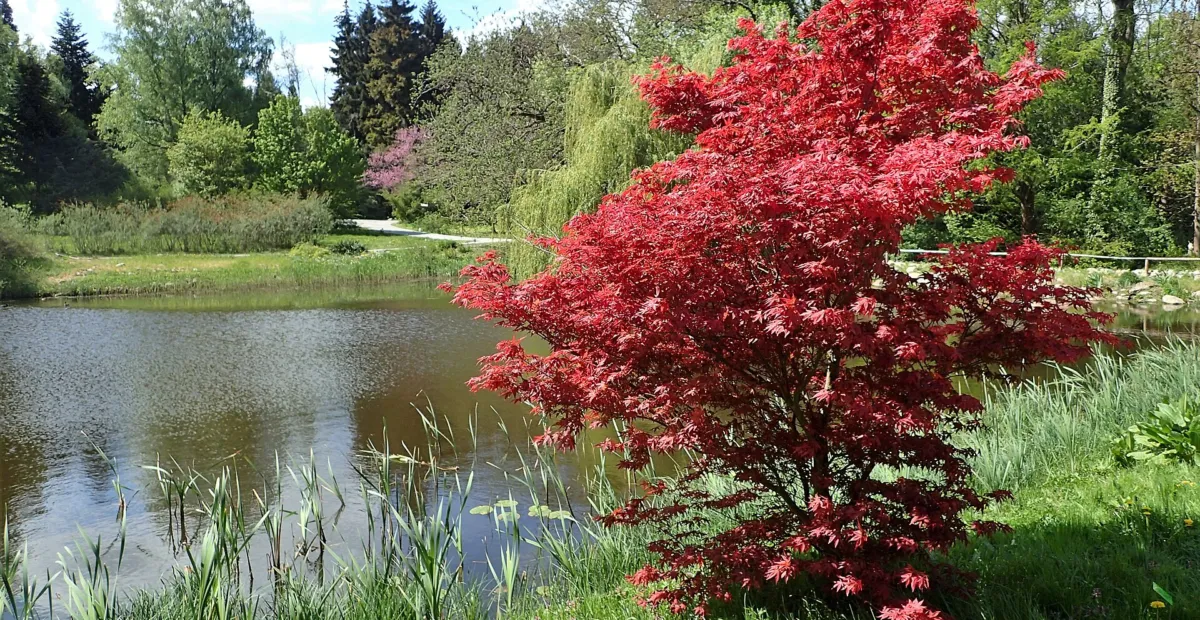
Acer palmatum 'Bloodgood' is a deciduous Japanese maple valued for its deep burgundy-red foliage, rounded branching, and brilliant crimson fall color. This cultivar grows as a broad, upright small tree or large shrub, usually reaching 15–20 feet in height and spread. Give it evenly moist, well-drained acidic to neutral soil, shelter from drying winds, and afternoon protection in hot climates to reduce leaf scorch.
Taxonomic classification
Bloodgood (Acer palmatum ‘Bloodgood’) care guide
Light and placement
Provide full sun to partial shade, with morning sun and afternoon shade preferred in hot-summer areas. Northern gardens can often support more direct sun; southern or reflected-heat sites should use filtered light or eastern exposure. Scorched margins, curled leaves, or premature browning indicate excessive heat, drought, wind, or sun. Weak color and elongated growth suggest insufficient light.
Watering and humidity
Water deeply when the upper few inches of soil begin to dry, especially during establishment and summer heat. Keep moisture consistent rather than alternating drought and saturation. Mulch the root zone to moderate temperature, but keep mulch away from the trunk. Increase monitoring in containers, windy sites, and hot climates.
Soil and growing medium
Use a loose, well-drained loam or organically improved soil that holds steady moisture without staying saturated. Slightly acidic to neutral conditions are suitable. Heavy clay should be amended through site selection, raised planting, or improved drainage rather than by creating a small isolated pocket of rich soil.
Feeding
Usually needs little fertilizer. Apply a thin layer of compost or a balanced, slow-release fertilizer in late winter or early spring before leaf expansion if growth is weak. Avoid heavy nitrogen, late-season feeding, and fertilizing drought-stressed or newly transplanted trees.
Growth and habit
Forms a dense, broad, upright crown with layered branches and often multiple trunks. Growth is slow to moderate, with stronger establishment when roots stay evenly moist. Avoid harsh reshaping; the natural branching pattern is one of the cultivar's main ornamental features.
Planting and repotting
Plant during dormancy, from fall after leaf drop through early spring, when the ground is workable. Set the root flare level with or slightly above surrounding soil, water deeply, and mulch broadly without touching the trunk. Allow roughly 15–20 feet for a mature specimen, less only when regular pruning is planned.
Repot container plants in late winter or early spring before leaf emergence, moving up only one pot size. Refresh compacted mix and preserve the root flare. Avoid excessive root disturbance, and use a container with generous drainage because prolonged saturation increases disease risk.
Propagation and pruning
Propagation
Commercially, preserve the cultivar by grafting onto Acer palmatum rootstock. Softwood or semi-hardwood cuttings can be attempted in active growth under controlled humidity, but success is less consistent than grafting. Seed will not reliably reproduce the named cultivar.
Pruning
Prune sparingly during dormancy, commonly in late winter, to remove dead, crossing, or poorly placed branches. Avoid major cuts in spring when sap flow is strong. Preserve the layered structure and never top the tree.
Overwintering
Plants in Zones 5–6 benefit from wind protection and a 2–3 inch organic mulch layer over the root zone after the ground cools. Protect containers from repeated freeze-thaw cycles by insulating or moving them to an unheated sheltered location. Do not bring outdoor plants into warm indoor rooms for winter.
Uses
A specimen, accent, understory, patio, or container tree for ornamental foliage and seasonal color. Its noncompetitive root system allows compatible companion planting. It is not a food, medicinal, or reliably edible plant.
Appearance
Leaves are simple, opposite, palmately lobed, and typically five to seven lobes with pointed tips. The foliage is deep burgundy-red through much of the growing season, while young stems and dark bark add winter interest. The dense, rounded crown and layered branches distinguish it from finely dissected laceleaf cultivars.
Flowering
Small reddish-purple flowers appear in loose clusters with or around the emerging leaves in spring. They are visually subtle but are followed by paired winged samaras that mature from reddish tones toward late summer and fall.
Pollination and visitors
The small spring flowers can be visited by bees, but the cultivar is primarily grown for foliage rather than pollinator value. Flower visitation is likely modest because the flowers are small and inconspicuous.
Acer palmatum 'Bloodgood' photos
Click any photo for a larger view. Source, author and license are shown separately.
Diseases and pests
Diseases
Verticillium wilt is the main serious concern, especially in poorly drained or stressed soil. Leaf scorch can mimic disease but is usually environmental. Improve drainage, avoid root injury, disinfect tools, remove severely affected material, and do not replant susceptible maples immediately in soil with a confirmed wilt history.
Pests
Aphids, horse chestnut scale, borers, caterpillars, and occasional gall mites may occur. Inspect new growth and branch unions, encourage beneficial insects, reduce plant stress, and use targeted treatments only when damage is significant. Deer may browse foliage and young growth.
Related diseases and pests
Only Plant Doctor profiles whose host data indicate this plant may be affected are shown here.
 PestHorse Chestnut Leaf MinerCameraria ohridella Deschka & Dimić
 Environmental stressSalt stress
 Environmental stressFlooding injury
 PestLeopard mothZeuzera pyrina
 DiseaseXylella fastidiosa bacterial diseasesXylella fastidiosa
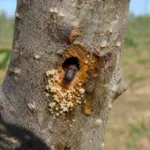 PestEuropean shot-hole borerXyleborus dispar (Fabricius)
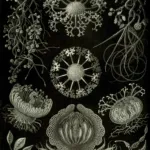 DiseaseMaple powdery mildewSawadaea bicornis
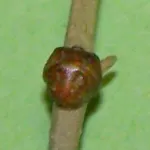 PestBlack scaleSaissetia oleae
Toxicity and pollen
No reliable evidence indicates that this cultivar is a significant human or household-pet poison. Avoid deliberate ingestion of leaves, bark, or samaras, as plant material can still cause nonspecific gastrointestinal upset, and consult a veterinarian or poison service after substantial ingestion or symptoms.
- Typical season
- Spring, generally April–May in much of the United States
- Pollination / pollen
- Small quantities associated with insect-pollinated flowers
A spring-flowering, insect-pollinated maple releases pollen from small flowers rather than producing the conspicuous windborne clouds associated with many allergenic trees. Individual sensitivity is still possible, so allergy risk should not be treated as zero.
Native habitat
The species is native to Japan, Korea, and parts of China, where it commonly occurs in woodland margins, mountain forests, and understory settings with moist, well-drained soils. The cultivar is a cultivated selection and is not native to the United States.
Interesting fact
The cultivar was introduced by Bloodgood Nursery on Long Island before World War II. Its leaves commonly remain red-purple through summer and deepen to crimson in fall. The epithet palmatum refers to the hand-like outline of the leaves. Plants grown from cuttings may develop more slowly than grafted plants.
Frequently asked questions (FAQ)
The most relevant questions about this plant, with short and direct answers.
🌱Quick care
How do you care for Acer palmatum 'Bloodgood'?⌄
Give Acer palmatum 'Bloodgood' full sun to partial shade, evenly moist well-drained soil, and protection from drying heat and wind. It generally needs little fertilizer and only light structural pruning.
How big does Acer palmatum 'Bloodgood' get?⌄
Acer palmatum 'Bloodgood' typically reaches about 15–20 feet tall and 12–20 feet wide in the landscape. Its final size depends on climate, soil, pruning, and growing conditions.
Is Acer palmatum 'Bloodgood' deciduous?⌄
Yes, Acer palmatum 'Bloodgood' is a deciduous tree that drops its leaves in fall. It provides red foliage in spring and summer, fall color, and attractive branching after leaf drop.
🌤️Environment and placement
Does Acer palmatum 'Bloodgood' need full sun or shade?⌄
Acer palmatum 'Bloodgood' grows in full sun to partial shade. In northern or cooler areas it can tolerate more direct sun, while afternoon shade is usually better in hot Southern climates.
Can Acer palmatum 'Bloodgood' grow in full sun?⌄
Yes, it can grow in full sun, especially where summers are moderate and soil stays evenly moist. Hot, dry conditions can cause leaf scorch, so afternoon shade and irrigation may be needed in warmer regions.
What is the best soil for Acer palmatum 'Bloodgood'?⌄
Use moist, well-drained soil with a slightly acidic to neutral pH and good organic matter. Avoid sites where water remains around the roots, because poor drainage increases stress and disease risk.
Can Acer palmatum 'Bloodgood' grow in clay soil?⌄
Yes, but clay soil must drain adequately and should not stay waterlogged. Planting slightly high or on a gentle slope can improve drainage in heavy clay.
What USDA hardiness zones are suitable for Acer palmatum 'Bloodgood'?⌄
Acer palmatum 'Bloodgood' is commonly grown in USDA Zones 5–8. Local exposure matters because early spring growth can be damaged by late frosts even where winter temperatures are suitable.
Where should I plant Acer palmatum 'Bloodgood'?⌄
Plant it in a protected location with morning sun or filtered light, consistent moisture, and shelter from strong, drying winds. Leave enough room for a mature tree roughly 15–20 feet tall and wide.
💧Care and problems
How often should I water Acer palmatum 'Bloodgood'?⌄
Water deeply whenever the upper soil begins to dry, keeping the root zone evenly moist but not saturated. Newly planted trees need more frequent irrigation, while established trees need supplemental water during drought or hot weather.
Why are the leaves of my Acer palmatum 'Bloodgood' turning brown?⌄
Brown leaf edges or patches are most often caused by heat, drought, drying wind, or excessive sun exposure. Keep the soil consistently moist, apply mulch, and provide afternoon shade when summer conditions are intense.
Why is my Acer palmatum 'Bloodgood' losing its red color?⌄
Leaf color can become less intense when the tree receives heavy shade, experiences heat stress, or grows weakly. Bright light with adequate moisture generally supports deeper red foliage, although seasonal variation is normal.
Does Acer palmatum 'Bloodgood' need fertilizer?⌄
Usually, Acer palmatum 'Bloodgood' needs little fertilizer if it grows in reasonably fertile soil. Test the soil before feeding, and avoid excessive nitrogen, which can produce weak growth and reduce color quality.
What pests affect Acer palmatum 'Bloodgood'?⌄
Aphids, scale insects, borers, and occasionally other chewing pests can affect Acer palmatum 'Bloodgood'. Healthy trees usually tolerate minor infestations, but persistent damage should be identified and treated according to the pest involved.
Is Acer palmatum 'Bloodgood' susceptible to disease?⌄
It can suffer from problems such as verticillium wilt and root stress when drainage is poor. Planting in well-drained soil, avoiding root injury, and watering consistently help reduce disease risk.
🪴Planting and repotting
When is the best time to plant Acer palmatum 'Bloodgood'?⌄
Plant Acer palmatum 'Bloodgood' in spring after the ground can be worked or in early fall before the soil freezes. Avoid planting during extreme summer heat or when the tree is actively experiencing drought stress.
Can Acer palmatum 'Bloodgood' be grown in a container?⌄
Yes, it can be grown in a large container with drainage holes and a well-drained, moisture-retentive potting mix. Container trees dry out and freeze more quickly than in-ground trees, so they need closer monitoring and winter protection.
How should I mulch Acer palmatum 'Bloodgood'?⌄
Apply about 2–3 inches of organic mulch over the root zone, keeping it several inches away from the trunk. Mulch helps conserve moisture and moderate soil temperature without creating a wet collar around the bark.
✂️Propagation and pruning
How is Acer palmatum 'Bloodgood' propagated?⌄
Named plants are commonly propagated by grafting, and selected plants may also be produced from stem cuttings under controlled nursery conditions. Seed will not reliably reproduce the exact 'Bloodgood' cultivar.
When should I prune Acer palmatum 'Bloodgood'?⌄
Prune lightly during dormancy, commonly in late winter before strong spring growth begins, or remove small problem branches as needed. Avoid unnecessary heavy pruning because the tree naturally develops an attractive branching structure.
Can I prune Acer palmatum 'Bloodgood' to keep it small?⌄
Light pruning can control shape and remove crossing, damaged, or low branches, but it is not a dwarf cultivar. Keeping a mature tree substantially smaller requires repeated pruning and may spoil its natural form.
⚠️Toxicity and safety
Is Acer palmatum 'Bloodgood' toxic to dogs or cats?⌄
No significant toxicity is documented for Acer palmatum 'Bloodgood'. Even so, pets should not be encouraged to eat large amounts of any ornamental plant, and unusual symptoms warrant veterinary advice.
🌸Flowering and special interest
Does Acer palmatum 'Bloodgood' flower?⌄
Yes, it produces small, inconspicuous reddish flowers in spring. The main ornamental features are its red foliage, fall color, branching habit, and winged samaras rather than its flowers.
Why did a late frost damage my Acer palmatum 'Bloodgood'?⌄
Acer palmatum 'Bloodgood' leafs out relatively early, so emerging leaves and shoots can be injured by spring frost. Wait until damage is clearly dead before pruning, because some buds and stems may recover.
Similar plants
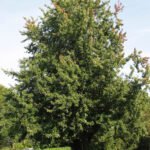 Silver maple (Acer saccharinum) care guideAcer saccharinum
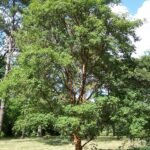 Paperbark Maple (Acer griseum) care guideAcer griseum
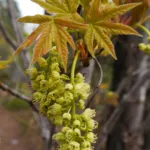 Bigleaf maple (Acer macrophyllum) care guideAcer macrophyllum
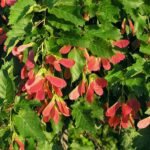 Tatar Maple (Acer tataricum) care guideAcer tataricum
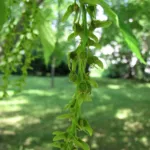 Père David’s Maple (Acer davidii) care guideAcer davidii
 Sugar maple (Acer saccharum) care guideAcer saccharum