
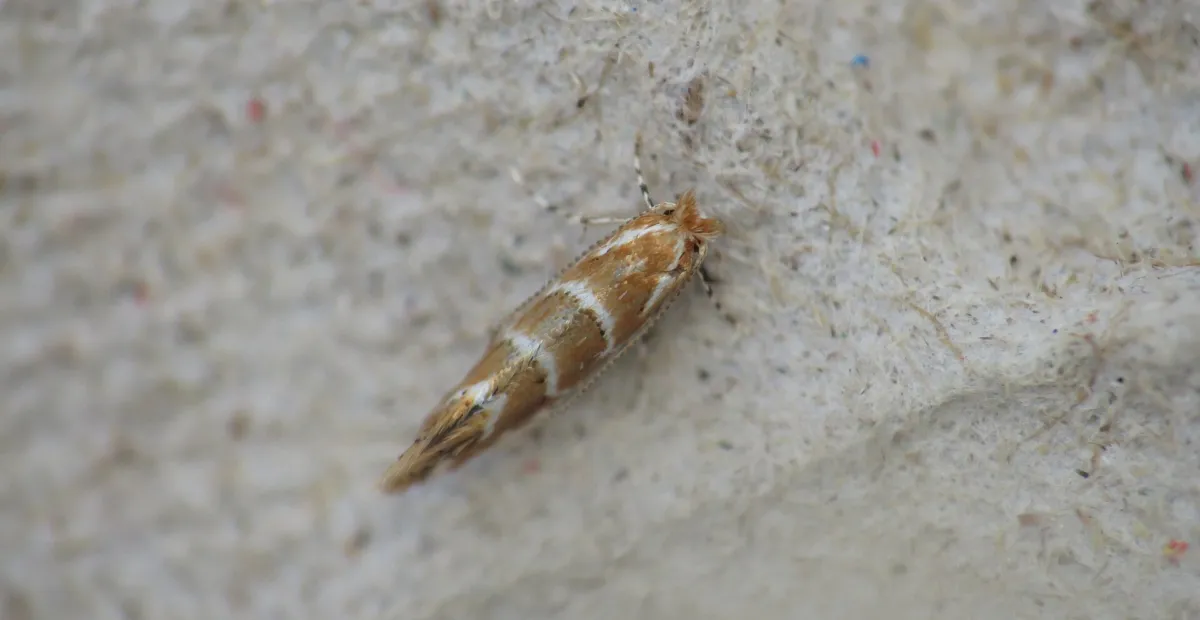
Horse Chestnut Leaf Miner
Cameraria ohridella Deschka & DimićHorse Chestnut Leaf Miner overview
The horse chestnut leaf miner, Cameraria ohridella, is a small moth whose larvae tunnel between the layers of horse chestnut leaves. The resulting pale blotches turn brown, merge across the foliage and may cause premature summer leaf drop. It is primarily a pest of European horse chestnut, although documented susceptibility in some Aesculus and Acer hosts is broader than its common name suggests.
Typical conditions
Overview
Cameraria ohridella, commonly called the horse chestnut leaf miner, is a small moth in the family Gracillariidae. Its larvae feed inside leaves rather than externally, creating pale or translucent blotches that later become brown. The main host is European horse chestnut (Aesculus hippocastanum).
In heavily infested trees, mines can merge and cause an early-autumn appearance during summer. The insect is well established across much of Europe but is treated in U.S. plant-health references as an exotic pest of concern rather than a routine, widespread U.S. landscape pest. Similar mines on horse chestnut should be confirmed because fungal leaf blotch and environmental scorch can look different but superficially similar.
Symptoms and identification
- Irregular, pale blotch mines appear between the upper and lower leaf surfaces, often beginning near veins.
- Mined tissue turns tan or brown, and separate mines may merge until much of a leaflet is necrotic.
- Infested leaves may curl, become brittle and drop prematurely, sometimes in July or August.
- Larvae, frass or a silk pupal cocoon may be visible within a mine when the leaf is held against light.
- Severe, repeated defoliation can reduce tree vigor, although established trees commonly survive individual infestations.
Do not confuse the mines with circular fungal leaf-blotch lesions, which are not confined between the leaf surfaces and may show fungal fruiting structures.
Causes and spread
The damage is caused by larvae of Cameraria ohridella feeding between the epidermal layers of the leaf. Adults disperse by flight and wind, while longer-distance movement may occur when adults, pupae or infested fallen leaves are transported on vehicles or with plant material.
Population buildup is favored where many European horse chestnuts grow close together and fallen leaves remain beneath the canopy. Host records outside Aesculus hippocastanum vary among studies; Acer pseudoplatanus is recognized as a host in EPPO records, while other maple or buckeye records may represent regional, opportunistic or experimental susceptibility.
Life cycle and persistence
Adults emerge in spring from pupae that overwinter in fallen leaves. Females lay small eggs on or near the veins of horse chestnut leaves. Newly hatched larvae enter the leaf and pass through several feeding stages, enlarging a blotch mine. Later stages form a silk-lined cocoon within the mine, pupate and emerge as moths.
Under temperate European conditions, two or three generations are common; warmer climates may support more. In a U.S. garden or urban landscape, the number and timing of generations will depend on local temperatures and host availability, so monitoring mines and adult flight is more reliable than applying a fixed calendar schedule.
Treatment and control
Begin with confirmation and monitoring. Inspect leaves against the light, check for active larvae or fresh mines, and distinguish the injury from horse chestnut leaf blotch and drought scorch. For valuable landscape trees, a certified arborist can assess canopy condition and whether treatment is justified.
Sanitation is the most broadly applicable measure: remove fallen leaves in autumn and dispose of them appropriately. Protect the root zone from drought stress and avoid unnecessary pruning or fertilization. Foliar treatments, where legally available and justified, must be timed to the local adult flight and early larval period; sprays applied after larvae are deep inside mature mines may provide poor control. Systemic or trunk-injection treatments require professional evaluation because tree size, product fit, application safety and non-target effects are important.
Low-impact and biological control
Use an IPM approach centered on autumn leaf removal, monitoring and tree-health care. Rake or vacuum leaves beneath and around susceptible horse chestnuts, remove them from the site, and prevent partially decomposed leaf litter from accumulating under the canopy. Encourage naturally occurring parasitoids and predators by avoiding broad-spectrum insecticides when they are not necessary.
Biological parasitism has been documented, but naturally occurring parasitoids often suppress only a portion of the population. There is no reliable home-garden biological treatment that consistently eliminates larvae inside established leaf mines. Organic production or homeowner products should be used only if they are registered and labeled for the specific crop, pest and site.
Prevention
- Plant a diverse mix of well-adapted trees rather than concentrating European horse chestnut in a continuous row or grove.
- Maintain tree vigor with appropriate watering during drought, adequate root-zone mulch and correction of confirmed soil or root problems.
- Inspect new horse chestnut foliage from spring through late summer for the first mines and record their progression.
- Remove and dispose of fallen horse chestnut leaves in autumn, before overwintering pupae can emerge. Where permitted, thorough composting that reaches adequate heat may be used; do not leave partially composted leaves beside the tree.
- Clean up leaves from neighboring infested trees when practical, because nearby untreated hosts can quickly recolonize a tree.
Interesting facts
- The species was first recognized near Lake Ohrid in the Balkans in the 1980s and subsequently spread rapidly through much of Europe.
- European horse chestnut is the principal host, but documented host use is not completely uniform among regions and studies.
- Severe infestations may make a tree look as though autumn arrived unusually early, even though the damage is caused by larvae mining inside the leaves.
- Fallen leaves are epidemiologically important because the final-generation pupae can overwinter in them.
- Repeated defoliation can add stress, but leaf-miner injury alone does not always kill a mature horse chestnut tree.
Use only products legally authorized for Cameraria ohridella on the specific crop and site in the United States, and follow the current product label exactly. Do not rely on pesticide recommendations from foreign publications or older literature, because registrations, permitted sites, rates, re-entry intervals and environmental restrictions vary. For large trees, consult a licensed pesticide applicator or certified arborist; protect pollinators and beneficial insects and avoid unnecessary broad-spectrum treatments.
Affected plants
The plants below are linked to this problem by structured host-plant data. The list updates automatically as new plant profiles are added.
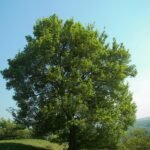 Field maple (Acer campestre) care guideAcer campestre
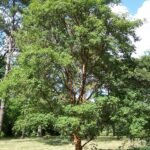 Paperbark Maple (Acer griseum) care guideAcer griseum
 Downy Japanese Maple (Acer japonicum) care guideAcer japonicum
 Boxelder (Acer negundo) care guideAcer negundo
 Acer palmatum care guideAcer palmatum
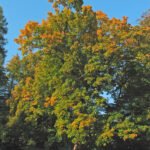 He Norway maple (Acer platanoides) care guideAcer platanoides
 Sycamore maple (Acer pseudoplatanus) care guideAcer pseudoplatanus
 Red maple (Acer rubrum) care guideAcer rubrum
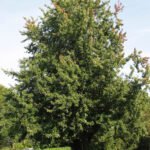 Silver maple (Acer saccharinum) care guideAcer saccharinum
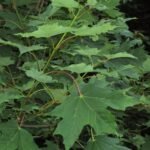 Sugar maple (Acer saccharum) care guideAcer saccharum
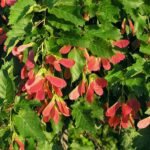 Tatar Maple (Acer tataricum) care guideAcer tataricum
 Amur Maple (Acer tataricum ginnala) care guideAcer tataricum ginnala