
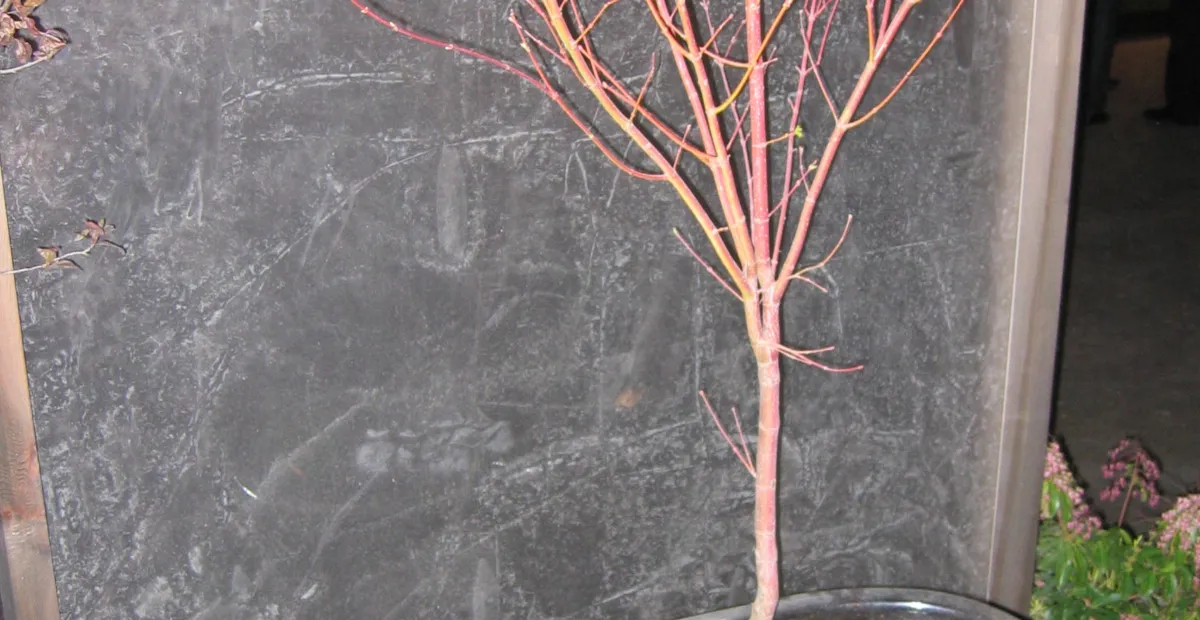
 Source:
 Sango Kaku (Acer palmatum ‘Sango Kaku’) short overview
Acer palmatum 'Sango Kaku' is a deciduous Japanese maple valued for its vivid coral-red young bark, especially striking after leaf fall. Pink-flushed spring leaves mature to soft green, then turn yellow to golden in autumn. This upright, medium-sized cultivar performs best in moist, well-drained soil with morning sun or partial afternoon shade, where protection from drying winds and intense heat helps prevent leaf scorch.
Taxonomic classification
Sango Kaku (Acer palmatum ‘Sango Kaku’) care guide
Light and placement
Give full sun in cooler climates, or morning sun with light afternoon shade where summers are hot. Strong afternoon sun, reflected heat and dry wind can scorch emerging leaves; too much shade produces weaker growth and may reduce bark color. A sheltered east or north exposure is often effective in warm regions.
Watering and humidity
Water deeply when the upper few inches of soil begin to dry, keeping the root zone evenly moist but never saturated. Newly planted trees need regular irrigation through the first two growing seasons; established trees need supplemental water during drought. A 2–3 inch organic mulch layer helps moderate soil moisture and temperature.
Soil and growing medium
Use a moisture-retentive but well-drained soil rich in organic matter. Loam is ideal, although the cultivar can tolerate sand or heavier clay when drainage is improved. Slightly acidic to neutral soil is suitable; avoid persistently waterlogged ground and excessive alkaline conditions.
Feeding
Apply a thin layer of compost or a balanced, slow-release fertilizer in early spring if growth is weak or soil is poor. Do not overfertilize, especially with high nitrogen, because lush late growth is more vulnerable to winter injury and can reduce the plant’s balanced form. Stop routine feeding by midsummer.
Growth and habit
This cultivar develops an upright to broadly upright branching framework and can become a substantial small tree. Young shoots may be vigorous, while exposed or cold sites can experience twig dieback. Consistent moisture, moderate feeding and thoughtful siting help preserve steady growth and branch quality.
Planting and repotting
Plant in spring or fall while temperatures are moderate. Set the root flare level with, or slightly above, the surrounding soil; do not bury the trunk. Mulch broadly but keep mulch away from the bark. Allow enough room for the mature canopy and water deeply during establishment.
Repot container-grown plants in early spring, just before active growth, when roots have filled the container. Move into only a modestly larger pot, preserve the root flare, and use a free-draining container mix that retains even moisture. Avoid unnecessary root disturbance.
Propagation and pruning
Propagation
Maintain the named cultivar by grafting onto compatible Japanese maple rootstock. Layering may be possible but is slower and less efficient. Seed will not reliably reproduce the cultivar, and ordinary cuttings are generally difficult.
Pruning
Prune sparingly while the tree is young to establish structure. Remove dead, crossing or weakly attached branches after the main winter cold or in late summer, when practical. Avoid heavy pruning and avoid unnecessary cuts during strong spring sap flow.
Overwintering
Outdoor plants are generally hardy in USDA Zones 5–8. Protect young trees from drying winter wind, abrupt temperature swings and rodent damage. Container specimens are more vulnerable than in-ground trees; insulate the pot or move it to a sheltered unheated location rather than bringing it into a warm room.
Uses
A high-value ornamental specimen for four-season gardens, woodland edges, entry plantings, patios and large containers. Its coral bark provides winter color, while the spring and fall foliage add seasonal interest. It is grown for landscape display rather than edible or medicinal use.
Appearance
The leaves are palmate and typically five-lobed, opening with a pink flush before becoming pale green. Young twigs and branches develop a distinctive coral to salmon-red color that intensifies in cold weather. The deciduous canopy and exposed winter framework make the cultivar identifiable even after leaf fall.
Flowering
Small reddish to purple flowers appear in spring before or with the expanding foliage. They are visually secondary to the leaves and bark and are followed by paired winged samaras. Flowering can be subtle and varies with climate and plant age.
Pollination and visitors
The small spring flowers of Japanese maple are visited by generalist insects, including bees and hoverflies, but the flowers are not a major documented pollinator resource compared with conspicuous nectar-rich ornamentals.
Acer palmatum 'Sango Kaku' photos
Click any photo for a larger view. Source, author and license are shown separately.
Diseases and pests
Diseases
Watch for verticillium wilt, anthracnose, tar spot, cankers and root problems in poorly drained soil. Improve air circulation, avoid trunk and leaf injury, remove diseased material, and water at the root zone. Severe wilt or cankering warrants professional diagnosis.
Pests
Aphids, scale, Japanese beetles, ambrosia beetles and borers may occur. Inspect new growth and woody stems, especially on stressed trees. Encourage natural predators, maintain consistent moisture, and use targeted treatments only when damage is significant.
Toxicity and pollen
No reliable cultivar-specific toxicity profile was found. Do not assume complete safety from the absence of a listing; discourage chewing of leaves, bark or seeds and contact a veterinarian or poison service after a concerning ingestion.
- Typical season
- Spring
- Pollination / pollen
- Insect-associated spring pollen
Japanese maple pollen is released during spring flowering. The flowers are insect-pollinated rather than a classic wind-pollinated allergy source, but sensitive people may still encounter pollen locally. Cultivar-specific clinical allergy data are not established.
Native habitat
The species is native to Japan, Korea and parts of China, where it occurs in temperate woodland and mountain environments with seasonal moisture, acidic to neutral soils and protection from severe exposure. The cultivar is a selected garden form rather than a wild population.
Interesting fact
The cultivar name is associated with the idea of a coral-colored tower. Cold weather intensifies the coral tone of the young bark. Its strongest ornamental display may occur after leaf fall, when the bare branching is exposed. It is also known under the older cultivar name 'Senkaki' in horticultural references.
Frequently asked questions (FAQ)
The most relevant questions about this plant, with short and direct answers.
🌱Quick care
What is Acer palmatum 'Sango Kaku'?⌄
Acer palmatum 'Sango Kaku' is a deciduous Japanese maple valued for coral-red young bark, light green foliage, and yellow fall color. Its winter bark is most noticeable after the leaves drop.
What is the best light for Acer palmatum 'Sango Kaku'?⌄
Give Acer palmatum 'Sango Kaku' full sun to partial shade. In hot or dry climates, afternoon shade helps reduce leaf scorch, while adequate sunlight improves coral bark color.
How often should I water Acer palmatum 'Sango Kaku'?⌄
Water Acer palmatum 'Sango Kaku' whenever the soil surface begins to dry, keeping the root zone evenly moist but not waterlogged. Newly planted trees need more frequent watering during their first growing season.
What type of soil does Acer palmatum 'Sango Kaku' need?⌄
Acer palmatum 'Sango Kaku' grows best in moist, well-drained loam enriched with organic matter. It can tolerate some clay or sand if drainage and moisture retention are improved.
How cold hardy is Acer palmatum 'Sango Kaku'?⌄
Established Acer palmatum 'Sango Kaku' is hardy to about -10°F under suitable conditions. Young trees and container-grown plants need more protection from severe cold and drying winter winds.
🌤️Environment and placement
Can Acer palmatum 'Sango Kaku' grow in full sun?⌄
Yes, Acer palmatum 'Sango Kaku' can grow in full sun when soil moisture is consistent. In regions with intense summer heat, filtered light or afternoon shade is safer for the foliage.
Where should I plant Acer palmatum 'Sango Kaku'?⌄
Plant Acer palmatum 'Sango Kaku' in a sheltered spot with well-drained soil, morning or moderate sun, and protection from strong winds. Avoid locations that become waterlogged or intensely hot and dry.
How much space does Acer palmatum 'Sango Kaku' need?⌄
Allow roughly 15 to 20 feet of width for a mature Acer palmatum 'Sango Kaku', although size varies with climate, rootstock, pruning, and growing conditions. Keep it away from buildings and overhead utility lines.
Can Acer palmatum 'Sango Kaku' grow in a container?⌄
Yes, Acer palmatum 'Sango Kaku' can grow in a large container with drainage holes and a high-quality, well-drained potting mix. Container roots are more vulnerable to heat, drought, and freezing than roots in the ground.
Is Acer palmatum 'Sango Kaku' suitable for USDA Zone 5?⌄
Acer palmatum 'Sango Kaku' can be grown in USDA Zone 5, especially in a sheltered site with reliable moisture. Winter protection is more important for young trees, exposed plantings, and container specimens.
💧Care and problems
Why are the leaves on my Acer palmatum 'Sango Kaku' turning brown?⌄
Brown or crispy leaves on Acer palmatum 'Sango Kaku' are commonly associated with heat, drought, wind, or excessive sun exposure. Check soil moisture and drainage, then provide deep watering and afternoon protection when needed.
Why is my Acer palmatum 'Sango Kaku' losing leaves early?⌄
Early leaf loss can result from drought stress, heat, root damage, disease, or normal seasonal dormancy. Inspect the branches and roots, and check whether the soil is staying either excessively dry or persistently wet.
Why is the bark on my Acer palmatum 'Sango Kaku' turning dark?⌄
Older branches of Acer palmatum 'Sango Kaku' naturally lose some of their bright coral color, but sudden darkening, sunken areas, or dieback may indicate injury or disease. Remove damaged material only after identifying the cause.
Is Acer palmatum 'Sango Kaku' prone to disease?⌄
Acer palmatum 'Sango Kaku' can be susceptible to bacterial blight, verticillium wilt, leaf scorch, and other maple problems. Good drainage, careful watering, clean pruning tools, and avoiding unnecessary wounds reduce risk.
Does Acer palmatum 'Sango Kaku' need fertilizer?⌄
Acer palmatum 'Sango Kaku' usually needs little fertilizer when planted in fertile soil. If growth is weak, apply a light, balanced slow-release fertilizer in early spring and avoid excessive nitrogen or late-season feeding.
Should I mulch Acer palmatum 'Sango Kaku'?⌄
Yes, apply a 2- to 3-inch layer of organic mulch over the root zone to conserve moisture and moderate soil temperature. Keep mulch several inches away from the trunk to prevent excessive moisture around the bark.
🪴Planting and repotting
When is the best time to plant Acer palmatum 'Sango Kaku'?⌄
Plant Acer palmatum 'Sango Kaku' in fall or early spring while the tree is dormant and soil can be worked. Avoid planting during frozen, waterlogged, or intensely hot and dry conditions.
How do I plant Acer palmatum 'Sango Kaku' correctly?⌄
Plant Acer palmatum 'Sango Kaku' with the root flare at or slightly above finished soil level in a wide planting hole. Backfill with the excavated soil, water deeply, and mulch without covering the trunk.
Can Acer palmatum 'Sango Kaku' be grown in heavy clay soil?⌄
Acer palmatum 'Sango Kaku' can tolerate some heavy clay if the site drains well and organic matter is incorporated broadly into the planting area. Do not plant it where clay remains saturated after rain.
How do I repot Acer palmatum 'Sango Kaku' in a container?⌄
Repot Acer palmatum 'Sango Kaku' in early spring before strong new growth, moving it into a container only slightly larger than the root ball. Use a fresh, well-drained mix and avoid burying the trunk or root flare.
✂️Propagation and pruning
How is Acer palmatum 'Sango Kaku' propagated?⌄
Acer palmatum 'Sango Kaku' is usually propagated by grafting, which preserves its cultivar characteristics. Softwood cuttings may be attempted by specialists but can root inconsistently, while seedlings will not reliably reproduce the named cultivar.
Can I grow Acer palmatum 'Sango Kaku' from seed?⌄
You can grow a Japanese maple from seed, but seedlings from Acer palmatum 'Sango Kaku' will not reliably remain true to the cultivar. The coral bark color, growth habit, and foliage may differ from the parent tree.
Can Acer palmatum 'Sango Kaku' be grown from cuttings?⌄
Acer palmatum 'Sango Kaku' can sometimes be rooted from softwood cuttings under controlled conditions, but success is inconsistent. Grafted nursery plants are the more dependable way to obtain this exact cultivar.
When should I prune Acer palmatum 'Sango Kaku'?⌄
Prune Acer palmatum 'Sango Kaku' lightly during dormancy or in late summer, removing dead, damaged, crossing, or poorly positioned branches. Avoid heavy pruning because it can spoil the natural form and expose the tree to unnecessary stress.
How do I keep Acer palmatum 'Sango Kaku' small?⌄
Keep Acer palmatum 'Sango Kaku' small with gradual structural pruning rather than repeated severe topping. Choose a suitable dwarf cultivar or container-grown plant if a permanently compact size is essential.
⚠️Toxicity and safety
Is Acer palmatum 'Sango Kaku' toxic to dogs or cats?⌄
There is no reliable cultivar-specific toxicity classification for Acer palmatum 'Sango Kaku' in the provided evidence. Prevent pets from eating large amounts of any ornamental plant and contact a veterinarian or poison-control service if ingestion causes symptoms.
🌸Flowering and special interest
Does Acer palmatum 'Sango Kaku' flower?⌄
Acer palmatum 'Sango Kaku' produces small, inconspicuous reddish to purple flowers in spring. Its main ornamental features are the coral-red young bark, green leaves, and yellow fall color.
When does Acer palmatum 'Sango Kaku' show its best bark color?⌄
Acer palmatum 'Sango Kaku' usually shows its strongest coral bark color on younger branches during fall and winter after leaf drop. Mature branches gradually become less brightly colored.
Why is my Acer palmatum 'Sango Kaku' not turning coral red?⌄
The coral color is strongest on young wood and may be muted by age, shade, heat, stress, or cultivar variation. Provide adequate light, steady moisture, and minimal pruning while recognizing that older branches naturally become less vivid.
Similar plants
 Atropurpureum (Acer palmatum ‘Atropurpureum’)Acer palmatum 'Atropurpureum'
 Silver maple (Acer saccharinum) care guideAcer saccharinum
 Père David’s Maple (Acer davidii) care guideAcer davidii
 Osakazuki (Acer palmatum ‘Osakazuki’)Acer palmatum 'Osakazuki'
 Sugar maple (Acer saccharum) care guideAcer saccharum
 Mikawa Yatsubusa (Acer palmatum ‘Mikawa Yatsubusa’)Acer palmatum 'Mikawa Yatsubusa'