
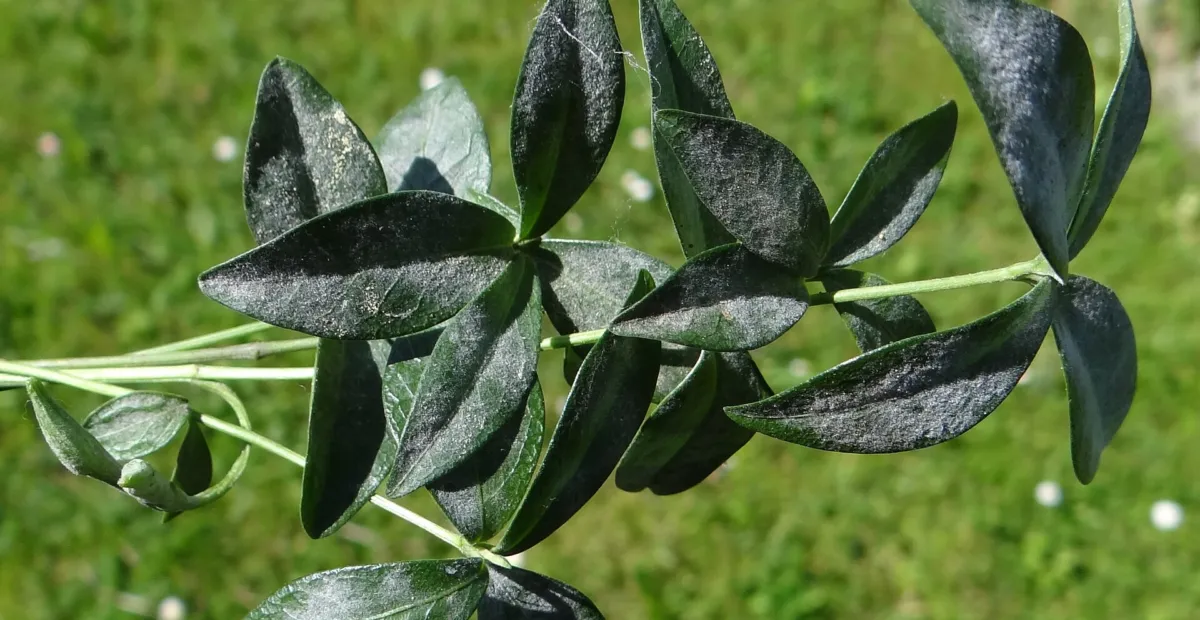
Golovinomyces orontii powdery mildew
Golovinomyces orontiiGolovinomyces orontii powdery mildew overview
Golovinomyces orontii is a living-tissue-dependent powdery mildew fungus associated with cucurbits and several other broadleaf hosts. It produces conspicuous white patches on leaves and shoots that may expand, yellow foliage and reduce plant vigor or fruit quality. Identification from appearance alone is often uncertain because related powdery mildew species look similar and older records may use former names such as Erysiphe cichoracearum.
Typical conditions
Overview
Golovinomyces orontii is a powdery mildew fungus in the family Erysiphaceae. In the United States it is especially relevant to cucurbit powdery mildew diagnoses, although related species such as Podosphaera xanthii may cause an indistinguishable disease on the same crops.
The name has a complicated taxonomic history. Many older reports used Erysiphe cichoracearum, Erysiphe orontii or other broad species concepts. Modern studies recognize closely related lineages within the G. orontii complex, so host records should be interpreted cautiously unless supported by microscopy and molecular testing.
Symptoms and identification
- White to gray, flour-like patches on the upper or lower leaf surface.
- Colonies enlarge and may merge, covering substantial foliage.
- Leaves may become pale or yellow, curl, dry, turn brown and die prematurely.
- Young leaves and shoots can be stunted, distorted or misshapen.
- Heavy infection reduces photosynthesis, vigor, yield and sometimes fruit quality.
- On cucurbits, fruit infection is less common than foliage infection but may occur, especially on cucumber or melon.
Unlike many leaf-spot pathogens, powdery mildew often develops without prolonged free water on the leaf. A white coating is suggestive, but species-level identification generally requires host information, microscopic characters and sometimes DNA sequencing.
Causes and spread
Spread occurs primarily through airborne conidia released from active white colonies. Close plant spacing, touching leaves, greenhouse airflow, handling, contaminated tools and infected transplants can move spores between susceptible plants. Disease severity increases when susceptible foliage remains continuously available and when dense canopies create humid, poorly ventilated pockets.
Do not assume every powdery mildew colony in a mixed planting is the same species. Host range can vary among lineages, and cucurbit powdery mildew may involve both G. orontii and Podosphaera xanthii.
Life cycle and persistence
The fungus is an obligate parasite and obtains nutrients through haustoria inserted into living epidermal cells. Spores produced on the surface are carried mainly by air currents, workers, tools and contact between crowded leaves. Under suitable conditions, repeated asexual spore production can create new colonies within the same growing season.
Some populations can form dark sexual fruiting bodies called chasmothecia, which may survive drying and winter conditions. On perennial hosts, the fungus may also persist in infected buds or living tissues. The relative importance of these survival routes varies by host, climate and lineage; many collections historically called G. orontii are observed mainly in the asexual stage.
Treatment and control
Confirm the diagnosis before treating. White superficial growth strongly suggests powdery mildew, but downy mildew, residue, spray injury and other diseases can look different or overlap. If species identity matters for crop protection, submit a fresh sample with the host identified to a university plant diagnostic laboratory.
Remove badly diseased leaves and improve the canopy environment. Fungicides work best preventively or at the first visible colonies; they generally cannot restore tissue that has already yellowed or died. Apply only a product labeled for the specific host and powdery mildew problem in your state, achieve complete coverage of both leaf surfaces where the label directs, and observe all label restrictions. Repeated use of the same fungicide mode of action can select resistant populations.
Low-impact and biological control
- Remove heavily infected leaves when practical and discard them away from the garden; avoid composting diseased material unless the composting system reliably reaches pathogen-killing temperatures.
- Improve sunlight penetration and air movement by spacing plants properly, trellising vines where suitable, removing overcrowded growth and controlling weeds.
- Water at the soil line and avoid handling plants when foliage is wet. Do not rely on overhead irrigation as a universal remedy because other diseases may be favored by leaf wetness.
- Use resistant or tolerant cultivars when available, particularly for cucumbers, melons, squash and pumpkins.
- For low-level infections, labeled low-risk products such as horticultural oils, potassium bicarbonate or biological fungicides may help suppress powdery mildew, but coverage must be thorough and repeated applications may be needed. Follow the product label and test sensitive plants first.
Prevention
- Start with clean, healthy plants and inspect transplants before purchase or planting.
- Select cultivars bred for powdery mildew resistance where available, while recognizing that resistance may be race- or species-dependent.
- Provide the crop's recommended spacing, full sun where appropriate and good ventilation.
- Avoid excessive nitrogen that produces soft, crowded foliage.
- Scout lower and older leaves at least weekly during warm, humid weather and remove early localized infections.
- Sanitize stakes, pruners and greenhouse surfaces; wash hands after working with infected plants.
- In protected culture, remove infected plants or crop residues promptly and avoid carrying infected material into a clean crop.
- Rotate fungicide modes of action only when chemical treatment is justified and permitted by the label; never repeat a single mode of action unnecessarily.
Interesting facts
- G. orontii is generally used for a broad-host-range powdery mildew lineage, but modern phylogenetic work has shown that the traditional concept includes genetically distinct groups.
- Older cucurbit literature frequently used the name Erysiphe cichoracearum; that historical synonym does not guarantee that a record represents G. orontii in the modern sense.
- Powdery mildew fungi are biotrophs: unlike many decay fungi, they normally cannot complete their life cycle on dead plant debris alone.
- Powdery mildew species are often more host-associated than their superficial appearance suggests, so a mildew from one plant should not automatically be assumed to infect every nearby plant.
Use only fungicides legally authorized and currently labeled in the United States for powdery mildew on the specific crop or ornamental plant. Follow the current label exactly, including crop, rate, preharvest interval, reentry interval, protective-equipment, application-timing and resistance-management requirements. Product registrations and labels can change; consult your state Extension service or an approved label database before application. Do not treat an unconfirmed diagnosis solely by scientific name.
Affected plants
The plants below are linked to this problem by structured host-plant data. The list updates automatically as new plant profiles are added.
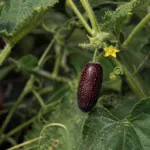 Maroon cucumbe (Cucumis anguria) care guideCucumis anguria
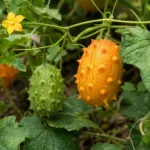 Horned Melon (Cucumis metuliferus) care guideCucumis metuliferus
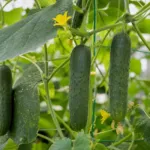 Cucumber (Cucumis sativus) care guideCucumis sativus
 Melon or true melo (Cucumis melo) care guideCucumis melo
 Cantalupensis Group (Cucumis melo Cantalupensis Group)Cucumis melo Cantalupensis Group
 Mango melon (Cucumis melo Chito Group)Cucumis melo Chito Group
 Oriental pickling melon (Cucumis melo Conomon Group)Cucumis melo Conomon Group
 Dudaim melon (Cucumis melo Dudaim Group)Cucumis melo Dudaim Group
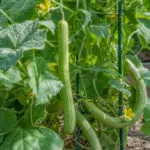 Flexuosus Group (Cucumis melo Flexuosus Group)Cucumis melo Flexuosus Group
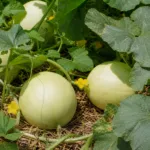 Inodorus Group (Cucumis melo Inodorus Group)Cucumis melo Inodorus Group
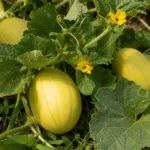 Makuwa Group (Cucumis melo Makuwa Group)Cucumis melo Makuwa Group
 Momordica Group (Cucumis melo Momordica Group)Cucumis melo Momordica Group