
White Pine Blister Rust
Cronartium ribicola J.C. Fisch.White Pine Blister Rust overview
White pine blister rust is a serious, often fatal fungal disease of five-needled white pines caused by Cronartium ribicola. It produces yellow-orange spots and cankers on pine needles, branches, and trunks, while currants and gooseberries commonly support other stages of the fungus. Early detection, pruning of localized cankers, resistant planting stock, and site-based prevention are central to management.
Typical conditions
Overview
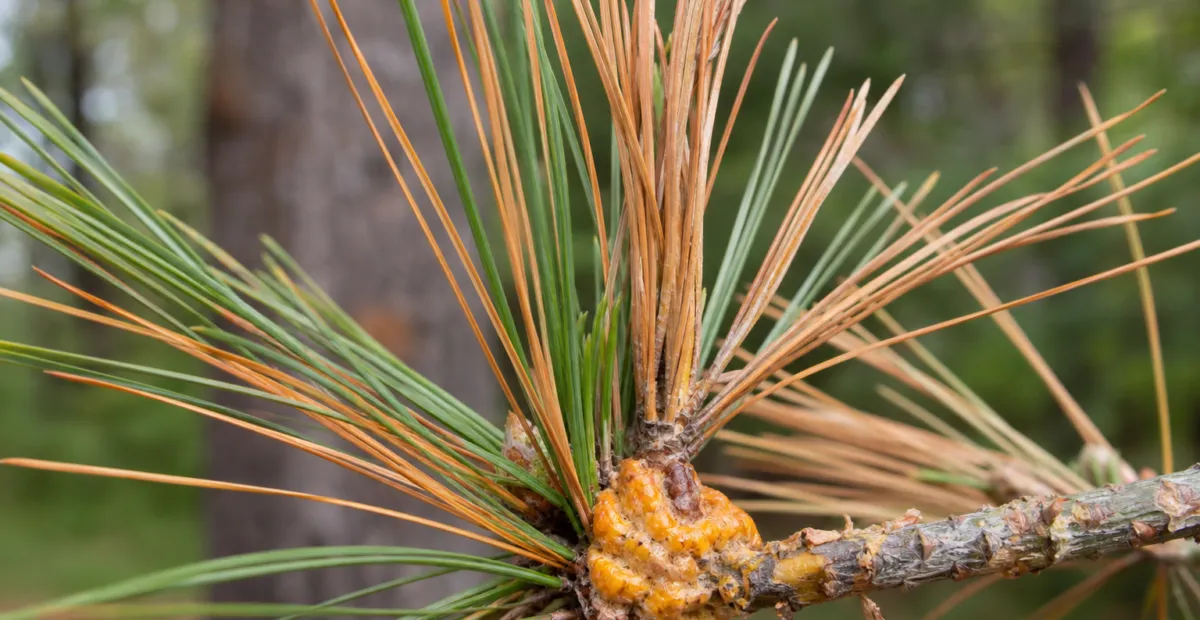
White pine blister rust attacks needles first, then may grow into branches and the main stem. On pine, infections can remain inconspicuous for years before producing a conspicuous canker, resin flow, yellow-orange blister, branch flagging, or top-kill. Young trees and branches close to the ground are often at greatest risk because they remain in humid air near alternate hosts.
The disease is most damaging where susceptible white pines grow in cool, moist sites and where suitable alternate hosts are nearby. It is not a problem that can usually be eliminated from an established forest, but landscape and nursery trees can benefit from inspection, prompt pruning of localized infections, improved site selection, and resistant planting material where available.
Symptoms and identification
- Needles: small yellow or reddish spots, often followed by bands of discoloration, premature needle loss, and dead shoot tips.
- Branches and stems: elongated, sunken or swollen cankers; resin bleeding; roughened bark; yellow-orange blister-like fruiting structures; and dead branch flags beyond the infection.
- Advanced disease: girdling of branches or the trunk, top-kill, reduced crown density, weakened growth, and eventual tree death.
- Alternate hosts: currants and gooseberries may show yellow spots on leaves followed by orange or brown rust structures, although damage to these deciduous hosts is commonly limited to the foliage.
Symptoms can resemble other canker diseases, winter injury, insect damage, or abiotic dieback. Confirmation is strongest when characteristic rust structures occur on the pine or alternate host.
Causes and spread
The causal organism is the rust fungus Cronartium ribicola. It is heteroecious, meaning that different stages normally develop on two unrelated host groups. Basidiospores produced on infected Ribes or other alternate hosts infect young white pine needles. The fungus then grows into the bark and wood, where it can form perennial cankers. Aeciospores produced on pine infect susceptible alternate hosts, allowing the cycle to continue.
Spread is favored by nearby susceptible hosts, windborne spores, prolonged needle wetness, cool humid weather, and dense vegetation that maintains moist air. Short-distance spread between alternate hosts and white pines is particularly important, although the effective distance varies with terrain, weather, host arrangement, and spore production.
Life cycle and persistence
- Basidiospores from infected Ribes, Pedicularis, Castilleja, or related alternate hosts reach young white pine needles during cool, wet conditions.
- The fungus penetrates the needle, grows through the twig, and advances into the inner bark. This phase may remain latent for several years.
- Infected pine bark develops a canker. In spring, yellow-orange aecial blisters rupture and release aeciospores.
- Aeciospores infect leaves of currants, gooseberries, and some documented non-Ribes alternate hosts.
- Uredinia can repeatedly amplify the fungus on alternate-host leaves during the growing season. Telia later produce basidiospores, which are carried by cool, moist air back to susceptible white pines.
The exact alternate-host contribution differs geographically. Ribes is the principal alternate-host genus in much of North America, but Pedicularis and Castilleja species are documented in parts of the interior West.
Treatment and control
Inspect suspected trees annually and mark the location and apparent length of each canker. If a canker is confined to a branch, prune during dry weather back to healthy wood and remove the entire infected branch at a suitable branch union or collar. Extension guidance commonly recommends cutting at least 4 inches beyond visible symptoms; larger cankers, trunk infections, and uncertain cases should be evaluated by a certified arborist or plant disease diagnostic laboratory.
Do not rely on pruning when the canker has reached the trunk, encircled a major stem, or appears to be advancing toward the main leader. Such trees may decline despite treatment and can become hazardous as structural wood weakens. Improve vigor through appropriate watering during drought, mulch kept away from the trunk, protection from mechanical injury, and correction of severe competition, but recognize that good vigor does not cure an established infection.
For forest, restoration, or high-value plantings, prioritize resistant genetic material, hazard assessment, sanitation of nursery stock, and long-term monitoring rather than attempting repeated curative treatments.
Low-impact and biological control
No reliable organic or biological treatment eradicates established Cronartium ribicola from infected pine tissues. The most practical nonchemical measures are annual scouting, pruning of localized branch cankers, removal of severely infected trees where appropriate, improved spacing and airflow, and use of resistant white pine material.
Removing nearby currants or gooseberries may reduce local inoculum in some settings, but it is not a guaranteed control because the fungus can use alternate hosts beyond the immediate property and, in some regions, documented hosts outside Ribes. Avoid transporting infected pine, Ribes, or other host material, and dispose of pruned material according to local plant-health guidance.
Prevention
- Choose white pine species, provenances, or cultivars with documented local blister-rust resistance when available through reputable nurseries or restoration programs.
- Plant on sites with good air movement and avoid persistently wet, foggy, or poorly drained locations when practical.
- Inspect nursery stock and established trees annually, especially lower branches and young pines.
- Space trees to reduce humidity and avoid dense volunteer growth around landscape plantings.
- Prune lower branches gradually as trees mature; do not remove more than one-third of the live crown in a single operation.
- Where appropriate, remove heavily infected alternate-host plants near high-value white pines, while recognizing that eradication is difficult and may not prevent infection from hosts farther away.
- Use clean pruning tools and avoid moving infected live plant material between sites. Follow state or federal movement restrictions when transporting white pine or Ribes nursery stock.
Interesting facts
- Cronartium ribicola was introduced to North America around the beginning of the twentieth century and has spread across much of the range of susceptible white pines.
- The disease name refers to the conspicuous blister-like rust structures that erupt through pine bark.
- White pines have five needles per fascicle, a useful field clue when assessing potential hosts.
- Alternate-host infection is often much less damaging to currants and gooseberries than infection is to white pines.
- Resistance varies among individual trees and seed sources, so genetically improved or locally tested resistant material is an important long-term management tool.
There is no dependable homeowner curative spray program for an established white pine blister rust canker, and USDA Forest Service guidance notes that chemical control is generally unavailable or ineffective for this disease. Use only products legally authorized for the specific crop and disease in the United States, follow the current EPA-approved label exactly, observe all use restrictions and re-entry or preharvest requirements, and obtain current advice from the relevant state extension service or pesticide regulatory agency before application.