Old World Bollworm
Helicoverpa armigera (Hübner)Old World Bollworm overview
Old World bollworm, Helicoverpa armigera, is a highly polyphagous caterpillar pest that attacks flowers, fruits, pods, ears and developing seeds. It resembles the native corn earworm, Helicoverpa zea, and damage alone is not sufficient for reliable identification. In the United States it is a regulated foreign pest of concern; suspected findings should be reported to state or federal plant-health officials rather than managed as an ordinary garden caterpillar.
Typical conditions
Overview
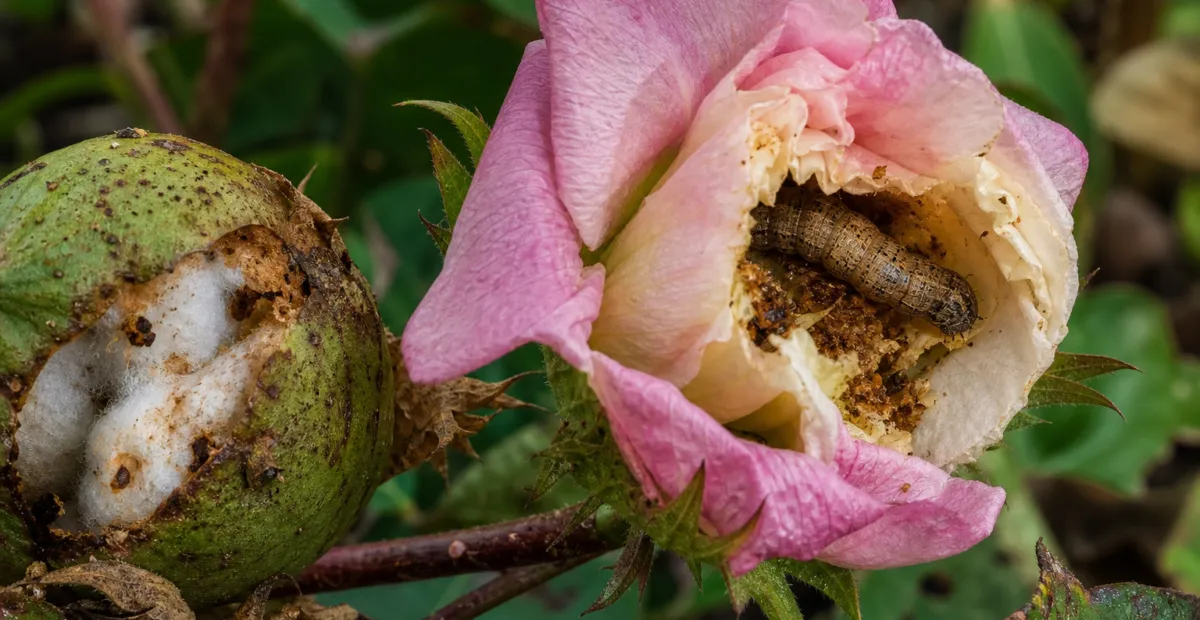
Old World bollworm is the common U.S. name used by USDA APHIS for Helicoverpa armigera, also called cotton bollworm or tomato fruitworm in some international references. The damaging stage is the caterpillar. Larvae may bore into flowers, fruit, cotton bolls, soybean pods and corn ears, where they are protected from contact treatments and can contaminate produce with feeding injury and frass.
In the United States, APHIS classifies this insect as a foreign pest of concern. Isolated detections have occurred, including surveillance and eradication activity near Chicago O’Hare International Airport; it has not been established in U.S. agricultural areas according to the current APHIS pest alert. A suspected specimen should be preserved and reported to the state plant-health official or USDA APHIS.
Symptoms and identification
- Irregular chewing holes in leaves, flowers, fruit, pods, bolls or corn ears.
- Round entry holes in fruit or reproductive structures, often accompanied by wet frass.
- Larvae partly or completely concealed inside tomatoes, peppers, cotton bolls, soybean pods or corn ears.
- Damaged flowers may abort, while bored fruit can rot secondarily.
- Larvae vary from green, yellow or brown to nearly black and often have longitudinal stripes, but color is unreliable for species identification.
Damage is readily confused with that of corn earworm and other noctuid caterpillars. Do not identify H. armigera from feeding injury alone.
Causes and spread
Adults are strong-flying moths and can disperse over long distances with favorable winds. Eggs and larvae can also move in infested flowers, fruits, vegetables, nursery material and other plant commodities. Dense flowering crops, volunteer plants, weeds in the nightshade, legume and malvaceous families, and warm weather increase the opportunity for population growth. In the United States, international and interstate movement of infested commodities is an important biosecurity concern.
Life cycle and persistence
Females lay single eggs or small groups on leaves, flowers, buds and other attractive plant surfaces, commonly at night. Eggs hatch in a few days under warm conditions. Larvae pass through several instars, usually feeding first on exposed foliage and then entering flowers, fruit, pods, bolls or ears. Mature larvae leave the plant and pupate in the soil. Adults emerge as nocturnal moths; several generations may occur annually in warm regions, while survival and generation number depend on temperature, host availability and local climate.
Treatment and control
Begin with accurate diagnosis and regular scouting of flowers, fruit and other reproductive tissues. Hand-pick visible larvae and remove infested plant parts in small gardens. Harvest promptly, destroy heavily infested produce, and reduce volunteer hosts after harvest. Biological and selective control is most effective against small, exposed larvae before they enter fruit, pods, bolls or ears. Coordinate any response to a suspected U.S. detection with plant-health officials because regulatory survey, delimitation or eradication measures may apply.
When a treatment is justified, use an integrated program based on crop, pest stage, local thresholds, resistance-management guidance and protection of pollinators and natural enemies. Avoid repeated applications of the same insecticide mode of action.
Low-impact and biological control
- Apply a properly registered Bacillus thuringiensis product when larvae are young and actively feeding on exposed tissue; coverage and timing are critical.
- Use commercially available biological products only when their label includes the crop and target pest. Products based on baculoviruses may be used in some production systems where legally registered.
- Encourage egg and larval parasitoids, predatory bugs, lacewings and other natural enemies by reducing broad-spectrum sprays and providing suitable non-crop habitat.
- Use physical exclusion, hand removal and sanitation as the primary approaches in home gardens.
- Do not release non-native biological-control organisms or maintain live H. armigera without required permits.
Prevention
- Inspect seedlings, cut flowers, fruit and vegetables before bringing them onto the property; do not move suspicious material across state or national borders.
- Remove and discard infested fruit, flowers and crop residues promptly. Do not compost material containing live caterpillars or pupae.
- Control volunteer crop plants and flowering weeds that can provide food and egg-laying sites, while retaining non-host flowering plants that support beneficial insects where practical.
- Use insect-exclusion netting over small plantings, keeping the edges sealed and checking plants frequently.
- Monitor with appropriate pheromone traps where available, but treat trap captures as a warning signal rather than proof of H. armigera; related Helicoverpa species can be difficult to separate.
- Report a suspected Old World bollworm to the state department of agriculture, USDA APHIS or an extension diagnostic service, particularly if the insect is found in imported material or near commercial production.
Interesting facts
- Helicoverpa armigera feeds on more than 180 cultivated and wild plant species in worldwide records.
- It overlaps strongly in appearance, host use and damage pattern with the native corn earworm, Helicoverpa zea.
- Larvae are most damaging when they enter flowers, fruit, pods, bolls or ears, because concealment reduces exposure to predators and contact sprays.
- The species is a major international agricultural pest and is included on the USDA APHIS list of animal and plant pests of concern.
- Some populations worldwide have evolved resistance to multiple insecticide groups, making rotation and integrated management important.
Use only insecticides legally authorized for the specific crop and pest in your state and country. Follow the current product label exactly, including crop, target pest, rate, preharvest interval, reentry interval, application method, personal protective equipment, resistance-management and pollinator-protection requirements. A product labeled for corn earworm or another Helicoverpa species is not automatically authorized for Old World bollworm.
Affected plants
The plants below are linked to this problem by structured host-plant data. The list updates automatically as new plant profiles are added.