
 Source:
 Box Tree Moth
Cydalima perspectalis (Walker)Box Tree Moth overview
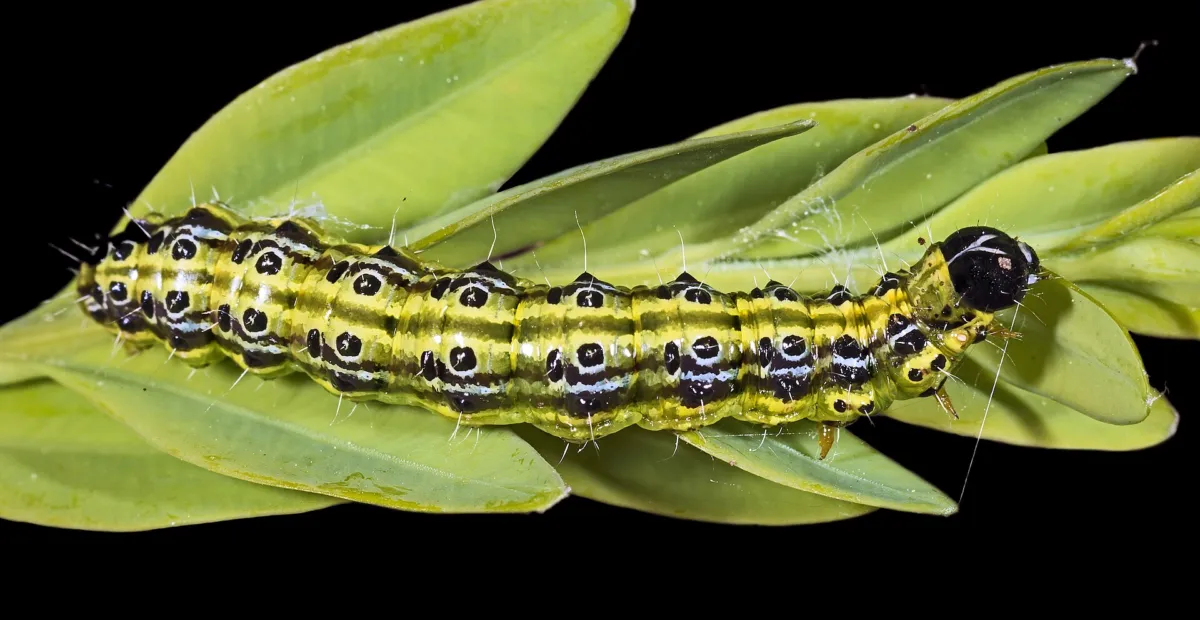
Box tree moth, Cydalima perspectalis, is an invasive caterpillar pest that primarily attacks boxwood (Buxus spp.). Larvae skeletonize and web leaves, produce green-black frass, and can rapidly defoliate shrubs. Severe infestations may lead to bark feeding, girdling, dieback, and plant death. In the United States, suspected findings should be reported to the appropriate state plant-health authority or USDA APHIS.
Typical conditions
Overview
Box tree moth is an invasive insect pest of boxwood, especially ornamental Buxus shrubs used for hedges, edging, topiary, and foundation plantings. The damaging stage is the caterpillar, not the adult moth. Larvae feed within webbing and can strip a shrub in a short period when populations are high.
In the United States, the pest has been detected in several states, particularly in the Northeast and Great Lakes region. Distribution and quarantine boundaries can change, so suspected infestations should be reported through state plant-health channels or USDA APHIS.
Symptoms and identification
- Young larvae scrape or skeletonize leaves, leaving pale or transparent patches.
- Older larvae chew entire leaves and tender shoots, often hidden in silk webbing.
- Green-black frass, webbing, shed skins, and caterpillars occur inside the canopy.
- Heavy infestations cause partial or complete defoliation, followed by browning and dieback.
- After foliage is exhausted, larvae may feed on bark, causing girdling and plant death.
Adult moths are usually white with a broad brown wing border, although darker forms occur. Damage can resemble other caterpillar feeding, so confirmation should include finding the characteristic striped larvae, webbing, frass, or adult moth.
Causes and spread
The pest spreads naturally when adult moths fly between host plants, but long-distance movement is strongly associated with infested boxwood plants, cuttings, foliage, green waste, and other plant material. Eggs are laid in clusters on the underside of leaves. Warm conditions can accelerate larval development and increase the number of generations in a season.
Moving, trading, or disposing of infested boxwood can carry larvae or pupae to new locations. State and federal quarantine requirements may restrict boxwood movement in affected areas.
Life cycle and persistence
Eggs are deposited in clusters, commonly on the underside of boxwood leaves. Larvae pass through several feeding stages, initially feeding inconspicuously within webbing and later becoming larger, strongly striped caterpillars. Mature larvae pupate in silk cocoons among leaves or sheltered plant material. Adults emerge, mate, and lay eggs for the next generation.
The number of generations varies with climate and photoperiod. In much of the United States, two or more generations may occur, while warmer regions can support additional generations. Partly grown larvae generally overwinter in silk shelters within the boxwood canopy and resume feeding in spring.
Treatment and control
Inspect the entire shrub and nearby boxwoods as soon as damage is found. Remove accessible caterpillars, webbed shoots, and pupae by hand or with a strong water spray when practical. Prune and securely bag heavily infested sections, disinfecting tools between plants when moving through a hedge.
For established infestations, coordinate treatment with a local Extension office or state plant-health authority. Insecticide timing is most effective when small larvae are present and before complete defoliation. Follow-up inspections are essential because eggs and larvae may be present in different parts of the canopy and generations can overlap. Severely infested or repeatedly damaged shrubs may need removal and replacement with non-boxwood alternatives where permitted and appropriate.
Low-impact and biological control
Hand-picking, pruning, bagging, and sanitation are useful for small infestations. Bacillus thuringiensis subsp. kurstaki can control young caterpillars when they consume treated foliage, but coverage must reach the feeding sites and applications must be repeated according to the product label. It is less effective against older larvae and does not control eggs or pupae.
Conserve birds, predatory insects, and parasitoids by avoiding unnecessary broad-spectrum sprays. Biological control is best integrated with monitoring, sanitation, and timely treatment rather than used as a stand-alone response to severe defoliation.
Prevention
- Inspect boxwood regularly from spring through fall, concentrating on inner foliage and leaf undersides.
- Look for webbing, frass, skeletonized leaves, clipped-looking shoots, and striped caterpillars.
- Inspect new boxwood before planting and isolate questionable plants until they are cleared.
- Do not move infested plants, cuttings, clippings, or loose boxwood debris across regulated areas.
- Bag infested debris securely and dispose of it according to local and state guidance; do not compost it unless the authority confirms that the process is adequate.
- Use pheromone traps for monitoring adult activity where recommended, but do not rely on traps alone to measure larval damage.
- Maintain plant vigor with appropriate irrigation and pruning, while avoiding dense unmanaged growth that conceals larvae.
Interesting facts
- The caterpillar, rather than the adult moth, causes nearly all direct plant injury.
- Boxwood is the primary host, but reports from the native range describe occasional feeding on certain Euonymus, Ilex, and Murraya species when nearby boxwood has been exhausted.
- Larvae can feed on bark after complete defoliation, which increases the risk of girdling and plant death.
- Adults may be white with brown margins or predominantly dark, so wing color alone is not sufficient for identification.
- Long-distance spread is especially associated with movement of infested boxwood rather than ordinary garden activity.
Use only products legally authorized in the United States for boxwood and box tree moth or the applicable caterpillar pest, and follow the current product label exactly. Confirm crop/site eligibility, target pest, application rate, reentry interval, environmental precautions, and state restrictions before use. Do not apply an off-label pesticide program, and obtain professional advice when treating large landscapes, nursery stock, or regulated material.