
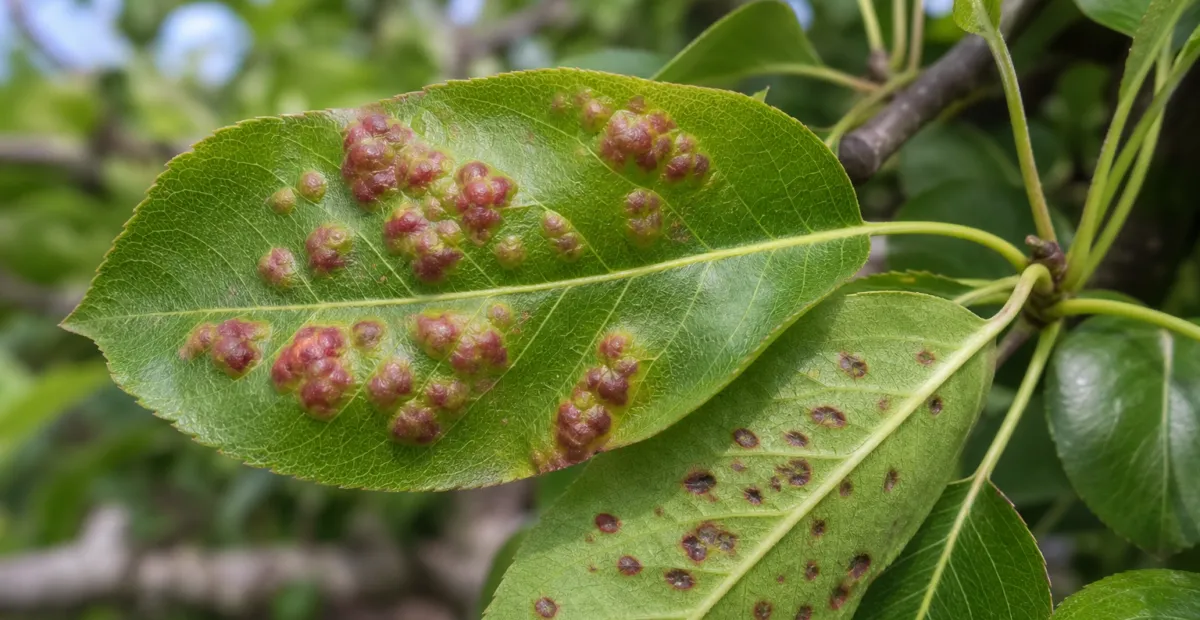
Pearleaf Blister Mite
Eriophyes pyri PagenstecherPearleaf Blister Mite overview
Pearleaf blister mite is a microscopic eriophyid mite that feeds beneath pear bud scales and inside developing leaves. Feeding produces raised pink, yellow-green, brown, or black blisters, and may cause russeted, distorted fruit when infestations are heavy. Most established trees tolerate light damage, but young trees and heavily infested orchard trees can lose foliage, fruit quality, and shoot vigor.
Typical conditions
Overview
Pearleaf blister mite, also called pear bud mite, is a tiny, worm-shaped mite in the family Eriophyidae. Adults are roughly 0.008–0.01 inch long and generally require a 14–20× hand lens or microscope for observation. The mites feed beneath bud scales during dormancy and then enter unfolding pear leaves, where their feeding induces blister-like chambers.
Light infestations are often cosmetic and may have little effect on mature trees or cropping. Severe, repeated infestations can reduce photosynthetic leaf area, weaken young trees, deform fruit, and contribute to premature leaf or fruit drop.
Symptoms and identification
- Small raised blisters on pear leaves, commonly about 0.125–0.25 inch across.
- Blisters begin pink, red, yellow-green, or pale green and commonly darken to brown or black as affected tissue dies.
- Blisters may be visible on the upper leaf surface, with a small opening or mite refuge on the underside.
- Fruit may develop oval, depressed russeted spots with a clearer halo, often near the calyx; severe injury can cause misshapen fruit.
- Heavy early feeding may injure buds, reduce shoot growth, cause premature leaf drop, or leave young trees visibly weakened.
Similar blister or gall symptoms can be caused by other eriophyid mites, insects, or disease. Confirmation should consider host identity, symptom timing, underside openings, and magnified examination.
Causes and spread
Damage is caused by feeding and secretions of mites concealed under pear bud scales and later inside leaf blisters. The pest is carried locally in infested buds, shoots, nursery stock, grafting material, and pruning debris associated with infested trees. Adults briefly move across plant surfaces when colonizing new leaves or fruit, but they survive poorly away from protected tissues.
Spread and severity are favored by persistent infestations, susceptible pear trees, abundant overwintering females, and conditions that promote rapid spring bud and leaf development. The species identity and host records reported for related rosaceous trees can be confused with other blister-mite species, so pear should remain the primary diagnostic host for E. pyri.
Life cycle and persistence
Adults, especially overwintering females, shelter in colonies beneath outer pear bud scales. As buds swell in spring, they become active and feed on emerging tissues. Females lay eggs in developing buds or newly formed leaf blisters. Eggs hatch into immature stages that feed and develop within the protected blister tissue.
Adults emerge through small openings and migrate to additional young leaves or developing fruit. Several generations may occur during the growing season, depending on climate and host growth. From late summer into autumn, females leave aging foliage and return to bud-scale shelters, where the population overwinters.
Treatment and control
First determine whether control is justified. On established pear trees, light infestations commonly require no treatment because the injury is mainly cosmetic. Prioritize intervention when young trees are repeatedly defoliated, buds fail to develop, fruit injury is commercially important, or monitoring shows a persistent population.
Timing is critical because mites are most exposed while leaving overwintering sites during late dormancy and early bud swell. Once they enter leaf blisters, they are strongly protected from contact products. Remove heavily infested shoots where feasible, improve tree vigor, and monitor the following season rather than treating automatically after symptoms appear.
In commercial orchards or nurseries, consult current state Extension recommendations for pear and time any approved intervention according to local phenology and monitoring. A dormant or delayed-dormant approach may be considered where locally recommended, but product choice, crop registration, application timing, and phytotoxicity precautions vary by state and cultivar.
Low-impact and biological control
- Tolerate minor damage on mature trees and concentrate management on young trees or economically significant infestations.
- Prune and discard severely infested shoots during dormancy or when practical, avoiding unnecessary removal of large amounts of healthy foliage.
- Use dormant-season horticultural oil only if a product is legally labeled for pear and pearleaf blister mite in the United States, and apply exactly according to the label and local Extension guidance.
- Conserve predatory mites and beneficial arthropods by avoiding unnecessary broad-spectrum insecticides and miticides.
- Use clean propagation material and maintain orchard sanitation to reduce movement between trees.
Biological control alone may not provide reliable economic suppression, but resident predatory mites can feed on exposed pearleaf blister mites and are valuable components of an integrated program.
Prevention
- Inspect dormant pear trees and nursery stock for a history of blister-mite injury before planting or grafting.
- Monitor buds from late winter through bud swell and continue checking young leaves through bloom and petal fall.
- Use a 14–20× hand lens to inspect bud scales, leaf undersides, and fresh blisters.
- Prune out badly infested shoots when practical, especially on small trees, and remove them from the orchard.
- Maintain balanced irrigation, nutrition, and canopy management so trees can replace damaged foliage.
- Favor selective IPM practices and avoid unnecessary broad-spectrum sprays that disrupt predatory mites and other natural enemies.
- Do not move scion wood, cuttings, or nursery plants from infested trees.
Interesting facts
- The mites are so small that diagnosis usually depends on the characteristic injury rather than seeing the animal directly.
- They have only two pairs of legs, unlike most familiar spider mites, which have four pairs.
- The blister is a protected feeding and breeding chamber, making late-season contact treatment difficult.
- Some older references list apple, serviceberry, hawthorn, cotoneaster, and mountain ash as hosts, but modern diagnostic sources caution that related eriophyid species and species complexes can be confused. Pear is the most dependable host association for Eriophyes pyri.
- Blackened late-season blisters do not necessarily mean the tree is dying; the overall effect depends on infestation intensity, tree age, and repeated annual damage.
Use only miticides, horticultural oils, or other pesticides legally authorized by the U.S. Environmental Protection Agency and registered in your state for pear and the target mite. Follow the current product label exactly, including crop, pest, rate, timing, weather, reentry, preharvest, and pollinator requirements. Do not infer legality or effectiveness from labels for other crops, countries, or mite species. Avoid applications during unsafe temperatures or when pear foliage may be injured.