
Dothistroma needle blight (red band needle blight)
Dothistroma septosporumDothistroma needle blight (red band needle blight) overview
Dothistroma septosporum causes Dothistroma needle blight, also called red band needle blight, on pines and occasionally other conifers. Reddish-brown bands girdle needles, killing the tips and triggering premature needle drop. Repeated infection can thin crowns, reduce growth, and sometimes kill young or severely stressed trees, especially where cool, wet weather and poor air circulation persist.
Typical conditions
Overview
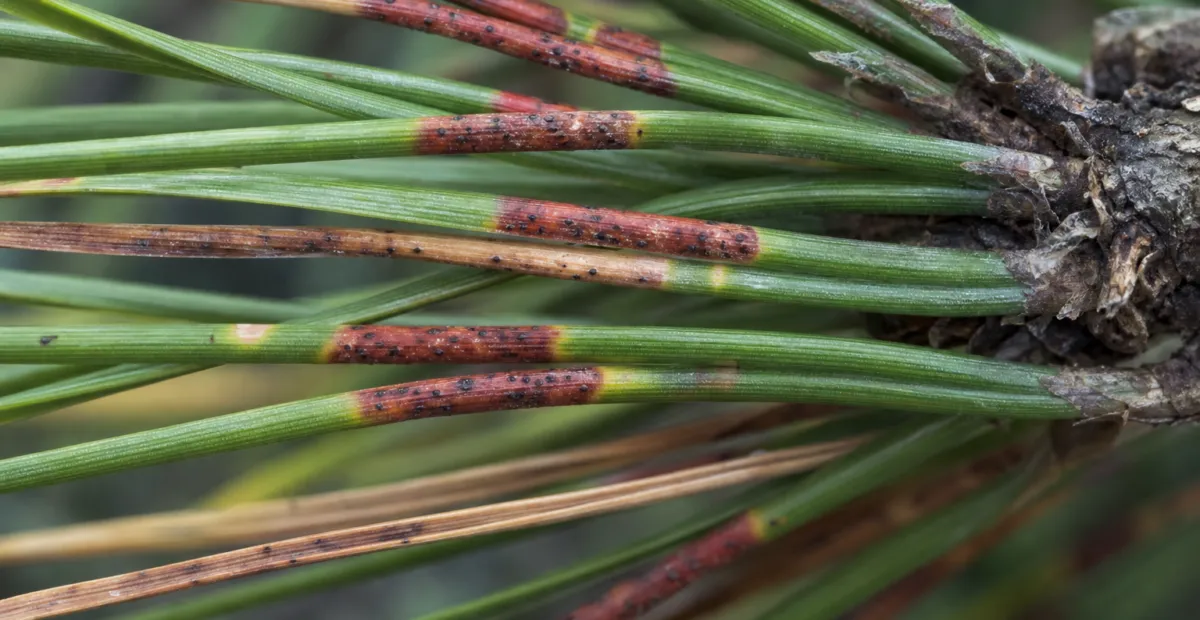
Dothistroma needle blight is a foliage disease of pines and, less commonly, other conifers. The most recognizable sign is a reddish-brown band crossing the needle, often separating a dead brown tip from a still-green needle base. Small black fungal fruiting bodies may develop in the bands or dead tissue.
Severity varies with host species, tree age, site conditions, and weather. Repeated years of infection can cause premature needle loss, sparse crowns, reduced growth, and occasional mortality, particularly in young trees, plantations, or trees under additional stress.
Symptoms and identification
- Reddish-brown spots enlarge into bands that encircle the needle.
- The needle tip beyond the band turns brown while the basal portion may remain green.
- Needles are shed prematurely, often beginning in the lower crown.
- Black, pinhead-sized stromata or fruiting bodies may erupt through the bands or dead needle tissue.
- Severe, repeated infection produces thin crowns, bare branch sections, reduced growth, and sometimes a “lion’s tail” appearance in which only terminal needles remain.
Symptoms can overlap with other pine needle diseases, including Dothistroma pini, Lophodermella needle cast, Cyclaneusma needle cast, and abiotic injury. Laboratory confirmation is advisable when management or regulatory decisions depend on species-level identification.
Causes and spread
The pathogen produces spores in dark fruiting structures on infected needles. Rain, irrigation, mist, and direct contact move spores to susceptible foliage. Disease spread is favored when needles remain wet for extended periods, especially during cool, humid, rainy weather.
Attached infected needles are an important inoculum source; fallen needles and pruning debris can also contribute to local disease pressure. Dense stands, shaded lower crowns, poor air movement, wet sites, overhead irrigation, and planting highly susceptible pine species outside their best-adapted conditions increase risk.
Life cycle and persistence
Dothistroma septosporum has a predominantly asexual disease cycle, although a sexual stage has been reported in some regions. Conidia are produced in stromata embedded in infected needles. Under favorable moisture and temperature conditions, spores germinate on wet needle surfaces and commonly enter through stomata.
The fungus has a prolonged, initially inconspicuous phase before visible necrosis develops. Reddish lesions and bands may appear weeks to months after infection, depending on climate and host. New stromata form in dead needle tissue, releasing additional spores. In temperate parts of the United States, infected needles may retain the pathogen through winter and sporulate during favorable periods in spring and early summer; timing varies by region and weather.
Treatment and control
There is no practical treatment that removes the fungus from already colonized needles. Management aims to protect new foliage, reduce inoculum, and improve growing conditions. Remove badly affected branches only when this can be done without damaging the tree, and dispose of infected evergreen clippings rather than composting them in a home pile.
For valuable landscape trees or Christmas-tree and nursery production, preventive fungicide applications may protect expanding needles when disease history and local weather indicate risk. Timing depends on regional bud break, needle expansion, product label directions, and disease forecasts; treatment is generally more effective before infection than after symptoms are established. Consult a certified arborist, state Extension specialist, or plant disease diagnostic laboratory for confirmation and a site-specific plan.
Low-impact and biological control
Use an integrated, nonchemical approach: choose less susceptible hosts, increase spacing and airflow, prevent overhead irrigation, remove heavily infected debris, control competing weeds beneath the canopy, and maintain a 3–4 inch layer of organic mulch without piling it against the trunk. These measures reduce leaf wetness and inoculum but may not provide complete control during prolonged wet weather.
No broadly reliable biological-control program is established for home landscapes in the United States. Avoid unverified home remedies, and do not assume that organic-status products are effective or legally labeled for this disease and crop.
Prevention
- Select locally appropriate, less susceptible conifers when planting in sites with a history of the disease. Scots pine and red pine are generally more resistant than Austrian, ponderosa, lodgepole, and Monterey pines, but resistance is species-, provenance-, and site-dependent.
- Avoid overcrowding and maintain spacing based on mature tree size.
- Improve air movement by removing selected low branches where appropriate; do not perform excessive pruning that stresses the tree.
- Use drip or low-volume irrigation directed at the soil rather than sprinklers that wet needles.
- Remove severely infected pruning waste and manage fallen needle debris where practical. Clean tools between trees when pruning diseased material.
- Inspect nursery stock before planting and avoid introducing visibly infected trees.
- Reduce other stresses through appropriate watering, mulching, protection from soil compaction, and correction of site problems.
Interesting facts
- Dothistroma needle blight is also called red band needle blight because of its characteristic reddish bands.
- Dothistroma septosporum and Dothistroma pini were historically confused because they are morphologically similar; DNA-based methods may be needed to distinguish them.
- The fungus produces dothistromin, a toxin associated with host tissue damage and needle necrosis.
- More than 80 Pinus host species have been documented globally for Dothistroma septosporum, but susceptibility differs substantially among species, provenances, and environments.
- Severe defoliation does not always kill an established tree, but repeated infection can reduce vigor and increase vulnerability to other stresses.
Use pesticides only when necessary and only products legally authorized and currently labeled for Dothistroma needle blight on the specific crop or ornamental setting in your state and country. The label is the law. Follow the current label for rate, timing, protective equipment, reentry, environmental precautions, and application restrictions. Copper products and other fungicides may be used preventively in some U.S. settings, but availability, crop labeling, and permitted sites vary; do not apply a product based solely on a general internet recommendation.