
Chestnut brown rot
Gnomoniopsis smithogilvyiChestnut brown rot overview
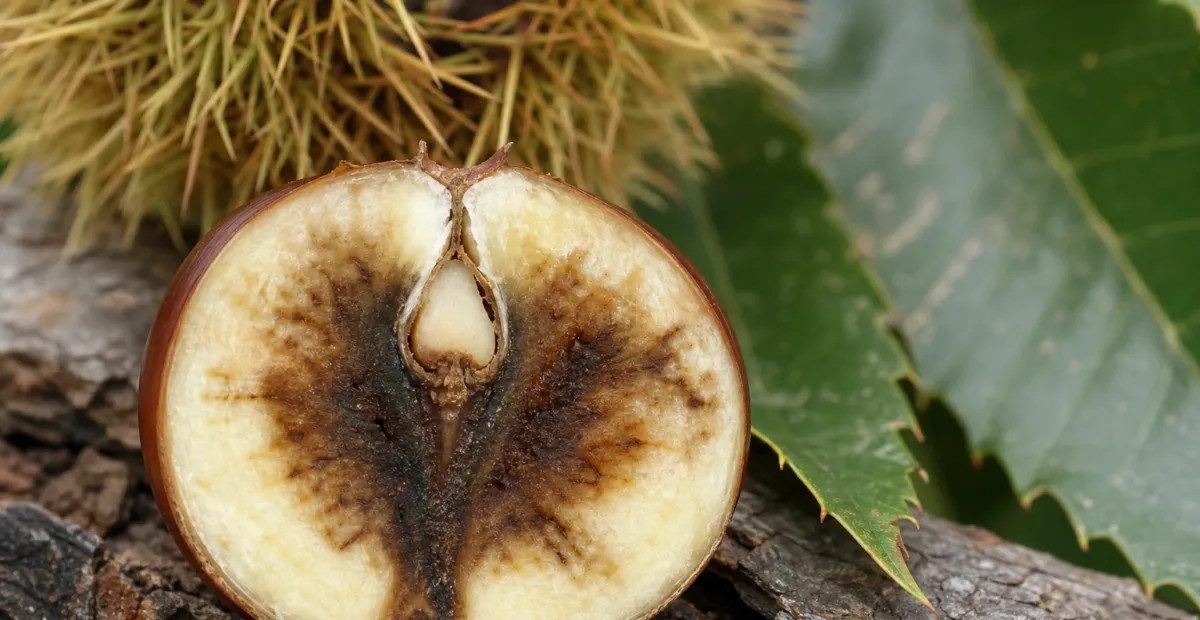
Chestnut brown rot is a fungal disease caused by Gnomoniopsis smithogilvyi. It primarily damages chestnut kernels, often without obvious external symptoms at harvest. Brown discoloration usually begins around the embryo or inner kernel and may intensify during storage. The fungus can also persist symptomlessly in flowers, leaves and stems and occasionally cause bark cankers.
Typical conditions
Overview
Chestnut brown rot is caused by the ascomycete fungus Gnomoniopsis smithogilvyi, also reported in older literature under the synonym Gnomoniopsis castaneae. It is an important postharvest and preharvest disease of edible chestnuts in several production regions, including the United States.
The most economically important symptom is internal kernel decay. A chestnut can look sound externally while the endosperm and embryo contain pale, tan or dark-brown lesions. Disease development may continue after harvest, especially when infected nuts are held in storage. The fungus has also been isolated from apparently healthy chestnut flowers, leaves and stems, so a positive laboratory detection does not always mean that visible disease is present.
In the United States, the disease has been confirmed on chestnuts in Michigan. Diagnosis based only on shell appearance is unreliable; cutting representative nuts open and, where necessary, laboratory identification are recommended.
Symptoms and identification
Typical symptoms include:
- pale, tan or medium- to dark-brown discoloration of the kernel;
- lesions beginning near the embryo or hilum and expanding through the endosperm;
- firm or progressively dehydrated, shriveled kernel tissue;
- internal rot that is absent or poorly visible on the outer shell at harvest;
- greater symptom expression during cold storage or subsequent shelf life.
Less consistently, the fungus is associated with necrotic areas or cankers on chestnut shoots and branches. Small dark fungal fruiting bodies may occur in dead burrs or branches, but these structures are not a dependable field diagnosis for homeowners.
Other fungi can produce similar chestnut kernel rots. Confirmation requires isolation and/or DNA-based identification by a qualified plant diagnostic laboratory.
Causes and spread
Gnomoniopsis smithogilvyi survives in dead chestnut burrs, branches and other infected plant debris, where it can produce sexual and asexual spores. Spores may be dispersed by rain splash, water movement, insects or contact with contaminated orchard and harvest equipment.
Research indicates that chestnut flowers are an important infection site. The fungus may colonize reproductive tissues without immediate symptoms and later develop into kernel rot as the nut matures. Wounds, insect injury, weather damage and stressed or damaged tissues may increase opportunities for infection, although the precise importance of each pathway varies among orchards and regions.
Mixing infected nuts with healthy nuts during harvest, washing, grading or storage can spread contamination and make losses more difficult to manage.
Life cycle and persistence
The fungus can overwinter as a saprobe in dead chestnut burrs and branches. During suitable wet conditions, it produces fruiting bodies that release spores. Infection may occur during flowering or while nuts are developing, followed by a symptomless or low-symptom phase inside plant tissues.
As the chestnut matures, the fungus may invade or colonize the kernel and produce progressive browning. Symptoms can remain hidden until nuts are cut open after harvest, and disease may continue to develop during storage. The pathogen may also persist as an endophyte in apparently healthy flowers, leaves or stems, which complicates epidemiological studies and field scouting.
The exact balance between endophytic colonization, latent infection and active disease is not fully resolved and may differ with cultivar, climate, orchard management and fungal strain.
Treatment and control
There is no curative treatment that reliably restores a chestnut kernel after internal brown rot has developed. The practical response is removal and disposal of affected nuts, followed by sanitation and improved harvest and storage handling.
For commercial orchards, use structured sampling: inspect nuts from multiple trees and orchard areas, cut open representative samples, record incidence by cultivar and harvest date, and submit symptomatic tissue to a diagnostic laboratory when confirmation is needed. Rapid cooling and properly managed cold storage can slow quality loss, but refrigeration does not eliminate the pathogen or make a rotten kernel marketable.
Where shoot or branch cankers are present, remove affected wood well below visibly diseased tissue during dry conditions and prevent movement of contaminated pruning debris. Because symptoms can resemble other chestnut diseases and rots, treatment decisions should be based on diagnosis rather than appearance alone.
Low-impact and biological control
Organic and low-input programs should emphasize exclusion, sanitation and harvest hygiene:
- Remove dead burrs, fallen nuts and diseased wood from beneath trees.
- Use clean containers and disinfectable sorting surfaces.
- Keep harvested nuts dry, cool and well ventilated before storage.
- Grade and discard damaged, cracked, insect-injured or visibly moldy nuts.
- Improve canopy airflow and manage irrigation to reduce prolonged wetness.
- Consider biological products only when they are specifically registered or permitted for the crop and intended use in the United States; efficacy against this disease is still an active research area and should not be assumed from results on unrelated pathogens.
Composting infected nuts or burrs is not recommended unless the process reliably reaches conditions that destroy plant pathogens. Follow local organic-certification and state disposal requirements.
Prevention
Management should focus on reducing inoculum and preventing infected nuts from entering storage:
- Collect and destroy or remove fallen burrs, mummified nuts and dead chestnut branches where practical.
- Prune dead or visibly diseased wood during dry weather and sanitize pruning tools between trees when disease is suspected.
- Maintain an open, well-ventilated canopy through appropriate pruning and avoid irrigation that wets flowers, foliage or fruit for long periods.
- Harvest frequently during nut drop and avoid leaving chestnuts on wet ground.
- Clean and sanitize harvest bins, picking equipment, sorting surfaces and storage containers.
- Separate lots by orchard block or cultivar when disease pressure differs.
- Cut open representative samples before long-term storage and remove suspect nuts promptly.
- Use sound, traceable nursery material and avoid moving contaminated burrs, branches or nuts between orchards.
Interesting facts
- The disease is often called chestnut brown rot because the most important symptom is internal browning of the kernel.
- Externally sound nuts may contain serious disease, making cutting and sampling important for diagnosis and quality control.
- The fungus can live asymptomatically inside chestnut tissues, including flowers, leaves and stems.
- Black perithecia may overwinter in dead chestnut burrs and branches.
- The species was described from chestnut-associated material in Australia and is now recognized from multiple chestnut-growing regions, including North America.
- Older scientific and agricultural references may use Gnomoniopsis castaneae for the same pathogen.
No pesticide program should be inferred from the disease name alone. In the United States, use only products legally authorized and currently labeled for chestnut, the target disease or an allowed use pattern in the applicable state. Follow the current EPA-approved label, state restrictions, worker-protection requirements, preharvest interval and reentry interval. Fungicides are generally preventive rather than curative for internal kernel infections, and application timing, residue limits and crop registration must be confirmed with a state extension specialist or licensed crop adviser.
Affected plants
The plants below are linked to this problem by structured host-plant data. The list updates automatically as new plant profiles are added.
 Castanea ‘Pumila’Castanea 'Pumila'
 Castanea ‘Sativa’Castanea 'Sativa'
 Japanese Chestnut (Castanea crenata) care guideCastanea crenata
 Castanea dentata care guideCastanea dentata
 He Chinese chestnu (Castanea mollissima) care guideCastanea mollissima
 Tree Aeonium (Aeonium arboreum) care guideAeonium arboreum
 Acorn banksia or orange banksia (Banksia prionotes) care guideBanksia prionotes
 Tuftroot (Dieffenbachia seguine) care guideDieffenbachia seguine
 Crested Coelogyne (Coelogyne cristata) care guideCoelogyne cristata
 Cymbidium insigne care guideCymbidium insigne
 Moth orchid (Phalaenopsis ‘Harlequin’)Phalaenopsis 'Harlequin'
 He giant barrel cactus (Echinocactus platyacanthus) care guideEchinocactus platyacanthus