
 Source:
 Diamondback Moth
Plutella xylostellaDiamondback Moth overview
The diamondback moth, Plutella xylostella, is a small, highly mobile moth whose caterpillars damage cabbage-family crops by scraping, mining and chewing leaves. Young larvae may leave translucent windowpanes, while older larvae create irregular holes and can injure growing points. It is especially important in spring, early summer and fall, and repeated insecticide use can rapidly select resistant populations.
Typical conditions
Overview
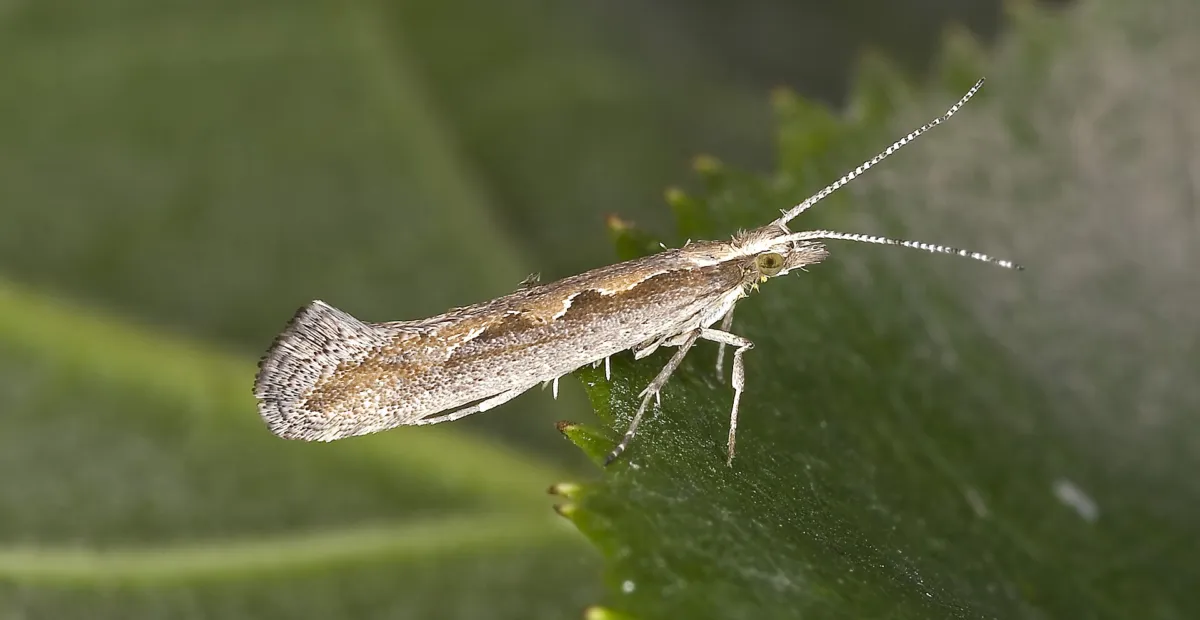
Diamondback moth is a small, slender, grayish-brown moth whose larvae attack cole crops and other cultivated brassicas. The caterpillars are small, tapered at both ends, green to pale gray, and often wriggle or drop on a silk thread when disturbed. Adults are about 1/4 inch long and may show a pale dorsal pattern resembling diamonds when the wings are folded.
Damage is caused mainly by larvae rather than adults. Infestations can be serious in vegetable gardens, commercial cole-crop fields, nurseries and greenhouse production. Seedlings and young plants are particularly vulnerable because feeding can slow growth or distort developing foliage.
Symptoms and identification
- Small translucent or papery windowpanes where young larvae scrape the leaf surface.
- Irregular holes in leaves as larvae mature; the upper epidermis may remain intact at first.
- Several holes may merge, leaving ragged foliage or skeletonized areas.
- Feeding may occur on buds, terminals, flower heads and young pods, reducing market quality.
- Heavy infestations can stunt seedlings, distort growth and occasionally kill small plants.
- Frass may be present among leaf folds or in broccoli and cauliflower heads.
Look closely on leaf undersides and within folded foliage because the larvae are small and easily overlooked. Similar chewing damage can be caused by imported cabbageworm, cabbage looper and other caterpillars.
Causes and spread
Adults migrate into crops from surrounding brassica plantings, crop residues and cruciferous weeds such as wild mustard. Females lay tiny eggs singly or in small groups, usually on leaf undersides. Warm weather, successive plantings and nearby unmanaged host plants can support overlapping generations.
Plantings established at different times beside one another can act as a continuous food supply. Wind-assisted movement of adults helps the pest colonize new fields and gardens. The species is difficult to manage where repeated use of the same insecticide mode of action has selected resistant populations.
Life cycle and persistence
The life cycle includes egg, four larval instars, pupa and adult moth. Eggs are laid on foliage and hatch into very small larvae that may initially mine or scrape leaves. Larvae generally complete development in about 10–14 days during warm weather, although timing varies with temperature.
成熟 larvae spin a loose silk cocoon on a leaf or stem and pupate. Adults emerge after the pupal period, mate and lay eggs for the next generation. A generation may be completed in roughly 25–30 days under favorable conditions. Several generations can occur in a growing season; in warm southern regions, activity may continue much of the year, while in colder areas populations are often replenished by migration.
Treatment and control
Begin with confirmation that the larvae are diamondback moth rather than another brassica caterpillar. Handpick larvae and remove heavily infested leaves in small plantings. A strong water spray can dislodge exposed larvae, but it will not prevent reinfestation.
When treatment is justified, target young larvae before they become larger and more tolerant. Apply only after scouting and according to the crop-specific action threshold or local extension guidance. Thorough coverage of leaf undersides and folded foliage is important. Rotate insecticide modes of action between generations rather than repeating the same chemistry, and reassess control because resistance is common in this pest.
Low-impact and biological control
Use row covers, sanitation and hand removal as the first measures. Caterpillar-specific Bacillus thuringiensis products can be effective against small larvae when they consume treated foliage; repeat applications may be needed because coverage and weather affect performance. Some organically permitted spinosad, azadirachtin or neem products may be options where the current U.S. label permits use on the crop.
Conserve natural enemies such as the parasitoid wasps Diadegma insulare, Cotesia plutellae and Microplitis plutellae, egg parasitoids in the genus Trichogramma, predatory bugs and ground beetles. Avoid routine pyrethroid or other broad-spectrum applications that can destroy these beneficial organisms and trigger pest resurgence.
Prevention
- Use floating row cover or insect-exclusion netting from transplanting or emergence until flowering or harvest activities require removal. Support covers above foliage so adults cannot lay eggs through the mesh.
- Inspect transplants before planting and remove infested leaves or plants.
- Remove brassica crop residues promptly after harvest and control nearby cruciferous weeds.
- Avoid maintaining overlapping plantings when practical; coordinate nearby cole-crop planting and harvest schedules.
- Scout leaf undersides, growing points and heads at least weekly, increasing to twice-weekly checks during warm periods or when moths are present.
- Protect beneficial insects by avoiding unnecessary broad-spectrum sprays and by maintaining flowering insectary plants near, but not within, harvest-sensitive crop areas.
Interesting facts
- The common name refers to the pale diamond-like pattern sometimes visible on the folded wings of the adult moth.
- Larvae commonly drop from leaves on silk when disturbed, making them easy to miss during casual inspection.
- Diamondback moth is highly migratory and globally distributed wherever brassica crops are grown.
- It is recognized for evolving resistance to many insecticide groups, including some products once considered highly effective.
- Natural enemies may kill or parasitize larvae late in development, so parasitized caterpillars can still cause some feeding damage before they die.
Use only pesticide products legally authorized in the United States for diamondback moth on the specific crop and production site. Follow the current product label exactly, including crop, rate, preharvest interval, reentry interval, protective equipment, application restrictions and resistance-management instructions. Do not assume that a product labeled for another caterpillar, crop or state is legal for this use. Because resistance is widespread, rely on scouting, rotate labeled modes of action, and integrate chemical control with exclusion, sanitation and biological control.