
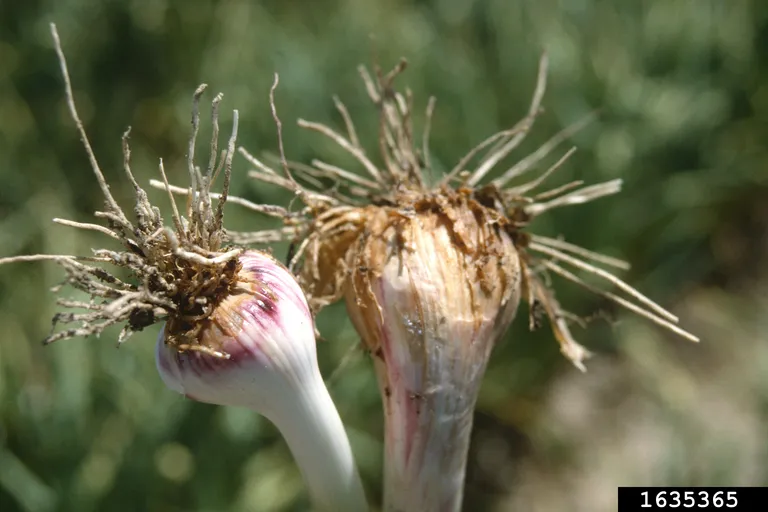
 Source:
 Fusarium wilt
Fusarium oxysporum species complexFusarium wilt overview
Fusarium wilt is a soilborne vascular disease caused by host-specific pathogenic strains within the Fusarium oxysporum species complex. Infected plants commonly show one-sided or uneven yellowing, midday wilting, vascular browning and progressive dieback. Because harmless, beneficial and pathogenic strains can look alike, laboratory diagnosis and host-specific identification are important before planning long-term management.
Typical conditions
Overview
Fusarium wilt is most often recognized by progressive yellowing, wilting and death of foliage, frequently beginning on one side of the plant or in older leaves. Cutting the lower stem, crown or petiole may reveal brown, red-brown or darkened vascular tissue.
Fusarium oxysporum is not a single uniform plant pathogen. The species complex includes harmless soil saprophytes, root-associated endophytes, biological-control strains and pathogenic lineages. Pathogenic forms are usually highly host-specific, so a strain causing wilt in tomato should not automatically be assumed to infect unrelated crops.
Symptoms can closely resemble Verticillium wilt, bacterial wilt, root injury, drought stress and other vascular disorders. A plant diagnostic laboratory is recommended when crop value is significant, symptoms are unusual or a resistant cultivar has failed.
Symptoms and identification
- Initial symptoms may include midday wilting that temporarily improves overnight.
- Older leaves commonly yellow, wilt and die first; yellowing may be uneven or concentrated on one side of the plant.
- Plants may become stunted, show progressive leaf drop and eventually die.
- Brown, reddish-brown or dark vascular discoloration may appear in a cut lower stem, crown, petiole, rachis or root.
- Seedlings can collapse, while mature plants may decline gradually over several weeks.
- In some situations, pink, orange or yellowish spore-producing structures may develop on dead tissue, but they are not always present.
- Diagnosis based only on wilt and vascular browning is unreliable because Verticillium wilt and other problems can look similar.
Causes and spread
Pathogenic strains survive in soil and infected plant debris, often as durable chlamydospores. They enter through fine roots, root wounds, transplant damage or injuries caused by cultivation and root-feeding nematodes. Once inside, the fungus grows through the xylem and may obstruct water transport.
Spread within a garden or production area is mainly associated with infested soil, infected transplants or seed, contaminated tools, stakes, footwear, equipment, irrigation water and plant debris. Weeds can maintain some host-specific forms. Warm soil and plant stress generally increase disease expression. Long-distance airborne dispersal is possible in some production systems but is usually less important than movement of contaminated soil and planting material.
Life cycle and persistence
- Resting chlamydospores and other survival structures remain dormant in infested soil or debris.
- Root exudates and favorable moisture and temperature stimulate germination near susceptible roots.
- The fungus penetrates rootlets, especially where roots are wounded or stressed.
- It colonizes the xylem and moves upward through the vascular system.
- Water transport becomes impaired, producing wilt, chlorosis, vascular browning and eventual dieback.
- New survival structures form in infected tissues and return to the soil when plants decompose.
Many garden situations have one principal infection cycle during a growing season, although the pathogen can persist for years and cause disease in later susceptible crops.
Treatment and control
There is no reliable curative treatment that restores a plant after Fusarium wilt has extensively colonized its vascular system. Remove and discard severely affected plants, disinfect reusable tools and avoid spreading infested soil or roots.
For future plantings, management should focus on resistant varieties or rootstocks matched to the suspected host-specific form, clean propagation material, sanitation and rotation. If resistance unexpectedly fails, submit symptomatic material and, where available, soil or pathogen isolates to a university or state plant diagnostic laboratory. Do not treat every wilt as Fusarium: Verticillium wilt, bacterial wilt, Phytophthora root disease, nematodes, drought and root damage require different responses.
Low-impact and biological control
Organic and low-input management is preventive rather than curative. Combine resistant cultivars, clean transplants, sanitation, careful crop rotation, weed control, reduced root injury and improved soil and irrigation management.
Solarization or other approved soil-disinfestation approaches may reduce inoculum in suitable U.S. climates, but results depend on soil depth, temperature, duration and pathogen distribution. Anaerobic soil disinfestation, compost-based practices, grafting and biological products containing antagonistic microorganisms can be useful in some production systems, but performance is crop-, strain- and site-dependent. Use only products and methods permitted for certified organic production when organic certification matters, and follow the applicable U.S. label.
Prevention
- Choose cultivars labeled with resistance to the relevant host-specific form or race, such as the appropriate Fusarium resistance designation for tomato.
- Buy certified or reputable disease-free seed, transplants, grafted plants and propagation material.
- Do not move soil from a diseased bed to clean beds; clean soil from tools, shoes, stakes, pots and equipment before moving between areas.
- Remove severely diseased plants promptly, including as much of the root system as practical, and dispose of them according to local rules rather than composting visibly diseased material.
- Rotate away from the affected host crop for at least 3–5 years where practical, while controlling susceptible weeds. Rotation is not equally effective against every forma specialis.
- Use grafted plants with resistant rootstocks when appropriate for the crop.
- Avoid unnecessary root injury, overwatering and excessive nitrogen. Improve drainage and maintain balanced fertility.
- Use raised beds, containers or clean growing media when a small garden area is persistently infested.
- In protected culture, sanitize benches, trays, irrigation lines and recirculating water systems between crops.
Interesting facts
- Fusarium oxysporum is a species complex containing many genetically and biologically different strains.
- Most pathogenic forms are host-specific and are commonly named as formae speciales, such as f. sp. lycopersici on tomato, f. sp. niveum on watermelon and f. sp. cubense on banana.
- Harmless and pathogenic strains can look alike in culture; pathogenicity is determined by host interaction and testing, not appearance alone.
- Some nonpathogenic F. oxysporum strains have been studied as biological-control organisms because they can compete for root infection sites or stimulate plant defenses.
- Resistance is often race-specific. A tomato labeled resistant to one race may remain susceptible to another.
- Planting a resistant cultivar may reduce symptoms without eliminating the pathogen from soil.
No routine foliar fungicide cures Fusarium wilt after vascular infection. Soil fumigation or other chemical measures are specialized, costly and subject to substantial worker-safety, environmental and regulatory restrictions; they should be considered only by qualified commercial growers and licensed professionals. In the United States, use only products legally authorized by the current EPA-approved label for the specific crop, site and problem, and follow the entire current label. Do not use an off-label pesticide program.