
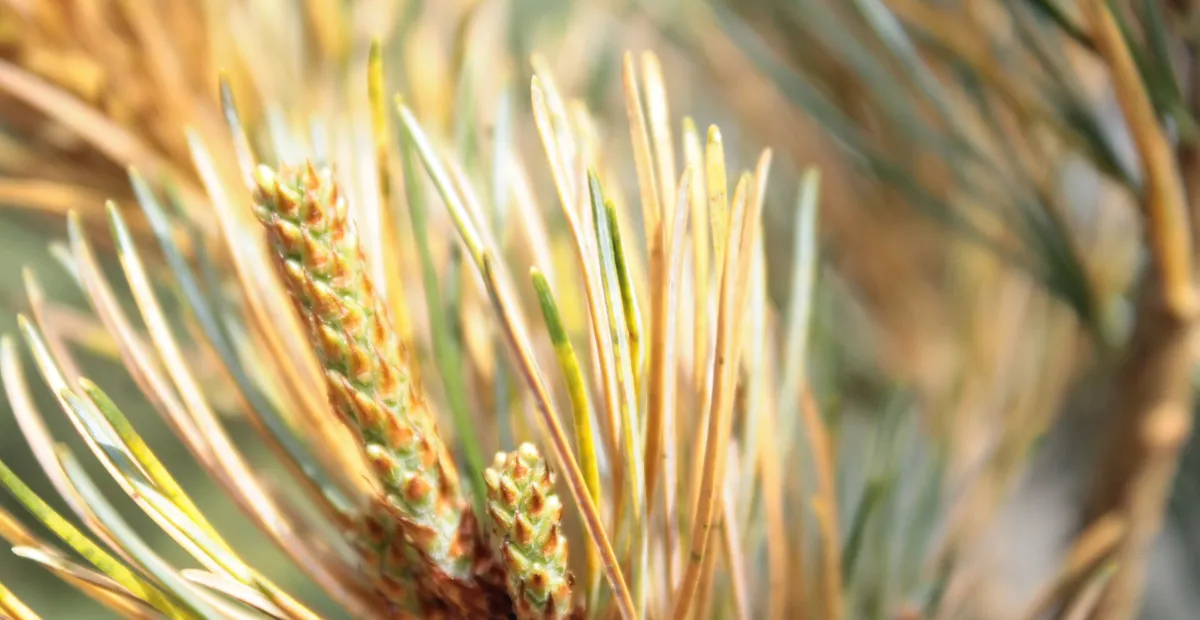
Lophodermium Needle Cast of Pine
Lophodermium seditiosumLophodermium Needle Cast of Pine overview
Lophodermium needle cast is a fungal disease of pine needles caused primarily by Lophodermium seditiosum. It is most damaging to young trees, nursery stock and Christmas-tree plantings, especially Austrian, red and Scots pine. Yellow-to-reddish spots develop on current-season needles, which later turn brown and drop prematurely. Cool, wet weather and prolonged needle wetness favor infection.
Typical conditions
Overview
Lophodermium seditiosum infects current-season pine needles and commonly causes symptoms from late fall through the following spring and summer. The disease is most serious on young trees, lower branches and densely planted nursery or Christmas-tree stock. Austrian pine (Pinus nigra), red pine (Pinus resinosa) and Scots pine (Pinus sylvestris) are among the most susceptible hosts in the United States.
Several other Lophodermium species occur on conifers, and some are mainly decomposers or weak pathogens. Fruiting bodies on dead needles alone do not prove that L. seditiosum caused the original needle loss; laboratory diagnosis may be needed when symptoms overlap with Cyclaneusma, Ploioderma, Dothistroma, insect injury, drought or normal seasonal needle shed.
Symptoms and identification
- Small yellow, tan or reddish-brown spots develop on current-season needles, often with contrasting halos.
- As lesions enlarge, needles develop a mottled appearance and later become uniformly brown, reddish brown or straw colored.
- Infected needles may remain attached through winter but turn brown and drop during spring or summer.
- Black, gray-black, football-shaped fruiting bodies with a lengthwise slit may be visible on dead needles.
- Symptoms are often most severe on lower branches and small trees. Repeated severe infection can cause crown thinning, reduced seedling growth or seedling death.
Needle spots can resemble sucking-insect injury, and black structures on dead needles may belong to other fungi. Confirm the diagnosis from representative symptomatic needles when management decisions are important.
Causes and spread
The causal fungus survives in infected and fallen pine needles. Moisture is central to disease development: spores germinate and infect when needles remain wet for extended periods. Spores produced on infected needle litter are dispersed by rain splash and air movement to nearby susceptible foliage.
Risk increases in crowded nurseries, plantations or landscape plantings with poor air circulation, dense weeds, shade, prolonged dew or frequent wetting of the crown. Cool, wet weather during the summer infection period favors epidemics. Stress is not required for infection, although drought, root problems and other stresses can increase the impact of premature needle loss.
Life cycle and persistence
Lophodermium seditiosum overwinters in infected needles on trees and on the ground. Black, slit-like fruiting bodies mature on dead needles and release airborne ascospores, commonly during early to midsummer in the northern United States. Infection of newly formed current-season needles generally occurs from late July through September or, depending on local weather, into early October.
After infection, symptoms may become evident in late fall, winter or the following spring. Needles progressively brown and are cast during spring or summer. The fallen infected needles then provide inoculum for the next disease cycle. Timing varies with latitude, elevation, host growth and rainfall.
Treatment and control
There is no curative treatment that restores needles already infected or prevents them from dropping. Management protects healthy, newly emerging foliage and reduces the amount of inoculum for subsequent seasons.
- Confirm the disease before treating, particularly on mature landscape trees or when symptoms are atypical.
- Improve sunlight and airflow by removing competing vegetation and, where appropriate, thinning crowded plantings. Avoid excessive pruning that further reduces the crown.
- Remove severely diseased seedlings or small trees when replacement is practical.
- For high-value nursery, plantation or landscape situations with a documented history of disease, a licensed applicator or local Extension professional can help determine whether a protectant fungicide program is justified and when local infection periods occur.
Expect previously infected needles to continue browning and falling even after successful protection of new foliage. Evaluate control by the health of subsequent needle growth rather than by recovery of old needles.
Low-impact and biological control
Organic management is primarily preventive and cultural. Improve spacing, sunlight and air circulation; control weeds; avoid overhead irrigation; and remove infected needle litter and severely diseased young plants where practical. Maintain adequate, but not excessive, soil moisture and avoid root damage or other stresses.
No widely reliable home remedy has been established for eliminating L. seditiosum. Biological or organically approved fungicide options, where available, should be considered only after confirming that a product is registered for the crop and disease in the United States and that its performance is supported by local Extension guidance.
Prevention
- Choose planting sites with full sun and good air movement; avoid crowded, shaded or poorly ventilated locations for susceptible pines.
- Space nursery and Christmas-tree plants adequately and control tall weeds around lower branches.
- Use healthy, disease-free planting stock and inspect incoming seedlings before planting.
- Remove and destroy heavily infected young trees when practical, especially in nurseries where they can be major inoculum sources.
- Rake and remove fallen infected needles around valuable young trees where feasible. Do not compost diseased needle litter unless the composting process reliably reaches pathogen-killing temperatures.
- Use irrigation practices that minimize prolonged wetting of foliage; water early enough for needles to dry rapidly, and prefer soil-level irrigation.
- Where site and landscape goals permit, favor less susceptible pine species or locally adapted planting material.
Interesting facts
- Lophodermium seditiosum is more virulent than many other Lophodermium species found on conifer needles.
- Young trees and nursery stock can suffer serious growth and survival losses, while older pines may tolerate isolated infections better.
- The characteristic black, slit-like structures are spore-producing fruiting bodies, but similar structures from other needle-colonizing fungi can occur on dead needles.
- Needle-cast symptoms often appear months after infection, so spring browning may reflect wet-weather infection from the previous summer.
- Eastern white pine can be infected in some regions, but it is generally less susceptible than Austrian, red and Scots pine.
Use chemical products only when the disease has been correctly identified and only products legally authorized and currently labeled for Lophodermium needle cast on the specific pine crop or site in your state. Follow the current label exactly, including crop/site, rate, timing, personal protective equipment, reentry and environmental restrictions. Fungicides are protectants for healthy emerging foliage, not cures for already infected needles; consult a state Extension service or licensed applicator for locally appropriate timing.