
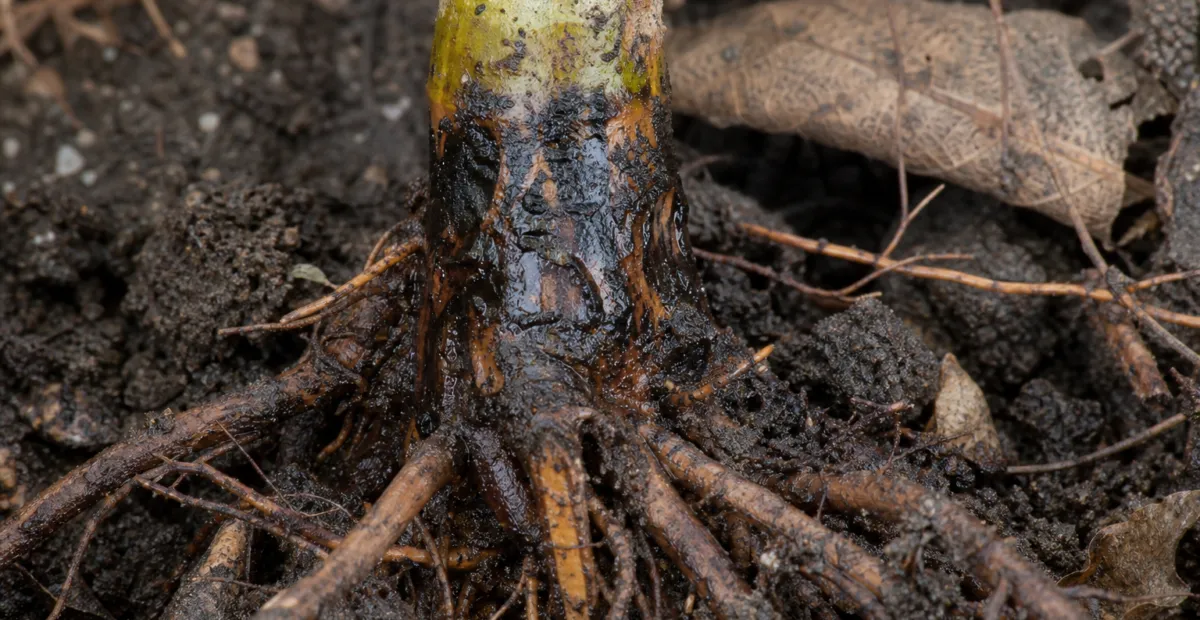
Phytophthora cambivora root and crown rot
Phytophthora cambivora (often written Phytophthora × cambivora in modern taxonomic treatments)Phytophthora cambivora root and crown rot overview
Phytophthora cambivora is a soil- and water-associated oomycete that attacks roots, crowns and sometimes the lower trunk of woody plants. It is best known for ink disease of chestnut but has also been documented on noble fir, beech, walnut, fruit trees and other hosts. Symptoms often resemble other Phytophthora diseases, so laboratory confirmation is important before major removals or treatments.
Typical conditions
Overview
This disease is caused by a water-mold-like oomycete that lives in soil, roots, infected woody tissue and contaminated water. The pathogen commonly attacks fine roots and then advances into larger roots, the root collar, crown or lower trunk. Above-ground decline may be gradual or may accelerate after prolonged wet weather, flooding, poor drainage or root injury.
Chestnut ink disease is the best-known association, but the organism has also been reported from fir, beech, alder, maple, walnut, apple, stone fruits, oak, rhododendron and other plants. A host report does not mean every cultivar or plant in that genus is equally susceptible. Other Phytophthora species are often present in the same planting, so species-level identification should not be based on symptoms alone.
Symptoms and identification
Early symptoms are usually nonspecific: reduced vigor, pale or undersized foliage, premature leaf color, sparse canopy growth and wilting during warm or dry periods despite moist soil. Root loss can cause poor shoot extension and increased susceptibility to drought, winter injury and secondary pests.
Examine the root system and lower trunk. Infected fine roots are brown to black, water-soaked or soft, and may have a sharp transition between healthy white tissue and necrotic tissue. Crown or collar infections can produce dark, sunken or water-soaked bark, cracking, bleeding or brown to black discoloration beneath the bark. Chestnut may show a dark lesion at the stem base and the characteristic “ink” exudate in some cases, although bleeding is not always present.
Advanced disease causes branch or leader dieback, whole-tree decline and death. Symptoms can be confused with drought, girdling roots, compaction, root-feeding insects, Armillaria and other Phytophthora diseases.
Causes and spread
The disease is favored by excess water around roots. Heavy rain, flooding, leaking irrigation, compacted soil, poor grading, high water tables and planting too deeply create the water films needed for zoospore movement and infection. Root injuries from digging, cultivation, construction, rodents or transplanting can provide entry points.
Spread occurs through infested nursery stock and root balls, contaminated soil and potting media, irrigation or drainage water, rain splash and runoff, and mud carried on tools, footwear, machinery or animals. In landscapes, removal of one infected tree does not necessarily eliminate inoculum if roots and contaminated soil remain.
Life cycle and persistence
Phytophthora cambivora survives in infested soil, infected roots and woody tissues. Under wet conditions it produces sporangia, which may release motile, biflagellate zoospores. These swim through water films and saturated soil pores, are attracted to susceptible roots, encyst on the root surface and germinate.
The pathogen grows through root and crown tissue, producing new sporangia when moisture and temperature are favorable. Soil, water, mud, infected nursery stock, tools and equipment can move the pathogen locally. Long-distance spread is especially associated with infested plants, root balls, soil and contaminated water. The persistence of inoculum varies with substrate, climate, host tissue and competing microorganisms.
Treatment and control
First confirm the diagnosis. Collect fresh samples from the margin between healthy and discolored root or crown tissue, keep them cool, and submit them promptly according to the laboratory’s instructions. A positive detection from soil alone may indicate inoculum but does not always establish active infection.
For valuable trees with limited crown involvement, improve drainage, stop chronic overirrigation, correct planting depth and prevent additional root injury. Carefully expose the root collar only when this can be done without damaging more roots. Remove dead, structurally unsafe wood, and have large trees evaluated by a qualified arborist.
Plants with extensive root or crown girdling, severe canopy decline or structural instability are often not recoverable and may need removal. Replanting the same susceptible host in the same contaminated soil carries risk; select a well-adapted, less-susceptible plant only after addressing drainage and sanitation. Registered oomycete-targeted products may protect remaining roots or reduce disease development in some crops, but efficacy, timing and legal use are product- and crop-specific. Follow the current U.S. label and local extension recommendations.
Low-impact and biological control
No dependable home remedy eradicates an established root or crown infection. The most useful low-input measures are exclusion, drainage and sanitation:
- Remove severely declining plants with as much of the infected root ball and surrounding contaminated soil as practical, and dispose of them according to local municipal or plant-health guidance.
- Do not move soil, muddy pots, runoff water, dead roots or contaminated mulch from an infested area to clean beds.
- Clean soil from shovels, pruners, harvest equipment, boots and vehicle tires before entering uninfested areas; disinfect cleaned tools with a product appropriate for the equipment and label directions.
- Use clean containers and disease-free propagation material. Avoid reusing potting media from affected plants.
- Where feasible, use raised beds, coarse well-drained media and irrigation practices that prevent saturation. Biological products or beneficial-microbe amendments may support root health in some production systems, but performance is variable and they should not be presented as a cure.
Prevention
Prevention is more effective than attempting to restore a tree after extensive root or crown loss.
- Buy nursery stock from suppliers using clean water, sanitized containers and pathogen-exclusion practices. Inspect root balls for foul odor, dark roots, excessive wetness and poor drainage.
- Match plants to the site. Correct persistent drainage problems before planting and avoid burying the root collar or piling mulch against the trunk.
- Use drip or targeted irrigation rather than routinely wetting the entire root zone. Allow the growing medium to drain between irrigations, while avoiding severe drought stress.
- Keep runoff from infected beds or tree pits away from clean production areas. Do not irrigate clean plants with water that has passed through infested soil.
- Minimize root damage and soil compaction during construction, mowing and cultivation. Maintain a broad, mulch-free area immediately around the trunk base.
- If decline is suspected, submit symptomatic roots and the root-collar margin to a state university or other qualified diagnostic laboratory before replanting.
Interesting facts
- The name “ink disease” refers to dark exudate sometimes seen at the base of infected chestnut trees, but not every infected tree produces visible ink.
- Modern studies have treated P. cambivora as a natural interspecific hybrid and may use the name Phytophthora × cambivora.
- In United States Christmas-tree production, P. cambivora has been reported prominently from noble fir root-rot problems in parts of the Pacific Northwest.
- Finding P. cambivora in a root sample does not automatically prove it is the only cause of decline; mixed Phytophthora infections and predisposing site conditions are common considerations.
Do not assume a fungicide or phosphite product is labeled for this exact pathogen, crop and use site. In the United States, use only products legally authorized by the U.S. Environmental Protection Agency and labeled for the specific crop or ornamental situation and disease; follow the current label exactly. Chemical treatments are generally protective or suppressive rather than curative once major root or crown tissue is dead.
Affected plants
The plants below are linked to this problem by structured host-plant data. The list updates automatically as new plant profiles are added.
 Field maple (Acer campestre) care guideAcer campestre
 Paperbark Maple (Acer griseum) care guideAcer griseum
 Downy Japanese Maple (Acer japonicum) care guideAcer japonicum
 Boxelder (Acer negundo) care guideAcer negundo
 Acer palmatum care guideAcer palmatum
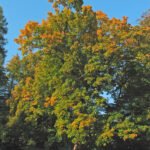 He Norway maple (Acer platanoides) care guideAcer platanoides
 Sycamore maple (Acer pseudoplatanus) care guideAcer pseudoplatanus
 Red maple (Acer rubrum) care guideAcer rubrum
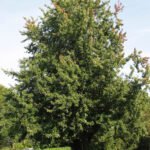 Silver maple (Acer saccharinum) care guideAcer saccharinum
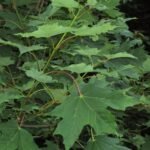 Sugar maple (Acer saccharum) care guideAcer saccharum
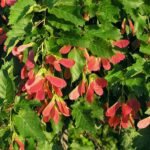 Tatar Maple (Acer tataricum) care guideAcer tataricum
 Amur Maple (Acer tataricum ginnala) care guideAcer tataricum ginnala