
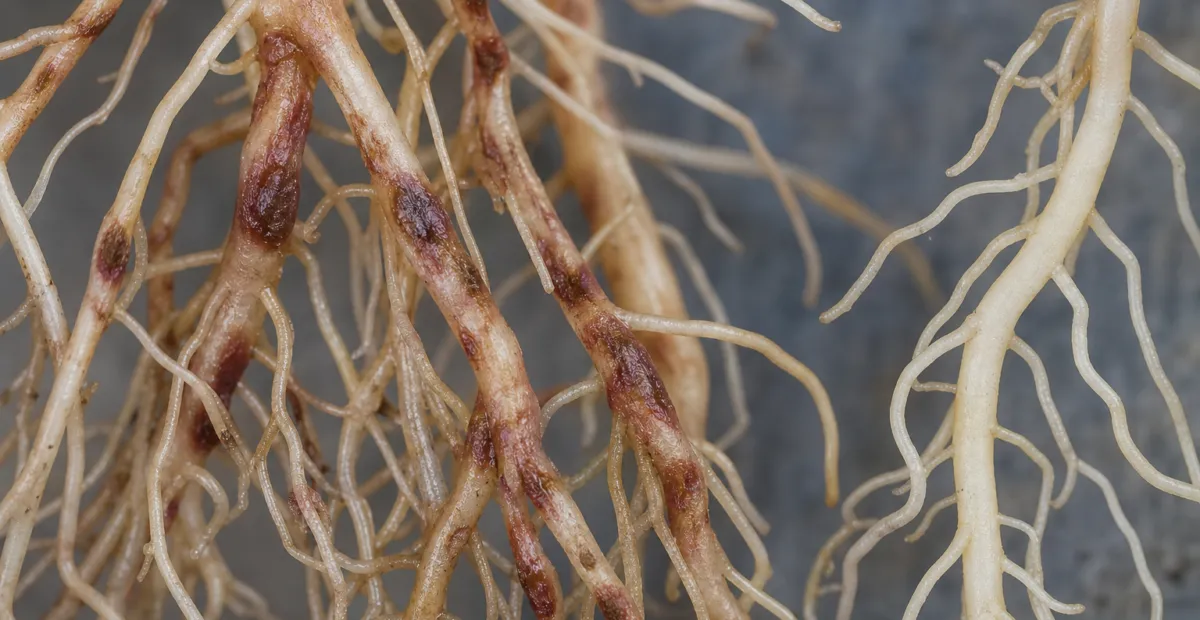
Root-lesion nematode
Pratylenchus penetrans (Cobb) Filipjev & Schuurmans StekhovenRoot-lesion nematode overview
The root-lesion nematode, Pratylenchus penetrans, is a microscopic soil pest that penetrates living roots and migrates through the cortex, producing reddish-brown lesions and a poorly developed root system. Damage is especially important in potato, where it may contribute to early dying and interact with Verticillium and other soilborne pathogens. Diagnosis requires soil and root sampling, often with laboratory identification.
Typical conditions
Overview
This nematode is commonly called the root-lesion nematode. It is particularly damaging in potato, where root injury can reduce uptake and contribute to potato early dying in association with Verticillium wilt and other stresses. It also affects crops and woody plants including corn, soybean, tomato, strawberry, apple, peach and raspberry, but host suitability and economic impact vary by isolate, cultivar, soil and cropping history.
Symptoms and identification
Aboveground symptoms are usually nonspecific: uneven growth, stunting, pale or yellow-green foliage, midday wilt, poor establishment and premature decline. Symptoms often occur in patches and may resemble drought, nutrient deficiency, compaction or vascular disease.
Roots may be sparse, shortened and poorly branched, with reddish-brown to dark elongated lesions in the cortex. Fine roots can slough or decay after secondary infection. In potato, root injury may accompany early vine senescence and reduced tuber yield; tuber lesions are possible but are not sufficient for diagnosis.
Confirmation requires collecting soil and roots from the edge and center of symptomatic patches and submitting them to a diagnostic laboratory. A visual diagnosis alone cannot reliably distinguish P. penetrans from other Pratylenchus species or unrelated root problems.
Causes and spread
The problem is caused by feeding and migration of Pratylenchus penetrans through root tissue. It is favored by continuous or frequent planting of susceptible crops and by conditions that keep host roots available for much of the year.
Populations spread primarily in infested soil, root fragments, transplants, nursery stock, potato tubers with attached soil and contaminated equipment. Surface water can redistribute soil locally. Weeds and volunteer crops may act as bridges between production cycles. Damage is often greater when root lesions permit secondary fungi or bacteria to invade.
Life cycle and persistence
Pratylenchus penetrans is a migratory endoparasite: juveniles and adults enter roots, feed and move through the cortex, then leave to infect additional roots. Eggs are laid in roots or soil, and development proceeds through juvenile stages to adults. Males and females occur, and reproduction is generally sexual, although field populations can vary.
The nematode can survive in infected roots, crop residues and soil without a living crop, allowing populations to persist between seasons. Several generations may develop during a growing season when susceptible roots remain available. Soil movement, infected planting material and contaminated root debris are important dispersal routes.
Treatment and control
There is no curative foliar treatment because the nematode lives in soil and roots. First confirm the diagnosis and estimate population density; then select measures according to crop value, rotation options, soil type and legal product availability.
- For annual crops, combine rotation, weed control, sanitation, tolerant or less-susceptible cultivars where documented, and planting into well-prepared soil.
- For potatoes, use tested poor or nonhost rotation crops and certified seed; monitor early dying and investigate Verticillium and other soilborne pathogens rather than attributing all decline to nematodes.
- For orchards, berries and nursery crops, address planting-site history, root removal, clean stock and preplant soil management before establishment because postplant options are limited.
- Where justified by laboratory results and economics, a licensed professional may evaluate a legally labeled preplant fumigant or nonfumigant nematicide. Chemical treatment should supplement—not replace—rotation and sanitation.
Low-impact and biological control
Management without synthetic pesticides is most effective when it begins with testing and sanitation:
- Use a laboratory soil-and-root assay before planting high-value crops and repeat sampling after harvest where practical.
- Clean soil from tillage equipment, harvesters, boots and tools before moving from infested to clean areas. Remove cull piles, volunteer potatoes and infected root debris.
- Use certified planting material and avoid moving untreated soil or rooted transplants from a problem area.
- Rotate with locally validated poor or nonhost crops. Do not assume that a generic grass, rye, wheat or Brassica cover crop will suppress P. penetrans; test-based, regional recommendations are important.
- Control weeds because some weeds maintain populations and can undermine rotation.
- Where suitable for the crop and site, consider anaerobic soil disinfestation, solarization or carefully selected biofumigant amendments as integrated measures. Their performance depends strongly on soil temperature, moisture, carbon source, tarp sealing and local conditions.
- Support vigorous root growth with appropriate irrigation, fertility, drainage and compaction management, while recognizing that good vigor does not eliminate the nematode.
Prevention
Start with a history of previous crops, patch symptoms and laboratory sampling. Keep clean fields clean by using certified seed potatoes or healthy nursery stock, removing soil from equipment and preventing movement of infested root debris.
Plan rotations using results for the identified Pratylenchus species and local host-suitability data. Manage weeds and volunteer potatoes throughout the season. Avoid treating a cover crop as automatically suppressive: some commonly used cereals and Brassicas can reproduce P. penetrans.
Reduce stress that magnifies root damage through sound irrigation, drainage, fertility, compaction and soil-structure management. In perennial fruit systems, remove old roots where feasible before replanting and obtain site-specific recommendations from a university diagnostic or extension specialist.
Interesting facts
Pratylenchus penetrans is one of the most widely important lesion nematodes in temperate agriculture and has a broad host range, but not every reported host is equally suitable.
In potato, its interaction with Verticillium dahliae is associated with the potato early dying disease complex. This means nematode suppression can sometimes reduce disease pressure without the nematode being the only cause of vine decline.
Crop-rotation advice must be species-specific. Rye, wheat, oats and corn can support different levels of reproduction, while a crop that is a poor host for one Pratylenchus species may support another.
Use nematicides or soil fumigants only when the product is legally authorized for the specific crop, site and problem in the United States. Follow the current EPA-approved label and all state requirements; fumigants are restricted-use products in many situations and require certified applicators, buffer zones, notification and other safety measures. Do not select a product or rate from this entry alone.
Affected plants
The plants below are linked to this problem by structured host-plant data. The list updates automatically as new plant profiles are added.
 Water spinach (Ipomoea aquatica) care guideIpomoea aquatica
 Apple tree (Malus domestica) care guideMalus domestica
 Solanum aethiopicum care guideSolanum aethiopicum
 Solanum macrocarpon care guideSolanum macrocarpon
 Eggplant (Solanum melongena) care guideSolanum melongena
 Garden Huckleberry (Solanum scabrum) care guideSolanum scabrum
 Broad Bean (Vicia faba) care guideVicia faba
 Lentil (Vicia lens) care guideVicia lens
 Garlic (Allium sativum) care guideAllium sativum
 Okra (Abelmoschus esculentus) care guideAbelmoschus esculentus
 Wild Celery (Apium graveolens) care guideApium graveolens
 Border Forsythia (Forsythia intermedia) care guideForsythia intermedia